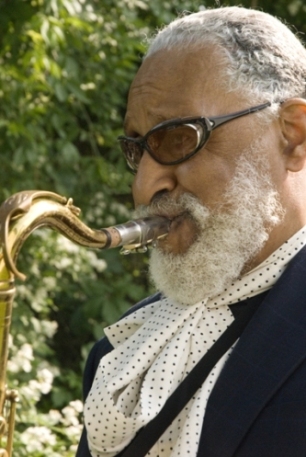
 Very few jazz musicians have attained the same stature and respect as Sonny Rollins, and even fewer of his generation are still around to endow us with their knowledge and experience. Rollins’s resume reads like a “Who’s Who” of the modern jazz era. He cut his teeth as a teenager, recording with trombonist J.J. Johnson and Bud Powell, an archetype for jazz pianists. Rollins later had stints with the one and only Miles Davis, as well as the trail blazing Clifford Brown–Max Roach Quintet. The 1950s saw him come into his own, collaborating with his musical motivator, John Coltrane, on Tenor Madness, recording classic sides such as the seminal Saxophone Colossus, as well as the activist The Freedom Suite, and introducing compositions such as “St. Thomas”, “Doxy”, and “Oleo” into the jazz lexicon. Rollins continued to grow and cross genres over the next several decades, and anyone wondering about his relevance today need only listen to 2005’s Without a Song: The 9/11 Concert to settle all doubts.
Rollins will be performing tonight at the Kennedy Center‘s Concert Hall in a performance sponsored by the Washington Performing Arts Society. His live performance presents his rich jazz experience and knowledge, but also showcases the 77-year old icon’s keen interest in the rhythms and music of the Carribbean.
At the end of the day, however, his music speaks for itself, and so when DCist had an opportunity to speak with the great Sonny Rollins, we chose to explore the connection between him and our fair city. Rollins did not disappoint, expressing a sentiment that the District’s jazz lovers have held for quite some time.
“One thing I can say about Washington is that some of the best, most soulful musicians I’ve met come out of the D.C. area,” Rollins said. “There was such a level of musicianship and a real deep ethnic sensibility.”