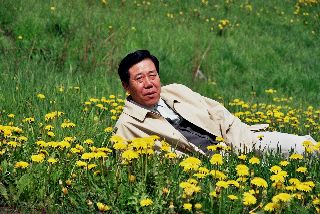
 At the outset of Lost Holiday, a charming, funny, and almost unintentionally political documentary out of the Czech Republic, director Lucie Králová rather cheekily declares the film, via the opening credits, to be a “detective documentary.” It’s a touch that borders on precious, and a tone that continues in the often wry intertitles that mark time throughout the “investigation” that is the film’s subject. What they’re trying to detect are the identities of six men who they know only through photographs. A man that Králová meets through an art project in which she was involved happened upon a suitcase in a dumpster in a run-down neighborhood near Sweden’s Göteberg airport. Inside there was nothing but a plastic bag containing 22 rolls of undeveloped film. He had them processed, and found himself with over 700 photos of six Asian men on what appeared to be a holiday throughout Scandinavia. What Králová wanted to know is if it’s possible, in the interconnected world we now live in, to track down these men based solely on what they can glean from their photographs.
With this wholly unique premise intact, the film is off and running. They begin by consulting Asians living in Prague to see if they can get a handle on the nationality of the men. Everyone has an opinion, most of the opinions are the same, but what is fascinating are the explanations people give for why they think the men are from a particular country or region, and why they couldn’t possibly be from certain other places. Despite it’s oddball foundation and the constant winks and nods, the undercurrent of subtle social commentary is established early on.
Králová and her crew continue their investigation, traveling to the same places the men do, often taking pictures of themselves in the same spots, or holding up their pictures in front of the empty landscape before dropping them to show the identical backdrop, sans Asian tourist, in front of their own lens. As the film progresses, we begin to feel part of the team, and we pull for them and feel their disappointment at every dead end, every police officer or government worker who declares their cause hopeless. They periodically return to scenes from Prague, where they’ve set up the pictures as a gallery installation that seems to be a fairly popular attraction; each visitor speculates, reasons, and postulates as to who these men are. Everyone loves the chance to play Sherlock Holmes, deducing facts about the men based on the smallest details in the photos. Everyone, interestingly, also loves having their own picture taken in front of the life size image of these strangers.