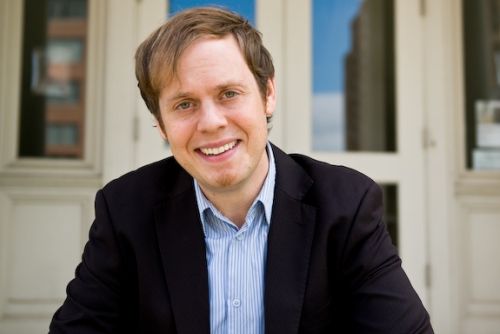
Washingtonians have a tendency towards hyper-engagement. Dynamism, if you will. Jeffry Cudlin – busy bee that he is – realizes this. “I think that all of the things I’m doing are interchangeable,” Cudlin reflected, “all parts of the same job. No matter what I’m doing, I’m advancing the same set of objectives.”
Cudlin is, without question, a D.C. artistic dynamo. Between curating at the Arlington Arts Center, penning his own blog and criticism for the Washington City Paper, writing and performing in acclaimed work like the mockumentary Ian and Jan: The Washington Body School, and teaching at the University of Maryland, we were pretty excited to get a few moments to talk shop. Fortunately, he wasn’t at a loss for words.
“If you’re a contemporary artist, with everything you create, you’re really making an argument about what art is supposed to be,” Cudlin mused. “If you’re a critic, you write about other people’s art, and say how people ought to understand it, or why it does or doesn’t participate in the bigger conversation. If you’re a curator, you’re presenting an artist’s work in a certain way to make a claim, or trying to illustrate why a certain number of artists are connected, and need to be understood together.”
That said, though, you’ll find him near impossible to pigeonhole.
“Presumably, if I were serious about being an artist, I would do nothing but seal myself in a little room and make lots more similar-looking stuff, piles of it, preferably in a variety of sizes. But I refuse to believe that I should have to be bored to be taken seriously.”
And how: Cudlin’s most visible work can be found at the Arlington Arts Center, where he is the Director of Exhibitions. The AAC, which he calls “the Kunsthalle that DC doesn’t have. And needs,” often features challenging exhibits – for instance, on black identity, politics, and urban illustration this past year – which play right into Cudlin’s vision for his self-described “small staff with a really big space.”
“I want to show people what contemporary art can do,” the enthusiastic curator beamed. “People generally find contemporary and modern art daunting or impenetrable, I think—and they shouldn’t. Contemporary visual art is at the front edge of culture, testing claims about who we are and how we live. But it’s also about life as it’s lived, sensitivity to local conditions, the ways people are relating to popular culture, that sort of thing.”
Photo of Jeffry Cudlin by Jason Colston.