In which DCist interviews area scientists, researchers, and academics on topics pertaining to natural and scientific interests. As Thomas Dolby would say: science!
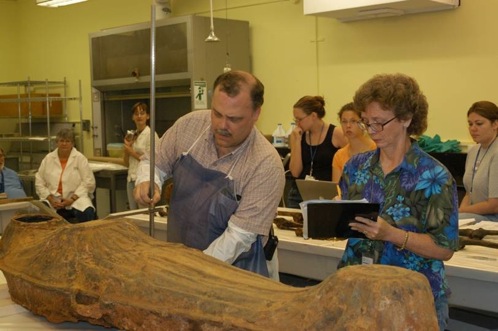 David Hunt is the collections manager for physical anthropology for the Smithsonian Institution. He has researched and published on several subjects in physical anthropology, with special emphasis on skeletal biology, human morphometrics, bioarchaeology, and forensic anthropology. Dr. Hunt has analyzed mass graves, helped to perform facial reconstructions, and studied mummification, and he has taken part in archaeological excavations in Mongolia, Italy, and the U.S. He is an adjunct professorial lecture at George Washington University.
Dr. Hunt’s primary activities at the Smithsonian’s National Museum of Natural History are curation, management, and conservation of the human skeletal collections, which includes more than 30,000 cataloged specimens. In addition, there are approximately 3,500 cataloged specimens of non-skeletal human materials—casts, busts, and a non-hard tissue repository of brains, organs, hair and dermal tissues—that Dr. Hunt oversees.
DCist: What are some common misconceptions about forensic anthropology?
David Hunt: We’re not Quincy, M.E.. He’s a coroner—coroners can’t arrest anybody. Or on CSI, where the people are experts on bugs as well as doing DNA and other chemical analyses and residue and gunshot ballistics. We as forensic anthropologists—in any criminalist science—you have to know what other people are doing, so you know how they could help you. So if I’m working on a skeleton that’s been around for more than 5 or 6 months, there will be insects that have left sign on the skeleton. I’m not an expert on forensic entomology, so I call someone.
When I work with a criminal investigative office, I’m a portion of the investigation—I’m not the investigation. I go to the morgue, I do an analysis of the skeleton, I do a description of what is present in the individualistic traits of the individual. Bones, tissues, male or female, what their apparent age or ancestry would be.
DCist: Is your work more often criminal investigation or research?
DH: Well, there are sometimes questions about a trauma or defect on the bone, and you may do an applied type of analysis, using a surrogate pig or cow bone where you may be testing stab wounds or gun-shot wounds or decay rates. There are tests, types of analyses where you try to test the hypothesis you have. That’s a research question rather than a criminal investigation per se.
A forensic biologist is actually a skeletal biologist, a person who deals with skeletons either on an individual or population level. “Forensic” means nothing other than “argument.” It’s a medical-legal question. Forensic geologist, forensic botanist, forensic chemist.