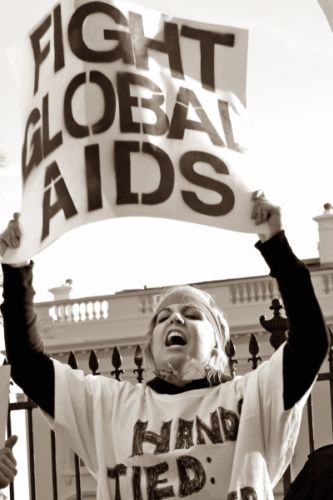
 Photo by IntangibleArts.
Much like this weekend’s weather, there’s little sunshine in this story: the Post reports this morning that current HIV/AIDS levels in the District of Columbia far exceed the amounts associated with a “generalized and severe” epidemic, according to a CDC-funded report from the George Washington University School of Health and Health Services.
Some of the statistics are truly appalling:
[The results of the report] translates into 2,984 residents [carrying HIV/AIDS] per every 100,000 over the age of 12 — or 15,120 — according to the 2008 epidemiology report by the District’s HIV/AIDS office.
“Our rates are higher than West Africa,” said Shannon L. Hader, director of the District’s HIV/AIDS Administration, who once led the Federal Centers for Disease Control and Prevention’s work in Zimbabwe. “They’re on par with Uganda and some parts of Kenya.”
Sure, the “3% of D.C.” figure paraded out by the Post smacks of fear mongering. But while the variation in infection rates between wards shouldn’t be discounted, it still stands that all wards outside Ward 3 are well above the 1% rate considered “severe” by the Center for Disease Control — especially considering that said couched infection percentage likely underestimates the actual numbers.
The report — which will be officially released tomorrow — notes that a majority of HIV-positive individuals in the District continue to have overlapping sexual partners and do not use contraception. Other incredible statistics: a 22 percent increase in HIV and AIDS cases since the end of 2006, an infection rate among black men of 7 percent, and the astonishing revelation that nearly 10 percent of D.C. residents between the ages of 40 and 49 are infected.
Regardless of the obvious disparities that exist between, say, Wards 3 and 8, the real question is this: with such incredible numbers floating around out there, is the District’s government focusing on the issue with gusto? Well, here’s Mayor Fenty’s take:
“In order to solve an issue as complex as HIV and AIDS, you have to step up,” he said. “It’s the mayor and certainly other elected officials. But it’s also the community. You have this problem affecting us, and you tell people how serious it is and it literally goes in one ear and out the other.”
But it’s one thing to lay equal blame on the community, but that only works if the government is actually holding up its end of the bargain. To wit:
David Catania (I-At Large), chairman of the D.C. Council’s health committee, said that although the District’s testing and monitoring have improved in the past two years, the AIDS office is still playing catch-up….”Frankly, there can be no excuse for the state of the HIV/AIDS Administration that I found in 2005,” Catania said. “I cannot speak to why it was not a priority previously. For years prior to 2005, mayors and previous individuals allowed things to exist in an unacceptable way. And I do blame this government for part of the epidemic we’re confronting.”
Until recently, the District’s AIDS office lacked a fully staffed surveillance unit to collect, analyze and distribute data. Inevitably, the office lost credibility, and although it has received millions in federal and local funds — $95 million this year — some care providers questioned whether resources were being properly allocated.
Certainly, it’s sobering to think about why it took the District until 2005 to start to really vamp up HIV/AIDS preventative services — and considering that timeline, origins for these massive figures start to become clearer. But if there is a bright side to this story, it is that D.C. has been steadily improving in the four years since. DC Appleseed, a pro bono advocacy group who has been focusing heavily on monitoring the city’s HIV/AIDS prevention work in the last few years, actually doled out moderately favorable marks to Washington in their most recent report card (PDF). Of course, efforts to fight the disease were bolstered by the Congressional lifting of the ability to use tax dollars for needle-exchange programs in 2007.
But even as such strides are taken, the battle cry has barely changed: in order to fight these incredible figures, there must be a steady maintenance of “determination and commitment from the District’s public officials.” Anything less would be doubly as frustrating.