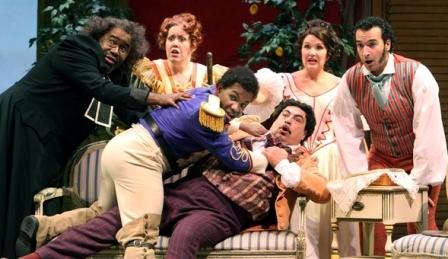
 Cast of “The Barber of Seville,” Washington National Opera, 2009 (photo by Karin Cooper)
Washington National Opera’s production of Rossini’s overexposed opera buffa The Barber of Seville was, on the surface at least, hardly an exciting way to open the Washington National Opera season. The second performance last night, however, proved that, in spite of the many deficits a company faces in making new something that is so familiar and even tired, it is definitely worth a hearing.
True, David Gately’s production hardly qualifies as original, with pretty enough sets (designed by Allen Moyer) and costumes (James Scott), somewhat updated from the 1995 premiere and 2001 revival, placing the action in the late 18th or early 19th century, but it is a mostly pleasing if very traditional evening.
Gately’s forte is the acting direction, and he makes every character’s gestures and movement make sense with the details of the storyline. Sometimes he takes this attention to detail to a fault, exaggerating the “freeze frame” effects of the Rossinian finale, for example, with a slow-motion farce at the end of the first act, way over the top. He also makes Figaro, the fast-talking factotum who takes more credit for the opera’s happy outcome than is really due him, into an actual all-powerful puppet master, a stand-in for the director himself, literally staging many of the scenes, posing the characters and putting props into their hands. The opera is, it’s true, mildly amusing but the sense of forced hilarity, the kind that makes one’s smiling muscles hurt from over-exertion, at times rang false.
The main reason to see this production is the chance to hear the opera in something resembling its original form, with Count Almaviva’s demanding Act II aria Cessa di più resistere restored. As described by Richard Osborne in his Rossini biography, the opera’s premiere, in 1816 at Rome’s Teatro Argentina, was a notorious fiasco in terms of stage accidents and lack of singer preparation. At many subsequent performances, and most modern ones, directors and conductors cut this aria. Rossini himself approved of the excision, but unwilling to let the music be wasted, reworked the aria twice, most famously as “Non più mesta,” the tour de force that concludes La Cenerentola and also as “Ah, non potrian resistere” in Le nozze di Teti e di Peleo.