Martin Austermuhle
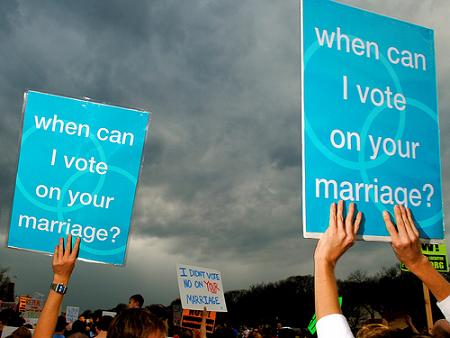 Photo by M.V. Jantzen
Legislation legalizing same-sex marriage in the District is going to pass, and no one is more aware of that fact than its opponents. Seeing that they’ve got little chance of swinging any votes on the D.C. Council, they’ve instead announced an offensive that will include pushing Congress to stop the legislation from taking effect and using the courts to enforce the federal Defense of Marriage Act on the city.
At yesterday’s hearing before the D.C. Council’s Committee on Public Safety and the Judiciary, opponents of the legislation made clear that they were angry and willing to take their fight to Capitol Hill. In a particularly heated moment of testimony early on, District resident Kathryn Pearson-West joined ANC Commissioner Bob King in threatening to ask Congress to overturn the legislation. The threat seemed alarming enough that Council member Jack Evans (D-Ward 2) warned of the dangers of inviting congressional intervention, and DC Vote’s Board of Directors took the time to send out a statement pledging to protect the city’s right to decide its own laws.
“While DC Vote has not taken a position on the legislation, we are prepared to defend the District’s right to enact laws on behalf of the almost 600,000 Washingtonians, via its own legislative processes,” said board member John Klenert in a statement. “We call upon Congress to treat us as equal citizens and give us our due respect. We are only doing what others take for granted: exercising the right to govern ourselves.”
In a hearing earlier in the day before the Board of Elections and Ethics, supporters of a referendum on same-sex marriage threatened to plead their case before the courts, both to argue that a 1995 D.C. court case defined marriage as between a man and a woman and to claim that the 1996 Defense of Marriage Act passed by Congress applies to the District.
Idle threats? Not really. In any other jurisdiction, opponents of same-sex marriage would be pretty much out of options. But this being the District, there’s always an additional layer of politicking above our elected officials. Having Congress intervene wouldn’t be anything new, though with the existing Democratic majority it may be a stretch. Pursuing the case before the courts, especially with the resources and advice of well-monied national organizations, could well either delay the implementation of the legislation or derail it altogether.