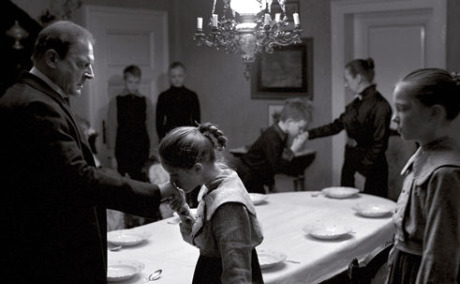
 It takes an act of courage to walk into a Michael Haneke movie. The filmmaker has established himself as such an adept and effortless manipulator of his audience’s deepest fears, anxieties, and moral weaknesses that the question isn’t whether we’ll leave the theater feeling deeply unsettled — that’s a given. The question is, rather, which of the most vulnerable areas of our psyche Haneke will brutalize — for either his amusement or our edification — this time around.
In the case of The White Ribbon, the film sets itself up as something like a series of rural folk tales, told from the memories of a village teacher many years after the events in the movie take place. His purpose in relaying these stories — which take place in a small German village over the course of the year prior to the assassination of Archduke Franz Ferdinand that sparked the first World War — is to try to give context to the events that would eventually take place in his country. The implication is that this microcosm of German society is meant to illustrate the roots of the Third Reich and the Holocaust, but Haneke’s reach is far broader: The film subtly reaches to the roots of fascism, terrorism, and oppression of all kinds, whether political, religious, or social. And he suggests, in the indirect yet incisive way that he has such mastery over, that each of us plays our own complicit role.
Mysterious happenings plague this village, beginning with a wire strung between two trees on the daily horse riding route of the village doctor. His horse trips over the invisible tripwire, severely injuring the doctor and killing the horse. Later, a farmer’s wife is killed in a work accident, a barn is burned down, the son of the village baron is kidnapped, hung by his ankles, and caned, and the midwife’s son, a sweet boy with Down’s Syndrome, is taken into the woods, savagely beaten, and nearly blinded.