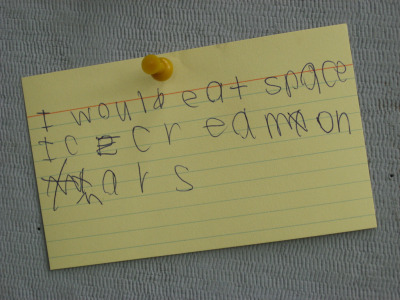
 “I would eat space ice cream on Mars.” Who wouldn’t! Image by cljo
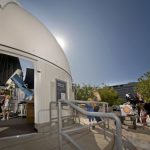
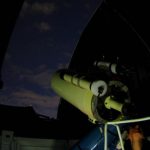
Last autumn the Smithsonian National Air and Space Museum opened the Public Observatory. Education staff and volunteers used the 16-inch Boller & Chivens telescope, with protective solar filter, to show visitors the many details on our Sun’s surface: sunspots, prominences, filaments, faculae, and more. The Observatory needed a few updates so it was closed down for the winter, but has opened back up to the public this weekend. Visit them between 10 a.m. and 2 p.m., Thursday through Sunday, weather permitting. The Observatory is located on the Independence Avenue side of the museum; when you approach the outside doors, go right and walk down the building until you hit the big dome.
>> Visit the Air and Space Museum this Thursday evening for a lecture by Peter Smith, the principal investigator for the Phoenix Mars Lander mission. The Phoenix mission just officially ended last week, after multiple attempts at finding a signal from the lander this year failed — not a big surprise, as the spacecraft performed past its initial mission timeline and was not expected to survive the harsh Mars winter. Listen to Smith discuss the many fascinating discoveries Phoenix made during its mission. Free, but you must request tickets. After the lecture, 8:30 to 9:30 p.m., head outside to the Observatory for night-viewing: Mars, Saturn, and even Venus may be visible.
>> Although not until early September, registration has just opened for Northern Virginia Astronomy Club’s “Almost Heaven Star Party” in Spruce Knob, West Virginia, “one of the premier dark-sky sites in the East.” This four day event includes, of course, nightly star parties — you don’t need your own telescope to participate, but if you have one, workshops are available to teach you how to use it — outdoor activities like canoeing, hiking, and rock climbing, and the big event: a tour of the National Radio Astronomy Observatory. Before August 1, registration is $80 for the first adult and $40 for each additional person sharing a campsite, up to six people.
>> Sky & Telescope “This Week at a Glance” is our go-to website to see what stars are aligning over us in the sky. They note that the Summer Triangle is nearly upon us, made by Vega (in Lyra), Deneb (in Cygnus) and Altair (in Aquila). Read S&T for tips on how to find it, or use the wonderful program I discovered last summer, Stellarium, for a great visual.