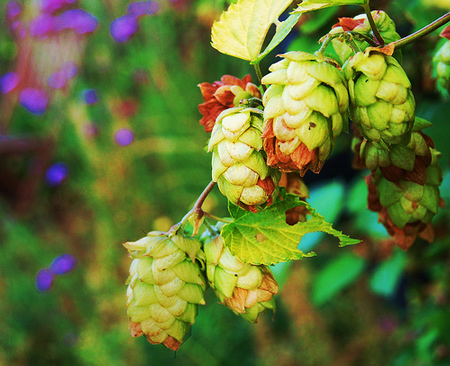
 Photo of hops by Duncan Harris
Hops. We’ve all heard the word. We know they’re an integral part of beer, and they pop up in advertisements as the origin of the flavor of your favorite brew. From Schlitz’s timeless “Just a kiss of the hops” to Miller Lite’s recent campaign of “Triple hopped,” the flowering Humulus lupulus has been synonymous with beer and been aiding people to get stoned almost as long as its family member Cannabis has. But what exactly are hops? Or perhaps even more importantly: what do they taste like and why should you care?
Beer is generally comprised of water, yeast, malts, and hops. The oils from these dried flowers are extracted through various steps throughout the brewing process. While they certainly balance out the sweetness the malts provide, hops bring a lot more to beer than just sharpness. Bittering varietals with high alpha acid content (those delectable oils) are thrown into the mixture, known as the wort, while it is boiling. Adding them in the beginning lends itself to more bitter flavors, while adding them later in the boil allows the more nuanced floral and aromatic characteristics to come out.
Aroma hops — those with lower alpha acid contents, but more aromatic/flavor characteristics — tend to be added later in the boil or even directly to the storage tanks to add flavor profiles unique to the particular hops. This process, known as “Dry Hopping,” has been rediscovered recently and is a large part of the contemporary craft movement.
So what do they taste like? While there are a number of single hop beers made by Mikkeller, Weyerbacher, and Harpoon that allow you to taste just that particular varietal, most brewers use a combination of many hops to achieve the desired taste of the beer. However, here is a very brief rundown of some of the most popular hops, their predominant flavors, and where you can find them: