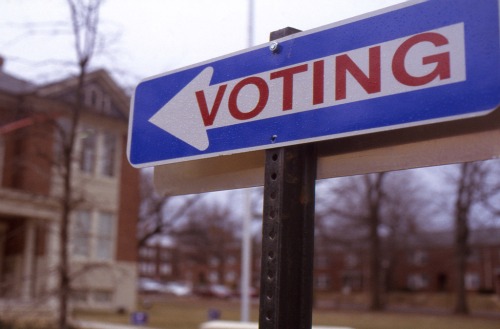
 Photo by scott*eric.
Last night, interim At-Large Councilmember and special election candidate Sekou Biddle won the endorsement of D.C. for Democracy, a progressive activism group. That’s the short version of the story: the long version involves a complex system of instant runoff voting, which some think is a better method of determining an election winner.
The basic idea behind IRV is that voters don’t select one candidate — they list two or more candidates, in descending order of preference. A winner is decided by counting the votes by first preferences; if no one candidate has a majority after that count, the candidate with the fewest number of votes is eliminated — and the votes for that candidate are transferred to the remaining candidates according to the next stated preference on those ballots. This goes on until there is a majority. It’s nothing new — for example, committees like the World Cup and the Olympics use variations on this system when awarding hosting rights. Supporters of IRV also believe that it is a simple process to understand, and that it eliminates things like the spoiler effect and serves as a better reflection of voter sentiment.
But there are drawbacks. Consider the end result of last night’s D.C. for Democracy voting: in the end, Biddle took the endorsement with 72.4 percent of the vote. Which sounds mighty impressive, until you realize that he would have won a first-past-the-post vote by merely one tally.