 Just a few days ago, we lamented the fact that too many jazz vocalists remain tethered to the Great American Songbook. Today, we profile a singer who sees so much depth in these classic songs that he does not feel the need to depart from them.
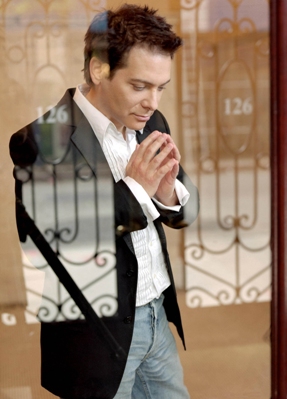
“The thing that makes a song great is the perfect combination of music and lyric,” said singer and pianist Michael Feinstein, who will be performing on Sunday at the Kennedy Center in a show sponsored by the Washington Performing Arts Society. “So as far as jazz singers not writing material, unless a jazz singer happens to be a spectacularly talented songwriter, it’s a good thing that they don’t.”
Known as “The Ambassador of the Great American Songbook,” Feinstein is certainly an authority on the subject. A music archivist turned performer, the five-time Grammy nominee serves on the Library of Congress’ National Recording Preservation Board and his award winning 2010 PBS series, Michael Feinstein’s American Songbook, will return to public television with new episodes this fall.
Feinstein’s interest developed at a young age, when his parents, both amateur performers, introduced him to this music.
“My brother and sister had the same influences and they listened to pop music on the radio, and I did not,” he said of his upbringing. “As I grew older, I became more interested in the classic music because it had a great attraction for me in a musical sense.”
Feinstein’s most recent release, Cheek to Cheek, was recorded live at his own Manhattan night club, Feinstein’s at Loews Regency. The album is a collection of duets with Broadway legend Barbara Cook. One of The Great White Way’s leading ingénues during the ’50s, Cook starred in the original productions of musicals like Candide and The Music Man. She has spent the past few decades as a successful cabaret singer.
“She is renowned for being so deeply connected to what she sings that it breathes new life into songs people have heard many times over,” Feinstein said of his collaborator.
For Sunday’s concert, Feinstein will revisit his 2009 album, The Sinatra Project, which earned him his latest Grammy nod. Accompanying him will be a 17-piece jazz orchestra. Feinstein is quick to note that while the project pays tribute to Ol’ Blue Eyes, it does not copy the legendary crooner. Instead, he attempts to reflect Sinatra’s taste in music. The program will also feature additional material that will be included on Feinstein’s next album, which is a salute to not only Sinatra, but his circle of friends and collaborators.
“That style of singing with a big band and those swing arrangements were in some sense evolved by Frank Sinatra,” Feinstein explained. “The musicianship was so extraordinary that it still holds up extremely well today. So people just go crazy over the sound of a live band because people aren’t accustomed to that kind of music anymore.”
Feinstein also augments the show by interacting with the audience and drawing upon his encyclopedic knowledge to tell amusing stories about Sinatra and the music.
“It’s such a rich mine of gold that there are immense rewards from immersing oneself in that music,” he said.
The Washington Performing Arts Society presents Michael Feinstein on Sunday, April 17, 2011 at 7 p.m. in the Kennedy Center‘s Concert Hall. Tickets are $40 to $75 + fees.