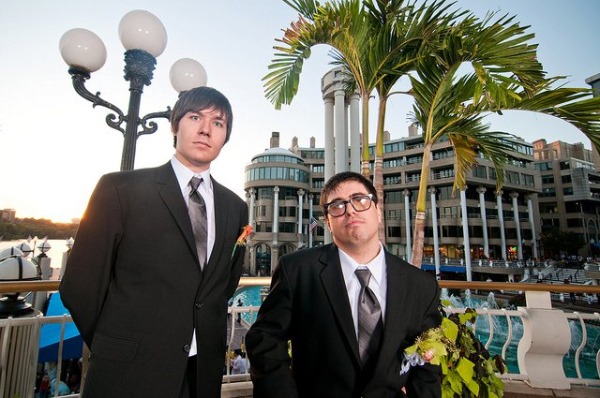
In honor of retail holiday Record Store Day, this Saturday, Three Stars is once again dedicating the month of April to interviewing the people behind local record labels.
What do abrasive hardcore, slickly produced post-punk, spacey finger-picked folk and earsplitting shoegaze have in common? For most people, the answer may be “absolutely nothing.” But Chris Berry and Sean Gray are not most people. Their record collections don’t reflect one sound or genre, and neither do the releases that they’ve put out on their imprint, Fan Death Records. In their effort to fill in the gaps of their (and by logical extension — everyone else’s) record collections, they’ve put out releases from bands as disparate as Screen Vinyl Image, Kurt Vile and Clockcleaner. (In fact, they met at this concert where Clockcleaner opened.)
Their intense passion for music has meant that they’ve run afoul of some local musicians who don’t meet their standards. Conversely, it means that they’ve become a consistent source for people looking for underexposed gems in a morass of options. Anyone looking to tread outside the beaten path need only look at past lineups of their increasingly popular DNA Test Fest…or the lineup for tomorrow’s showcase at Sonar in Baltimore. Better yet, just ask them for recommendations. Berry and Gray love to talk about music and will do so candidly and at length. Their encyclopedic knowledge is impressive and their energy, exciting. Plus, as widespread as their interests are: there’s probably something in the Fan Death catalog that will resonate with someone willing to listen.
In fact, Gray and Berry talked to us at such length that we’re doing something unprecedented for Three Stars: printing their interview in two parts. In today’s first installment: thoughts on college radio during their tenure at WMUC, the role of their third label head and why DNA Test Fest is taking a break this year.
Find them online: At their own website or on Facebook.
Buy their albums: At their online store.
See them next: At their showcase tomorrow at Sonar. Bands include Locrian, Broken Water, Heroin Sucks, kim phuc, Pleasure Leftists and Ed Schrader’s Music Beat. $12, 8:00 p.m.
You guys were both doing college radio when you started this, right?
Chris: Yeah.
That’s been the case with more than one person that I’ve talked to who went on to start a label. What do you think it is about college radio that’s conducive to this idea?
Chris: It’s a really great environment for people who are really passionate about music. The people who are passionate and obsessive enough about music to do a record label probably would do a pretty cool radio show, too.
Sean: I also think it’s an old school way of connecting with people who are into music.
Chris: Definitely.
Sean: I mean, college radio still exists. But Chris will tell you that even WMUC was not what it was even when Chris and I were doing it.
Chris: Well here’s what I think is really cool about college radio. You get to meet people and hang out with people and bounce ideas back and forth off of each other. Whereas, there are a lot of people who are really involved with music where they have a blog or a tumblr or something where they might be clued into a very specific style or specific scene or something. But at a college radio station — we had a hundred other people working at WMUC who listened to everything from metal to indie pop to Indian classical music. And then there were people who really weren’t that into music who were into sports, too. And that’s something I really liked about it.
Sean: Yeah, like Chris was saying, it’s a very old way of getting to know people who are into music. And I also think that when you’re actively going to a radio station and setting up playlists and actually playing music, there’s something to be said that there’s something different about that as opposed to writing on a blog and just throwing it out there. When you’re putting your voice on radio and you’re kind of putting yourself on the line a lot more than you would with a blog, per se, because you can edit that.
Chris: Yeah, if you’re writing, it’s a little bit easier to have, “This is my style, this is who I am,” whereas with radio, the person coming out of the radio is who you actually are.
Sean: Yeah, and I think you get those kind of inconsistencies and you get those things where you kind of look back on it more and it’s like, well, this is what I was into way back when and you can do that with a blog but then again, with a blog, there’s a whole feature of editing that and changing things. You can’t really do that with radio. My first radio shows versus the last one that I did…something changed because of being on radio. But as far as Chris and I meeting on radio, that was interesting because I’m 28 years old and Chris was, you’re what, 25?
Chris: Today is my 24th birthday.
Happy Birthday.
Sean: I didn’t grow up with blogs. It’s very old school to trade tapes or to do whatever you used to do in the ‘90s to get to know people who were into music.
Chris: Whereas when I first started going to shows, there’s actually a record trading message board that I’ve been posting on since I was sixteen.
Sean: And I think there’s something to be said that Chris, he’s four years younger than me is still kind of a part of that ilk. So, I think it was just kind of natural for us to meet in a radio station. And actually we kind of met doing record labels but our relationship grew out of the radio station. What’s nice about us is that I look back at our record label and there’s still kind of an old school aesthetic in terms of how we started.
Chris: Yeah, definitely.
Sean: It wasn’t one of these things where Chris was doing a blog and I was doing a blog. It just happened that way.
Chris: And it wasn’t the sort of thing where we were both like, “This guy…!” and we both released records by fifteen hype bands right off the bat. Everything we’ve released from the very beginning, we were like, “Okay, we have enough money to do this release, what’s the other thing that we’re really really into and really really believe in.”
Sean: And I think that kind of shows, too. That’s still how we operate. While Chris is in Baltimore, I’m in D.C. and Tracy is in Montreal. We still operate on a level where it’s very meticulously planned and it’s not something where we just jump into things. Especially now, the way the label is going. You’ll notice that our releases are fewer, but they’re much more calculated.
Chris: It’s not like a bunch of things will come out staggered over the period of a couple of months. We’re trying to consolidate so that a couple of things come out at a time. It’s interesting doing the label, because we’ve really had a trial by fire and we’ve learned so much since we put the first record out about the process.
Sean: And we’re still learning. Every release we put out, we’re like, “Well, we should do this differently or we should do this differently,” and to kind of go back to your original question in terms of the radio station, as far as facilitating this old school mentality that we have, it would be very easy for us to just do hype bands and not really challenge ourselves to put out vinyl and not really have this meticulous care for it. But while it might be a little bit funny or embarrassing to say sometimes, we’re both record collectors. And ultimately, as much as I make fun of record collectors, it’s what we are and that’s why the record label started.
What are some of the things that you’d say you’ve learned over time?
Chris: Have as much together as early as possible to make sure that there aren’t delays in putting a record out.
Sean: I think the number one thing is work with people that you trust in and believe in.
Chris: Really get to know the people that you work with.
Sean: I think with every good independent label, you can see that in their label, that they’ve worked with people they believe in and trust in. It resonates with them. It’s one of those things where you kind of learn early on, especially when a record label is doing well, who your friends are and who your friends really aren’t. You get to see what bands really care about what the label is doing and what the label can do for them, versus bands who just want a record out and that’s it.
So, it’s one of those things where you really learn to interact with people, too. It pushes you to be social. Because you can’t put out records if you’re just going to sit there and be like, “I like your band,” and that’s all you say. You have to be sociable. So, it really kind of pushes you to really interact and, I hate to use this as a term, but to do business deals. It’s one of those things where you learn that kind of thing.
Chris: Most of the records that we have coming out in the next few months are people that we’ve known for years. It may not have necessarily been that we’ve known them through the label. Like in the case of Sharkey from Puerto Rico Flowers, he and Sean go back to 2003 or 2004. So, the big thing is you get to know people and build trust with them.
Sean: And I think you can see that in our relationship with who we work with. If you look at our releases, actually, right now there’s a string of releases coming out where the bands are pretty connected. We did the Homostupids tape. We did the Pleasure Leftists record which is members of Homostupids. We’re doing the Puerto Rico Flowers record which is Sharkey who used to play in 9 Shocks of Terror with the guys from Homostupids.
Chris: But then Chris Grier we’ve been in the same circles with the Velvet Lounge and Test Fest and stuff and we’ve been aware of each other for awhile and he was like, “You know what, these guys would probably be into it.”
Sean: The other thing that you learn that I think is really important and I always say this, too, is that you always have to have, as record collectors and as somebody that has a lot of records, you have to care about putting out records. You can’t not have that, it would show in the work that we would do if we were half-assing it. If you look at the progression of our releases, they’ve gotten better and better in terms of quality of how they’re presented and it would be a disservice to Chris or I or Tracy or the bands to just go, “Well, we’re just going to stick with this kind of formula that works.” And I’m not dissing DIY culture, but…
Chris: …but from the beginning we’ve been like, we don’t ever want to put out just one type of record. We’d want to put out the records that we would want in our collection. Our collections both range from…I don’t know where to start.
Sean: Chris and I love hardcore a lot, and then in the middle of that we’ll have free-jazz records and in the middle of that we’ll have some weird foreign…
Chris: …we’ll have reggae records.
Sean: Chris is really into that stuff, I’m really into Gilbert O’Sullivan and Chicago and Yes. I grew up on KISS records. I grew up on the Ramones and KISS. That was kind of how I cut my teeth with records was my dad gave me those records. And through that it progressed into punk and weird music. Chris can tell you the same thing. We always have to have that mindset that reverts back to that we’re both record collectors. But, I think one thing that we’ve learned is that as frustrating as the record label can be, because it’s a lot of work…
Chris: …It’s essentially another part-time job on top of both of our full-time jobs.
Sean: It’s a great job!
Chris: It’s immensely awesome and gratifying to get a record in that you spent months working on and then send out tons of copies to people who love it.
Sean: I think the thing is — as Chris says, too, and I want to emphasize — is that the records Chris and I put out, we want in our collection. We want to sell records and we want them to do well. That is a priority. I’m not going to sit here and bullshit you and say that we don’t care about moving units. That’s stupid. We want to move units because we want to put out the next record. That being said, we put out records that we want in our record collection that we would be proud to place next to the Negative Approach record or the Neil Young record that we love. That’s immensely important to the both of us. If it’s a record that we couldn’t do that with, we can’t put it out.
So, that’s another thing, too. When we analyze records, the one thing that we learn is that “Do we really want to put this out?” One thing that Chris and I will discuss with every record we put out is, “In five years, will we look back and cringe?” If we wouldn’t, it’s worth putting out. That being said, I think the one thing I’ve learned as a record label is that you can’t take yourself 100 percent seriously. You’re putting out records. I think we have a certain sense of humor and a certain sense of presenting ourselves that…I think a lot of people that put out records are very cut and dry, very “We’re only putting out 500 copies of a record!” We know who we’re placating to in terms of record collectors. We are record collectors. But we are also able to play with that a little bit and make fun of ourselves.
I think you have to have a sense of humor in this music business because if you take yourself too seriously, it gets boring. So, if you look at how we present it, we handle ourselves very well. But there are also things about Fan Death that you can laugh about. Yeah, these are just record collectors who are kind of having fun with it. That’s the main thing for me. If we’re all having fun with it, that’s how I know that we’re doing a good job.
What are your full-time jobs?
Chris: I’m a legal assistant.
Sean: I work for NASA. I can’t really say much more than that.
When did Tracy in Montreal start working with you guys…or was she there from the beginning?
Sean: I’ve known her for what’s got to be ten years. Basically, we met through a message board and we’d kept in contact for years, off and on and I used to run this record label called Hit That Records. Basically, she would help me do the website for that. This was many years ago. I started that record label, when I was, say, 20 and I put out Baltimore bands, one most notably being Double Dagger, who I guess is now a much bigger Baltimore band. I put out their first record. Anyway, she was doing the website for me. We kept contact off and on. She did her thing. I did mine. About two years ago, she got back in touch with me and went, “What have you been up to, Sean?” So I told her, “Chris and I are doing this record label and it’s doing really well. It’s doing way better than Hit That ever was.”
Chris: So she came on doing our website.
Sean: And we needed it.
Chris: I mean, it was the most basic HTML website. I was going back to 8th grade, going back to my Dead Kennedys fan Geocities website.
Sean: It was bad. The thing was, Chris and I kind of did it, to go back to that term, old school. Our main objective was to put out records. That whole website thing and that whole presentation was kind of alien to us in a way. Chris and I grew up buying records and ordering through catalogues.
Chris: And having to order through mail and go down to the post office and fill out a money order and put it in the mail and maybe you’ll get something two months later.
Sean: It was one of those things where I remember ordering from…I don’t remember what label it was, but it took three to four months and this was before e-mail was big, so it wasn’t like “Where the hell is my package?” It’s like, you hope for it to come through. So Tracy signed on and said “I’ll do your website for you” because she looked at it and said, “This is a piece of crap,” and I was like, “This is what we’ve got. But if you want to help for free.” She said, “Yes, of course, we’ve been good friends for years.” Plus, she loved the music that we were doing. She kind of saw how well we were doing and how well we operated but she also knew that we needed…I wish you could interview Tracy…essentially, she saved our asses.
She kind of disciplined us and made sure this is the way things should be operating. The way Fan Death operates is that I’m the guy who goes, “Yeah, we should really do this, Chris!” and I’m enthusiastic and Chris is like, “Well, let’s sit down and think about this for a minute. Let’s look at all the angles.” But Chris is also a busy person because he has a job and he’s doing things. And sometimes I’m overly enthusiastic to the point that Chris can’t resist it. But Chris and her gel really well because they’re able to tell me, “Sean, we’ve got to sit down and think about this for a minute.”
So, Tracy’s main role is to organize us and make sure that we’re on the right track to do what we need to do. Not only that, but she brings really good ideas to the table. Chris and I make our mistakes and Tracy’s there to say, “No, this is the way it should be done.” And any idea that she’s brought to the table has made the label 10,000 times better than it was without her.
Chris: I’ve gotten to know her through the label and through Sean and it never hurts to have another person, even if it’s the for casual, bouncing ideas off of each other. She’s definitely looks at things the same way that I do in that we try to look at all angles before we proceed.
Sean: Well also, her being from Montreal and having that kind of experience with a different scene or something like that might affect how the label is run. People in different countries consume records differently or they like different kinds of records. So, what she brings to the table is that this may be a better idea for Canada. I mean, that’s never really been the case, but to know that she brings something else different to the table that I don’t think Chris and I could ever even fathom because we live on the East Coast and we’ve practically at one point lived in the same area. It’s good to have that different perspective, you know?
Chris: And knowing Tracy, it seems like all of the scenes there are really really interconnected in a way that reminds me a little bit of Baltimore but it seems like it’s really cool up there.
So, DNA Test Fest is taking a break this year?
Sean: I am taking a break this year, because working for NASA has taken its toll on me. And it takes a year to plan a Fest, you know? It’s one of those things where, when I got this job, I kind of didn’t anticipate how crazy it would be. I kind of work sixty hours a week. But it’s going to come back. Chris and I have thrown around the idea of doing it in the fall.
Chris: We had the date. We had reserved the date, like, nine months in advance but we didn’t know that it was going to be Record Store Day until a month and a half ago. We found out that Leather dropped off because they were doing a Record Store day release up in Philly. Their label was doing a showcase.
Sean: I also think that because we’re concentrating on the record label a lot more, the one thing about Test Fest is that while it was great, it took up a lot of our resources as a record label. So, one of those things is that if we’re going to sit down and put out records that not only appeal to record collectors but to the mass public, which essentially is going to cost more resources. We have to kind of sacrifice something. Test Fest will be back. Chris and I love Test Fest and putting it together has been our baby, almost. It’s one of those things where it started out me, but once Chris and I started the record label…
Chris: …It became a showcase for bands either that we were putting out or that we really loved or bands that we thought would be interesting to bring to D.C. or Baltimore because we thought that they wouldn’t be coming here otherwise.
Sean: It’s one of those things that I think will happen in the fall. But we have so many good records coming out and it’s not cheap to put out records, so I don’t necessarily know. But it will be back next year, I think. It’s just a thing where it takes a year to plan out those things. It’s just one of those things where if you don’t have time to do it…you don’t want to half-ass a Fest. So, I’d rather put out the best Fest we possibly can and sacrifice it maybe not happening this year just so we can put out a really good Fest. So, it will happen again and I wish D.C. was more receptive to what we were doing ‘cause it started in D.C.
Yeah, it was at the Velvet Lounge two years ago. I went on the Kurt Vile/Drunkdriver night.
Sean: A very odd pairing. But Test Fest is also reminiscent of our record collection. If you look at Test Fest is just a mishmash of just, stuff. I mean, the first year we did Test Fest, while Chris wasn’t involved, he was there, I had this hardcore band YDI play and Homostupids play and a good friend of ours who DJs really weird World Music 78s. It was one of those things where it was a mishmash of stuff and it just continued that way and it still continues that way just because it’s a good representation of what Chris and I are into. It’s an extension of Fan Death. I’m really comfortable with…we’ve got the Puerto Rico Flowers record coming out which is like a weird synth-pop record and then right after that we’re doing this noise record and then we’re just finalizing something else.
Chris: We’re finalizing a couple of other things that sound completely different and it’s not just one thing.
Read the second part of our interview with Chris and Sean here.