Martin Austermuhle
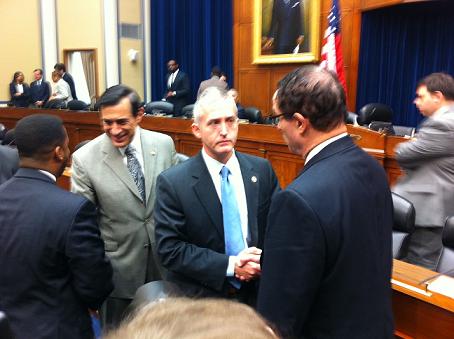 D.C. Council Chair Kwame Brown, Rep. Darrell Issa (R-CA), Rep. Trey Gowdy (R-SC), and Mayor Vince Gray at this morning’s hearing.
During a hearing on the D.C. budget on Capitol Hill this morning, Rep. Darrell Issa (R-CA) rejected a proposal for full budget autonomy for the city but proposed an alternative measure that would allow the city to more easily spend its locally raised funds.
Issa’s proposal came in the middle of a House Oversight Subcommittee hearing where Mayor Vince Gray, D.C. Council Chair Kwame Brown, D.C. CFO Natwar Gandhi and former Control Board Chair Alice Rivlin delved into the city’s financial health, described the 2012 budget currently being debated by the D.C. Council and made their case for allowing the District to allocate and spend its own money without having to wait for Congress to approve it.
Under Issa’s plan, Congress would retain the right to vote on the District’s budget, but it would do so in two parts — the first on the city’s spending for local services and the second on federal funds allocated to the District for a variety of programs and services. The first vote would likely come in June or July, allowing the District to stick to the usual fiscal year used by cities and municipalities. Under the existing arrangement, the D.C. Council votes on the budget in June, but has to wait until at least September for Congress to approve it — which sometimes it doesn’t, opting instead to keep spending levels at what they were the year prior.
Issa’s proposal differs from Del. Eleanor Holmes Norton’s push for full budget autonomy in that Congress would still play a role, which he pointed out is part of the legislative body’s responsibility when it comes to overseeing the “federal city.”
“Eleanor [Holmes Norton’s] proposal, which has been out there for a while, is a relinquishing of our responsibility, and we don’t think that’s appropriate,” Issa said after the hearing. “But we do think that there’s merit in her initial question, which is, ‘Can we give the District of Columbia more autonomy?’ We think there is a way to do this through what we’re calling a contingent budget. It would be passed by the Congress early on so we’d have met our responsibility but, at the same time, it would free the District from worrying about whether or not there is going to be a shutdown now or 15 years from now.”
Of course, much like the 1973 congressional act that gave the District Home Rule, Issa’s offering is an act of compromise. While the city would have more control and flexibility in how it spends its own money, Congress would have the final say — and still get to attach riders to city spending measures like those prohibiting the District from spending local funds on abortions or needle-exchange programs. Additionally, according to Issa, the District would have to prove to Congress that it could maintain all essential services like schools and police without any additional federal funds, a burden of proof placed on no other state that takes in federal money.
Gray, who advocated for budget autonomy during his testimony, called the hearing “encouraging” and “constructive.” The stars of the show, though, may have been Gandhi and Rivlin, who used their expertise and reputations to stress how the current arrangement faced by the District simply doesn’t make financial or bureaucratic sense. (Gandhi submitted 30 pages worth of testimony, tables and charts for the record.)
“The more time that elapses between the formulation of a budget and its execution, the more likely the operating assumptions underlying that budget will not hold true,” said Gandhi, complaining of the four-month lag that exists between when the D.C. Council passes the budget and Congress gets around to approving it. In response to a question by subcommittee chair Rep. Trey Gowdy (R-SC), Gandhi also pointed out that the District’s inability to tax income at its source and tax large swaths of land were severe limiting factors in financial planning.
In many ways, Issa’s proposal closely mirrored Gandhi’s take on budget autonomy. In his testimony, Gandhi stressed that only the $174 million the District got in distinct federal payments should have to be allocated by Congress, not the whole package. (The 2012 budget is $8.99 billion, $6.34 billion of which comes from local revenue and $2.45 billion coming from Medicaid and federal grants available to all states.)
“I suggest that only the federal payments specifically and uniquely earmarked for District programs or federal initiatives should be appropriated by the Congress. In the case of local funds, the Congress has rarely altered an allocation made by the District,” he argued. Gandhi made no mention of the social riders that so often impose congressional policy restrictions on local programs.
Norton said she was caught by surprise by Issa’s proposal, though she indicated that she’s be happy to work with him on it. Issa didn’t give any sense when he’d push the proposal forward, but he did say he wanted to do so with Norton as a co-sponsor.