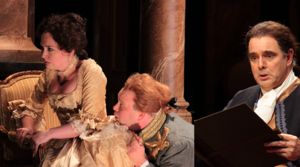
 Laura C. Harris, Sasha Olinick and Edward Gero in “Amadeus”.
Amadeus is an almost perfect illustration of what makes a good film and what makes a good play.
The famous film version was rewritten from Peter Shaffer’s play quite thoroughly by Shaffer’s own hand; where the film is image-filled, broad in scope and lush, the play is verbal, tightly focused and spare. In this production at Round House Theatre, director Mark Ramont takes full and confident grasp of what makes the play a play and sets forth a powerful entertainment.
The story opens with rumors from two professional gossips called Venticelli (JJ Kaczynski and Kenyatta Rogers) that the old composer Antonio Salieri is raving about having assassinated, some thirty years prior, the one and only Wolfgang Amadeus Mozart. Salieri (Edward Gero) speaks to the audience, promising to reveal whether or not he really committed the murder — after he has told his story. Back in his youth, Salieri swears to God that he will trade a life of religious circumspection for the chance to be famous for composing music to God. Salieri eventually seems to achieve this goal as a composer in the court of Austrian Emperor Joseph II (Floyd King) — that is, until the young Mozart (Sasha Olinick) shows up and spends years crafting the most beautiful music Salieri has ever heard. However, only Salieri, despite being musically “mediocre” himself, has enough of an ear to recognize how glorious and perfect Mozart’s music is, despite Mozart being such a dissolute, arrogant and potty-mouthed man-child; swearing revenge on the God who has allowed such a backwards arrangement of musical talent and personality, he sets out to be Mozart’s personal ruin.
This tale of intrigue in the lace-and-wigs world of Enlightenment Vienna (only partially based on historical fact) is a delicious frame upon which Shaffer hangs sharply observed characters, witticisms and emotional knife twists. Ramont’s production is dry, ironic and arch, which is appropriate since it — and the audience — spends the entire time completely in the hands of Salieri.
As Salieri says in the first scene, “a note of music can either be right or wrong absolutely,” and Gero is note-perfect as Salieri. Here is an actor with such a precise grip on the character that not a single sideways glance or raised eyebrow is disharmonious, and the result is magnetic. His Salieri has a kind of bitter wisdom; he’s been through a hell of his own making and gotten nothing to show for it except a keen understanding of the faults and cruelties he, society and God are all capable of. On top of that, he is funny — very funny — without losing an ounce of his poise. Gero takes Round House’s large hall full of people all the way inside Salieri’s head and delivers the play, almost inside-out, from there.
He is well supported by the rest of the cast and the design team. Olinick is fearlessly unlikable as Mozart, with nary a hint of his better qualities (and there are many) until very late in the play — too late, of course, to sway Salieri. As Mozart’s mercurial wife Constanze, Laura C. Harris reveals two or three new complexities with each subsequent scene. Since Ramont generously allows Gero’s Salieri to control the play so firmly, the resulting effect is similar to observing the interactions of high school students as an adult: all of the characters’ motivations and bad choices are bare and inevitable, and the result is both more distanced and more wrenching for being so plain. Appropriately, then, all the visual elements, from James Kronzer’s set to Bill Black’s costumes, while attractive, are restrained and unshowy.
Thus, no one should come to this production expecting high spectacle or gentle and colorful laughs. From the first moment that Salieri brings up the lights to look at the audience and Gero shows no hint of apology or winking humor for the use of this device, it is clear Ramont is out to suck you into the play, as opposed to the play coming to you. In the end, what this Amadeus intentionally sacrifices in classic stage beauty, it more than makes up for in the powerful challenge it offers to every audience member who has not lived up to his or her own dreams.
Amadeus runs through June 5 at Round House Theatre Bethesda. Tickets are available online.