Martin Austermuhle
 The District’s redistricting plan, which was rolled out yesterday, received the initial endorsement of the D.C. Council subcommittee that drafted it, despite protests from a number of councilmembers about how new ward boundaries are being drawn and repeated calls for respect amidst a process that has proved predictably rancorous.
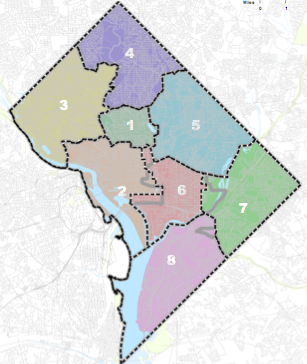
At a hearing this afternoon, councilmembers Michael Brown (I-At Large), Jack Evans (D-Ward 2) and Phil Mendelson (D-At Large) outlined the plan that would shift a part of Shaw into Ward 6 and a part of Hill East into Ward 7 as a means to get all of the city’s eight wards as close to 75,000 residents as possible. (Map, report — both also embedded below.) In opening statements, both Evans and Mendelson noted that redistricting, though it only happens once a decade, proves to be one of the most contentious issues that most councilmembers face.
And so it has been, notably for Ward 6, which under the approved plan will lose a chunk of eastern Capitol Hill, home to over 9,300 residents. (They protested at Lincoln Park earlier this week.) Councilmember Tommy Wells (D-Ward 6), visibly angry by the redistricting decision, called the committee’s decisions “selective,” accused Evans of gerrymandering Ward 2 and tried to derail a final vote on the report by arguing that concerns raised by four Ward 6 ANCs had not been directly addressed by the committee’s report.
Evans fought back at any claims that he had gerrymandered in his own favor, arguing that last-minute changes were made in order to keep Penn Quarter and Shaw as close to whole as possible. In defending his decision to keep the Convention Center and Verizon Center in Ward 2, though, Evans proclaimed a sense of ownership over the two, claiming that since he had worked on both, he should get to keep them. (That being said, Wells benefitted from gerrymandering too — both Eastern High School and Eliot Hine Middle School were drawn back into Ward 6 after an initial plan would have seen them go to Ward 7.)
Councilmember Marion Barry (D-Ward 8) also leveled harsh criticisms at the committee, arguing that it missed an opportunity by keeping all of his ward east of the Anacostia instead of giving it a Census tract across the river. (Under the plan, Ward 8 will pick up a small part of Ward 7, but nothing else.) Liberally quoting statistics about race, employment and home ownership in Ward 8, Barry argued that bringing his bailiwick across the river would help correct historic injustices and improve the ward’s standing.
More measured words came from councilmembers Harry Thomas, Jr. (D-Ward 5), Yvette Alexander (D-Ward 7) and Muriel Bowser (D-Ward 4), who appealed for unity and argued that changing ward boundaries would not break up neighborhoods as some have insinuated. “Though borders might change, neighborhoods don’t,” said Bowser, calling upon her own experience of sharing communities with both Ward 3 and Ward 5.
In a closing statement, Mendelson argued that despite all the passion involved, redistricting does not necessarily affect economic development or neighborhood projects, nor do changing ward boundaries affect school districts or police service areas. Even residential parking, he noted, could be altered to account for changes in wards. He also responded to Barry, arguing that levels of employment or home ownership in Ward 8 wouldn’t change appreciably if it gained a Census tract from across the river.
As Brown brought the hearing to a close, Barry continuously interrupted him, demanding a personal privilege to counter Mendelson. Though Brown repeatedly called him out of order and Mendelson reached over to turn off his microphone, Barry rambled on, forcing Evans to call a quick vote on the report — it passed — and adjourn the meeting by slamming his fist on the table like a gavel. Even then, Barry kept on.
Next up is a public hearing on June 1, and then the subcommittee’s final report will be voted on by the whole council. (Think Barry won’t be waiting for his turn to talk?) Come fall, the next fun part of the process kicks off — ANCs, SMDs and voting precincts get redrawn.