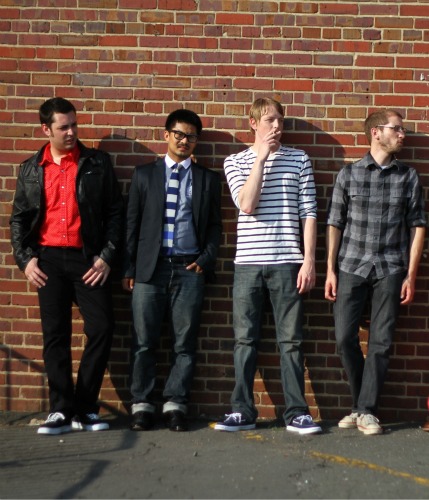
 Considering how much rock and roll standards have influenced everything thereafter, there aren’t nearly as many bands who wear their influences as effortlessly as The Nunchucks. From the beginning chords of “Clean Me Out” on their recently released Eat Your Moneys EP, you can hear the bold guitar riffs of classic rock songs like “You’ve Really Got Me”, but there are also very smooth vocals from Ron Soltes that bring to mind more pop-oriented fare. However, there’s a cleverness that’s distinctly their own (listen closely to the lyrics to “Zebra”) and a few jazzy chord progressions not often found within the parameters of rock and roll.
We sat down with singer Ron Soltes and bassist Brandon Schnedl to talk about their take on local music, their international influences and remaining together for several years.
Find them online: http://www.myspace.com/wearethenunchucks
Last time I saw you was at the very ambitious Sweet Tea Pumpkin Pie Fest.
Ron: Yeah, I thought it was going to be a total clusterfuck and I’m sure Dave did, too, but it ran super smoothly. I loaned my amp to someone the day of. There were a lot of people out moving through the venues. It was just good to see people out trying to see some D.C. bands.
I almost think that was the target audience: people in D.C. bands.
Ron: Had he kept it as small as he initially was going to, that would have I guess been fine, but he ended up having more bands and involving more venues than was previously planned. But for something that he kind of whipped up, it worked. And obviously he’ll learn from all the stuff. I thought it was cool. We sold some CDs!
How long have you guys been a band?
Brandon: There was a Nunchucks before I was in it and that was, what, six years ago?
Ron: Even this incarnation of the band has been around for four or five years. The band didn’t start to get serious as far as, “Oh, we’re going to record and we’re going to try to tour after we record and have merchandise.”
Brandon: Merchandise is awesome, by the way.
Ron: So we’re just kind of getting our shit together in the last couple of years. I figure if we’re going to stay a band, we might as well have our shit together. Because we’ve seen tons of bands around us break up. Bands that we love or at least like, just, not last.
Brandon: Especially when we started out, there were a bunch of really cool D.C. bands.
Which bands?
Ron: Let’s French. Black & White Jacksons. Uh…
Brandon: Why are D.C. bands so forgettable?
Ron: Because they break up! No, there’s more. There’s a Richmond band we used to play with a lot, Prabir & the Substitutes. Although I like Prabir’s new project and the rest of the guys are in the Trillions, who are, like, my favorite new band. I know there are more. We’ve definitely seen them come and go.
Having been a band for this long, how would you say your style has grown?
Ron: Leaps and bounds.
Brandon: At least from when I started, it just seems like the more that we stay together, the more that we define our sound. I don’t know if it’s necessarily palatable to what everyone wants to hear in D.C. It feels like if you’re not a dance pop band, you’re not going to get a big crowd. That’s not necessarily true. It just feels like I feel like some of the new songs that we have coming out are starting to sound like us and not we’re sounding like other bands, which is really hard to do. It just seems like as you progress, everybody wants to, as musicians, you tend to write towards the bands that you’re listening to. If you’re listening to a certain band, you’re going to subconsciously write towards that. It just seems like recently and hopefully for the next album we have coming out, it’s going to be more our sound than any other thing we’ve done. You can make a whole list of bands that we’ve been influenced by dating back to the Kinks and stuff like that. I’m personally excited for the direction we’re going towards.
Ron: When we first started out, we didn’t really have a voice, so we were playing stuff that everyone, and with good reason, said sounded Weezer-esque. Then, there’s the fact that we had a keyboardist, so, it sounded Rentals-esque. I also listened to the Rentals a lot growing up, so it was this very sugary power-pop with the synthy undertone.
I definitely don’t get that from you now.
Ron: We lost the keyboardist. She went and did other stuff. Then we picked up Brandon and doubled up on guitar. John moved up from bass to guitar, so we were able to have a bigger guitar sound. John’s a phenomenal guitarist, so that’s made us a lot more diverse as far as what we’re able to do. The sounds that I hear in my head — I’m able to talk to him and I’m able to get those sounds out into real life. It’s a huge asset. And Brandon is an awesome bassist. He’s a guitarist before he was a bassist but he’s just as good as a bassist as, I think, any of the other bassists in the city. Having said that, John was also a good bassist, so he was filling big shoes and he did fine. Being able to keep a big presence on bass and have two guitars, one of which could solo and compose really cool lead parts, it just opened up that sound. I think it’s what we sound like now, a bigger rock dual guitar sound.
Brandon: I honestly don’t think that there’s a lot of people in the city doing what we do. We’re not trying to sound like what sells necessarily. We’re playing the stuff that we like and we’re writing the stuff that we like and if other people dig it, that’s cool. I just feel like there’s a big void in what’s really big now. There’s so many formulaic things you can do with music nowadays where if you want to sound like something that sells, you do three things: have a catchy bass line, a jangly guitar riff and a kind of atonal weird vocal sound and you can almost instantly catch on.
Ron: Oh wait, The Killers?
Brandon: But what I’m saying is that we’re trying to write newer, traditional rock and I don’t think there’s a lot of people still doing it. It’s almost like a dead genre. It’s like if you’re not directly copying from somebody and doing something that’s so specifically throwback to one genre or band, it just kind of gets washed out. We’re tapping a bunch of different influences and trying to make it interesting. We’re trying to keep ourselves occupied, too. We’ve all been playing for a really long time. We’ve all played different roles in different bands.
Ron: My thing is, if I start to write the same song over and over, I’m going to stop. So, I’m always trying to add a different dimension. Lately, I have this other project that I’ve been developing, slowly, on the side, and it’s all based on Brazilian music. I’ve had to learn weirder chords, different voicings of chords, jazz chords and stuff like that, and even subconsciously that stuff is leaking into the Nunchucks stuff I’m writing because I’m using jazz and bossanova chords in a rock context. That’s definitely changing the sound, because rock just sort of moves around the same kind of template and you can stretch that template a little bit. It’s not like people haven’t used jazz chords before, but as far as what I’ve heard in the general area, I just hear the same stuff. We play off our influences and lately my influences have been off of international music. I think any time you throw something international into the mix, that’s going to cause something new.
I didn’t realize that international music was part of your disparate range of influences. That’s pretty cool.
Brandon: Yeah. Ron definitely spearheads the songwriting. He basically brings to the band the blueprint or the outline. Then, we have a guy who’s a phenomenal guitarist who writes around his parts and I basically try to complement what they’re doing. That’s kind of how our writing process works. You caught our set, right? Did you hear the last song?
Yes.
Brandon: I think we’re all in agreement that this song is a little bit different than what we usually do, and we all feel that we’re getting closer to what we want to do. That song sounds like a Nunchucks song. It doesn’t sound like a Kinks song or an Animals song. It doesn’t sound like a Weezer song. It sounds like us. We’re writing pretty consistently and we’re going to have a whole album of us. It’s one thing when you’re writing and you feel like you’re influenced by somebody, but it’s another thing when you feel like you’re your own sound.
Ron: And honestly, it has taken six years to get this together. That’s why it’s weird to see bands come and go, and you wonder what bands would have sounded like so many years later. I’m glad to say that we’re still here, despite all of us being a little bit jaded by what the scene has been.
Brandon: Really jaded.
Like…how?
Ron: Brandon alluded to this earlier, but as far as rock and roll being thought of as something that can progress, that’s not really the mindset. People are kind of putting it to bed or writing it off. It’s basically at this point considered classical music. The stuff that is going around is very electronic, which is fine. There’s definitely a demographic for that. But, I think our collective feeling is that there’s still more you can do in rock music and still keep it innovative.
Brandon: It’s not even so much that there’s still more you can do. It’s like, keeping the torch alive. There are no young bands trying to play good rock-n-roll anymore.
Ron: It’s like saying, “You can’t use oils anymore. You have to paint with something else.” You can always make a good painting out of oils, as long as there’s good composition and technique and all the other stuff that goes into painting. I think it’s the same thing with any genre. You’ve got to keep it fresh. You’ve just got to create.
Brandon: It just makes it that much harder. Especially because a lot of the time we play to flat audiences. They want that electronic. They want pop. We play to those audiences on a consistent basis, and it’s the fact that eight or nine times out of ten, we’ll still get people who really dig the sound. It’s just so washed over with this, “I’m wearing the plaidest shirt out of everybody in the room and I am so fucking hip. It’s so plaid that it can’t be any plaider. You can’t talk to me because I’m so cool and it would just burn your eyes out.” That’s the kind of mentality that a lot of bands in D.C. have nowadays. “We’re just going to out-hip the other band. It doesn’t matter if our music’s good, we’re just hipper than the other band that came on before us, so people will listen to us.” And it’s proven true. Kids will show up to these fucking shows because they’re like, “Wow, I saw that guy out-plaid the shit out of everybody in the room.”
Ron: We’ve all seen this. Bands that aren’t necessarily terrible, but mediocre to good that dress the shit out of their sets and always have photographers, always have write-ups in all the local blogs. It’s not that all of them are terrible, it’s just that they’re beating us at a fashion contest, not a music contest.
Brandon: We’re essentially the Bruce Springsteen of the D.C. indie scene right now. We’re the working me. All of us show up after work. Our guitar player has four kids, our drummer just had his first kid.
Ron: Our drummer shows up in his muddy work boots. I don’t know how he plays the drums in those steel toed boots.
Brandon: He basically works twelve-hour shifts and then shows up to gigs.
Ron: He’s since moved up so he does more office stuff, but he used to show up in muddy work boots and fly through a set.
Brandon: I’ve never played a gig where I wasn’t showing up from work with this band in the five years we’ve been together. Mind you, I’m not working the most strenuous job, but we’re not dicking around, squatting in some flat, which would be way cooler than what we’re actually doing. I just have a feeling people are starting to not care about how music sounds and they want to care more about how it’s presented. It’s got to be glossed-over and poppy and brainless for them to like it. It’s a shitty feeling for people who spent a long time learning how to play.
Ron: I’m also not dismissing the importance of appearance. Maybe not to us, but to the industry, that is important. It’s just that it’s become the most important thing over the music. I definitely appreciate a band that has a good physical outer appearance but when it’s coupled with their good music, that’s when you can appreciate it. I guess every band that has ever existed is at the mercy of what the public wants or likes at the time. I feel like we’re one of those bands that’s in a weird spot where we don’t want to do what’s going to please everybody. We just want to play to our influences and keep rock and roll going in forward motion, not just try to do something that sounds like something. but just keep it moving forward. It seems like the demographic is getting smaller and smaller, I guess.
I guess you must not completely discount appearance, because I saw you play a show in what looked like ninja turtle makeup.
Brandon: That show was just so weird. Sometimes, when you play enough, you just show up at gigs where you have this moment of clarity like, “why are we playing this?” And you look at everybody and they’re all like, “yeah, we’re ready to play!” And you’re like, “yeah, I guess I am, too?”
Ron: I wanted to play that show because it was specifically for kids who either couldn’t drive to D.C. or it’s 21 and up. That’s why I wanted to do it. That’s the other reason that I decided to dress up like an idiot and entertain the shit out of these high school kids because if I was in high school, I would have ate that shit up. Maybe it’s a different generation and they were like, what’s this idiot doing?
Brandon: I also had a phase where I’d get so pissed off at some audiences that I’d just run out on the floor and play in front of people. That might have happened that night. I went up to this girl and she was standing right up front, but didn’t seem particularly interested. I walked straight up to her in the middle of a song while we were playing and I was like, “How’s it going? Are you enjoying the show?” and she said, “Yeah, it’s pretty cool,” so I said, “That’s nice. Why don’t you act like it?” She was like, “I guess I’m trying?” so I said, “Okay. I’m gonna go.” I was in the middle of a song.
Ron: I don’t think I have the wherewithal to listen to play my guitar, listen to the rest of the band and have a conversation with someone in the crowd.
Brandon: I might have been a few beers deep.
Ron: That was definitely a dry show so they were definitely drinking in the parking lot.
Brandon: We looked at each other before the show and decided to pound a few beers each in the parking lot. That’s part of the rock-n-roll experience. If you’re going to play shows, you’ve got to at least have fun and enjoy it. The second you start to treat something like playing out like a job, it stops becoming fun. For me personally, I feel like when doing something like this isn’t fun anymore, than what’s the point?
How much touring have you guys done outside of D.C.?
Ron: Not a lot. But the summer should be our first actual tour because we have to promote the album.
Brandon: It’s essentially because we have members with multiple children, touring’s been difficult, but we’re making the push.
Ron: Not difficult — it’s been impossible. We’re bringing on a substitute drummer because Nate can’t really tour with his first kid. You always freak out with the first kid, I guess. I would. We’re going to have a touring drummer that we still need to bring up to speed. The farthest that we’ve gotten other than Baltimore and Richmond is New York and that was before Brandon was in the band. So, we played at Knitting Factory years ago. I don’t even think it’s at that location anymore, but that’s the closest we ever got to touring. Our first actual multiple date/multiple city tour will be this summer if all goes to plan. Kind of grudgingly, I’ve had to be the booking agent, the promoter and the manager of this band. It’s kind of a lot on my shoulders, since I also do all of the songwriting. I trust at some point they’re going to write songs, but up until now, I’ve written every single song, so having all of that on my plate is tough. Brandon actually said this to me once, “This band will go as far as you push it to go,” which is totally true. If I’m not the protagonist or whatever, no one else is going to be. Everyone contributes equally as far as writing their own parts, but as far as administrative stuff, it’s all me. But as Brandon said, the band will go as far as I push it to go so any touring that happens, but if we ever get on a label, if we ever get distribution, it’ll happen because I’m out there managing the band, basically.
Brandon: We had some pseudo-managers at a couple of points.
Ron: That did a quarter of what I do. And some of them actually got paid. I don’t really get paid. That’s why they call it a labor of love.
Brandon: He has pushed harder for this band than I’ve seen a lot of other guys do. Taking it all on by himself, going for it. And a lot of us grew up together or knew each other growing up. When I got into the band initially, we were all there for Ron, basically. It’s evolved since then, but definitely at first were like, “Let’s just play these songs for Ron.” He’s a good guy to get behind.
Ron: I would say, I’ve known John since seventh grade. I’ve known Nate since ninth grade.
Brandon: I knew John since the end of high school.
Ron: Between the four of us, we basically grew up together. Two years after high school, I went to Brazil and came back and that’s when I met Brandon. But Nate and I played in a band in ninth grade. Me and John had a guitar class in high school and we knew each other from middle school, but being able to be in a band with best friends is what’s kept us together. That’s also what creates the chemistry that we have in songwriting. I’d say that’s the best experience of this band is being in a band with your best friends.
What’s next for the Nunchucks?
Brandon: Getting out there and trying to catch on. D.C. is such a hard nut to crack, because people are so closed-minded and generally awful.
Ron: We love you, D.C.!
Brandon: The driving force behind us getting out of here as a band is to see if our sound will catch on in other areas. D.C. is so rough. It has to be a certain thing or it just doesn’t fly. It’s mean and it’s cold and it’s fickle.
Ron: It makes bands break up that you like.
Brandon: Really cool bands broke up because of D.C. That’s our motivation for touring is to see if it’s just D.C. or if it’s the entire world.
Ron: If we need to stop, we will stop!
Brandon: If we’re just that bad, then, cool. But it’s just a mean place to play.
Ron: Our next step is just getting out and seeing if our sound listenable to other audiences and maybe hop in on a label. So, that’s it. Going for the big push!