

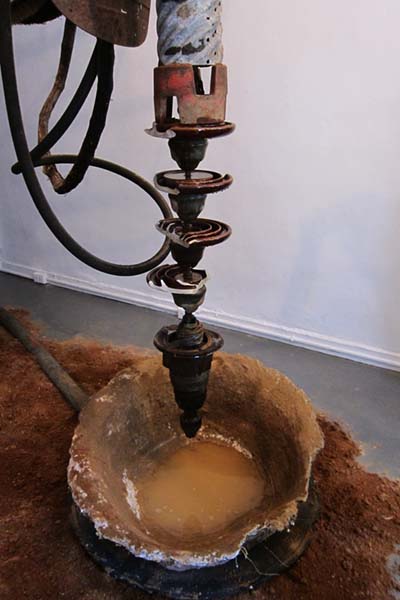
 Detail from Oreen Cohen’s Running Drill (2011). Photo by Pat Padua.
Transformer’s Exercises for Emerging Artists series is now in its eighth year. The gallery launched the program in 2004 to give young artists an opportunity for creative and professional growth. This process includes bi-weekly gatherings over a span of three months, during which time participating artists are mentored, and can also engage with and critique each others works.
E8, facilitated by Washington artist Joe Hicks, focuses on site-specific sculpture tailored for Transformer’s P Street NW space. An unassuming store-front structure which once housed a Christian thrift store, the gallery space may be dwarfed by the Whole Foods down the street. But Transformer’s modest frame has been host to a number of ambitious site-specific works in the past, like Rebecca Key’s Archetype, which converted the gallery’s interior to a simulation of the air shaft it once was — complete with garbage.
The E-series has traditionally showcased its participants as a group, but the sheer scale of the artists’ work has resulted in a series of three summer exhibits, each one the first D.C. solo show by the featured artist. First out of the gate is Oreen Cohen‘s Running Drill. The piece is informed by Cohen’s personal connection both to Israel and Bull Run in Manassas. The artist explained to me that the tragedy of the Civil War is remembered by the way we treat battle sites like Bull Run as hallowed ground, soil upon which blood was shed and ghosts may linger. These historic sites have generally become park land, but the troubled soil of Israel remains a site of great upheaval, which makes it difficult for those on either site of the conflict to stop and honor the fallen. Cohen notes that the soil of both Manassas and Israel is highly ferrous, iron suggesting the industrial havoc of war and agriculture, the ruddy land evoking the lives lost.
For all the bitter political history that informs Running Drill, the work does not pummel you with meaning as one might expect a massive drill to do. The metaphors transcend politics, creating a tension between the organic and the industrial — not only from the mechanical excavation of the land but from the varied detritus of the machine itself, which consists of pipes and cables and antiquated agricultural equipment, but also of winding vines and that red soil. The sculpture fills up much of the gallery, creating a spatial divide, but this divide requires visitors to coexist in the confined space. Running Drill also speaks to the creative process: the drill exhumes significance from the land, destroying in order to rebuild — much in the way that the artist destroys her materials in order to create. The history of the Transformer space and of the surrounding neighborhood, basking in a post-gentrification glow, resonates as well. Running Drill reflects on tensions half a world away — and also on the upheaval and destruction that lead to rebirth right here at home.
Running Drill will be on view at Transformer Gallery, 1404 P Street NW, for one week only. See the piece Friday and Saturday, July 8 and 9; and Wednesday through Saturday, July 13-16. Gallery hours are 1:00-7:00pm each day.


