

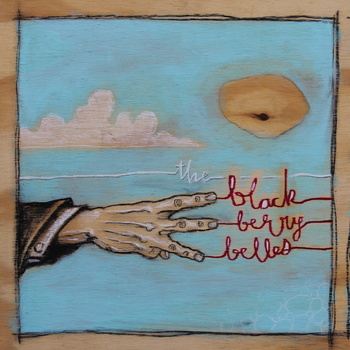
 When a band has just finished recording an album, it’s obvious in the best way possible. The band has a certain chemistry and tightness that makes for an impressive performance. No note, beat or movement seems without purpose, but the movements seem unforced and natural. That was The Blackberry Belles last night at Fort Reno.
The trio of Tony Blankenship (guitar/vocals), Alison Krayer (drums) and Jesse Hooper (piano/bass/organ) have an ease about them that comes from years of playing, even though the band has only been together for a short time. Although their name is culled from a Twilight Singers album, their sound is a little bit closer to the gritty soulful rock of the Afghan Whigs. Yet, Blankenship’s voice is more suited to singing the blues which he does well over the pronounced drumming of Krayer and Hooper’s organ. The organ riffs sound similar to those on Widespread Panic albums without the jammy looseness. Ultimately, these songs sound classic: like they could have been released in any of the past four decades.
We caught up with the trio at Galaxy Hut to talk about the downsides of playing with their idols, their affiliation with Girls Rock DC and why recording an album in two days was not as difficult as it sounds.
Find them online: http://theblackberrybelles.com/
See them next: At the Sidebar in Baltimore tonight or at their CD release (and Girls Rock DC Benefit) at the Black Cat on July 29th
Buy their album: From their website
Who came up with the name Blackberry Belles?
Tony: I guess in all fairness, Greg Dulli did, of the Twilight Singers. We were looking for a band name and I was telling a friend of mine who was sending me mp3s of his music. And he had a track where he sounded just like Greg Dulli but he had never listened to him. So, I was just telling him how awesome Greg Dulli was. Then it dawned on me. I was telling him that my favorite album was Blackberry Belle and I was like, “Fuck it! We need a band name.” It was down to the wire. We had a show and we needed a band name. So, I said, “The Blackberry Belles.” It eventually took.
Jesse: I just listened to the Twilight Singers yesterday and I really like them. I feel like after a year, it was time for me to pay my respects.
Tony: I just hope he doesn’t come after us.
How long have you been playing your respective instruments?
Jesse: Since I was little. I played piano as a kid and then in high school I started playing in garage bands. Then, she and I met in ’99 and played in a band together off and on for a number of years. You had been playing for a long time before that and then we got back into this last year.
Alison:: I’ve been playing drums for eighteen years.
Tony: I’ve played for seventeen years.
So how long has The Blackberry Belles been a unit?
Jesse: A year.
Tony: A little over a year. We got together in May and then we had our first show in June. It was the benefit for Driving Blind. So I have this friend who is legally blind and he was raising money to make a movie about he and his brother driving across the country to see all these landmarks before they lost their sight completely. It’s still in production. I ran into him at a bar and we were just BSing and he was asking about my bands and I told him I had this band. He said, “Oh, I’m going to put a show together, you should play.” I said, “Okay, cool, whatever.” He calls me, like, a day later and says, “The show’s booked, you’re playing.” I thought, “Holy shit, we’ve only been together for like, a week.” So, we were together for about a month and then played our first show and from there we just continuously booked.
That had to be nerve-wracking.
Tony: We just hit the ground running.
Alison:: We’d all been playing so long before that we came to each other with knowledge and skills anyway. We just combined them.
Jesse: It’s like Voltron.
Do all of you live in Virginia?
Jesse: Just me. I live in Falls Church.
Tony: I live in northeast D.C.
Alison:: That’s where camp’s going to be this year. In Brookland. It used to be in Kingsbury, but now it’s going to be over by you.
How did you get involved with Girls Rock DC?
Alison:: I had a friend who taught at the school there. She was a music instructor at Kingsbury School, at the school they have the camp at, but they’re not doing it there this year. She said they needed drum instructors and asked if I would do it. This was at the beginning. I was actually interviewed in DCist for Girls Rock Camp 2008 by Sommer. I’ve been part of it since the beginning.
But you’ve been involved ever since?
Alison:: Yeah. Now, I’m a band coach.
What specifically do you love about that organization?
Alison:: It’s more like an empowering camp with a “we’re going to teach you instruments and you’re going to rock out” [theme], but the main point of the camp is to empower these kids. So, it’s full of self-esteem and creativity and they channel through instruments. It’s more about teaching them their strengths and how they work with each other and then they get to rock out at the same time.
Are any of you originally from elsewhere?
Tony: I grew up in Ohio.
Alison:: I grew up in California.
Jesse: I grew up here.
I only ask because you’re on the schedule for Fort Reno and I was wondering if any of you had ever been to one.
Tony: Oh yeah! I’ve been doing it for a couple of years now.
Jesse: I’ve only been once. When I was in school a few years ago a friend of mine took me out. I can’t remember who was playing. It was a lot of fun though.
Alison:: I was supposed to go last year, but something happened and I didn’t make it. One of my friends’ bands was playing last year and I didn’t end up going. I think it might have gotten rained out.
Jesse: It’s been going on for a really long time, right? I looked it up and found pictures of what looks like some metal band. It looked like Ted Nugent was playing Fort Reno in 1982. Similar shirtlessness and sideburns.
Two of the instruments that you utilize are the Rhodes and the organ. How did you end up using those in a rock setting?
Jesse: Well, I’ve just been doing it for a long time and it makes sense for me. I really like playing an organic instrument, playing an instrument that sounds different depending on how you play it. It gives output based on the input unlike a lot of synthesizers and other keyboards. There’s not a lot of personality to it. But the Rhodes has got a lot of personality and the organ does. The Rhodes is set up so that it’s split. The lower end goes into a bass amp and the upper part goes into a guitar amp. So it has a little more versatility there.
When we first started out we were going to get a bass player. We couldn’t find one, so I had always felt like I should learn how to play bass. I was terrible at it at first but they were okay with letting me dig around a bit until I figured it out. Slowly but surely, I’ve gotten comfortable with it, but it took me a long time. I’m still figuring it out, but it actually works really well with our music because most bands that I’d been in before had a lot more instrumentation that played a lot busier styles of music and there was a lot of embellishment and there wasn’t a lot of empty space. The way that this band is set up, there are only three of us, and I’m preoccupied with doing two things at once. So, it leaves a lot of space and it’s made me learn how to play simply in a way that I’d never really figured out before.
That’s interesting since there’s sort of a garage rock aesthetic to Blackberry Belles. What styles had you been playing with before?
Jesse: Personally, I’ve been all over the place. I’ve been in a lot of jam bands. I know that’s an instant “out” in indie D.C. culture, but my roots are in jam bands. I like all different kinds of stuff. I bounce around with electro bands and jazz groups and reggae bands just sitting in here and there. I really like this, though. I really like that it’s focused on the songs and it’s focused on feeling rather than showing off individual instrumentation like so many other bands out there, who I also really like. It’s just refreshing to play a different kind of music and not be focused on the individual. This is much more focused on the whole sound than other groups I’ve been in.
So, is that how the songwriting works? Is it very much a collective process between the three of you?
Tony: It is. I generally come in with the skeleton of the song. Like, I’ll have some riffs and I also want to be a bass player, so I come up with my bass line to what I’m playing and then he comes up with his bass line to what he’s playing and since mine doesn’t sit in that register it doesn’t pass as a bass line. I’m the only person that knows it’s a bass line. So, I’ll come in with the chord progressions, the riffs, the lyrics. Sometimes I won’t have all my shit together and we’ll piece it together from there. Then, they’ll add embellishments and take things out and edit me. They kind of fill in the rough sketch. So, like, I come in with one idea and we leave and it’s a whole other idea but it’s awesome. It’s an awesome song.
Jesse: We keep writing our songs months and months later, too. We’ll get them and we’ll play them out for awhile and then decide that we need to work on that some more and we’ll change it. Most of our songs have been changed like three or four times, even after we thought we were done the first time.
What do you feel are the pluses and minuses of club shows versus house shows?
Tony: As a band, we’ve played one house show.
Alison:: It was really fun. It was for BYT.
Tony: It was in Brookland! There’s a guy who writes from them who’s in this band called the Dusties. He saw us at the Black Cat and then invited us to play a house show and it was fun.
Jesse: It was fun because everyone was more relaxed in a not pressure-heavy environment. In clubs, everyone’s got their social goggles on or something. But this was a bunch of friends and everyone was happy to be not at school or not at work and hanging out. They weren’t worried about spending money at the bar. It’s a little freer. I always end up in conversations with people before and after house shows. Clubs are a little different because they come and then leave and when people get in their going out mode it’s harder to breach that initial shell than when someone’s at their house or at their friend’s house and everyone knows each other.
Alison:: But we’ve gotten a lot of really good shows at really good venues.
Tony: We have gotten a lot of really good shows. Somehow.
Jesse: It’s been miraculous.
Alison:: Rock and Roll Hotel, Black Cat…
Tony: I write really nice e-mails to people.
Jesse: I attribute it to luck. Some of it was that he had a relationship with some club owners before D.C. way more than either of us did. Maybe that helps. But also we e-mail them at the right time or call them at the right time and we showed up and had posters at the right time and people have just responded well to that. But, I’ve been in other bands where I feel like we do the same thing and it just didn’t work out. It’s not like we sent them really high quality recordings or anything. There was really no evidence of what we were when this all started happening. I can’t really say it’s because we’re badass.
Alison:: We’re hard workers, though. We work hard and we have hard working e-mails.
Tony: We’re polite.
So, you’ve gotten to play with some of the touring acts that have come through here?
Alison:: Gene Ween!
Tell me more.
Alison:: He made us play acoustic.
Jesse: Well, they didn’t want a loud rock band opening for one guy on an acoustic guitar which is understandable, I guess. And we offered to play.
Tony: I saw he was coming. I wrote to the club and asked if we could play. They checked with his people. His people said, “Well, will you do it acoustic?” Until that point, we had never played acoustic together and of course I just said, “Yeah, we’ll do whatever you want. We’ll do it a capella. We don’t care.” And we got the show.
Alison:: He broke Tony’s heart, though.
Tony: I was really excited to meet him and he wanted nothing to do with me. I felt like Clark Griswald.
Alison:: Yup. He got to Wally World and Wally World was closed.
Tony: So, I’m done! I don’t want to meet anybody else. Not any of my other heroes!
Have you played mostly with locals. then? Are there any that you particularly align with?
Jesse: Everyone we’ve met has been great. We’ve played a few times with the Dirty Names out of Annapolis. It’s hard to explain, they’re like a ’50s soul-rock band. They’ve gone down that road as far as they could.
Tony: They put on a great show.
Other people feel that there isn’t a D.C. scene. Do you agree/disagree?
Tony: There are a lot of good bands in D.C. Maple. J. Forte — anything J. Forte is doing. Any project he’s got his hands in.
Jesse: I like the Laughing Man a lot. There are so many. I can never think of all of them.
Tony: Courtesans are pretty rad. I’m chasing that guy. Their guitar player. He’s awesome. The guy that sings for him — I steal like 90 percent of my stuff from that guy.
Alison:: Yeah…your alter ego.
Where did you record the album?
Tony: Inner Ear! With TJ Lipple. He was great.
Jesse: It was the best recording experience I’ve ever had.
Alison:: Me too. Love him!
Jesse: He had a lot of great input. He helped a lot. We went in with kind of an idea about what we wanted to do but we were real open to suggestion. I don’t know about anyone else but I had been in recording situations before where you go in and you know exactly what you want to do and it always ends up sounding really forced if you’re not open to listening to what people are saying, especially the engineers who listen to music all day long. It’s their job to know. We picked really well.
Tony: A buddy of mine recommended him to us, so I wrote to TJ.
Was it a long recording process?
Tony: Two 12 hour+ days. Two marathon recording sessions.
And you guys still liked each other at the end! You weren’t about to kill each other?
Alison:: No!
Jesse: It was amazing.
Alison:: We just flowed from one to the next. I mean, it was hard. It was exhausting. Really exhausting. But that’s how we decided to do it.
Jesse: Some of them were lucky. We went in thinking we might get five songs really well done, maybe seven on the high estimate, but if we have time, we’re going to record everything. We went in initially and had only booked one day and didn’t have hopes of getting very much done. But we came out with two days.
Alison:: We had to cut two songs, though. We were selective.
Tony: So, we actually recorded twelve songs.
Alison:: We recorded twelve songs in two days. We were crawling to our cars falling down exhausted. I was, anyway. I couldn’t even finish thoughts.
Jesse: Tony did all of his vocal tracks in one take.
Tony: Mostly. I had a couple at times we went back.
Jesse: The whole album was pretty much live except for his vocals and picked the best take. Then there was a little bit of studio magic but not much. It was the correct approach and TJ was the best possible choice for us at that time.
What’s next for you guys?
Jesse: We’ll go as far as it will take us. We’re not really sure what’s going to happen. We’re just going to keep playing and looking for shows.
Alison:: I would like to go on tour opening for a band and be the opening band for many, many shows all over the country. I would like to do that and I think Jesse would like to do that.
Jesse: I think we’d all be up for that. If somebody sends us that e-mail, we’ll assess it at that time.


