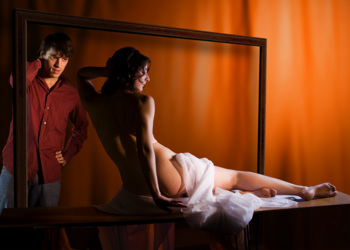
 Fringe’s “A Day At The Museum”.
A Day at the Museum is an artful, surprising, and engaging Capital Fringe work. I had preconceived doubts about this wordless play. Looking at the promotional photo and description (“A nude woman in a painting looks out at people”), I imagined an oil on canvas startling an admirer with a wink, throwing an icy stare back at an ogler, or maybe even stepping out for a rendezvous with Ben Stiller.
The play, though, is much more about the parade of characters coming through the museum. The silhouette of a nude model appears and fades away behind a large white sheet. She strikes alternating poses of innocence, motherhood or sensuality based on which of three large picture frames museum visitors are viewing. The actors make their way through the gallery of these images with their back to the actual model, looking out through the frames directly at the audience.
The focus is on the characters, their reactions to the painting and their interactions with each other. Robert Barnett catches just about every type of visitor you might expect to see and some you may not expect at the Smithsonian Gallery of Art. Memorable ones include an Asian tourist, a shirtless dom with his lover on a dog collar and chain, and a disinterested Scout family. But there are dozens, several played by each performer, and the acting and direction from Perry Schwartz brings each to life and leaves you hanging on each hand gesture and facial expression, excited for the next introduction.
A Day at The Museum proceeds almost like a dance performance. Movement and mimed actions are choreographed thoughtfully, leaving words unnecessary to convey how each character is reacting to the three paintings. The background that several of the actors, including John Milosich, have in physical theater from their work with Arlington’s Synetic Theater is evident. Just as vital to this purpose is the score of Brian Wilbur Grundstrom who composed the music and also happens to be the play’s producer. A celebrated composer, every step, shrug, head tilt, and double-take taken corresponds to the notes of Grundstrom’s strong score.
A Day at the Museum embodies the spirit of Fringe because chances are it’s not like anything you’ve seen before. It’s a classy, tasteful, and polished experiment.
A Day at the Museum has four remaining shows on July 15, 16, 20, and 23. Tickets are available online.