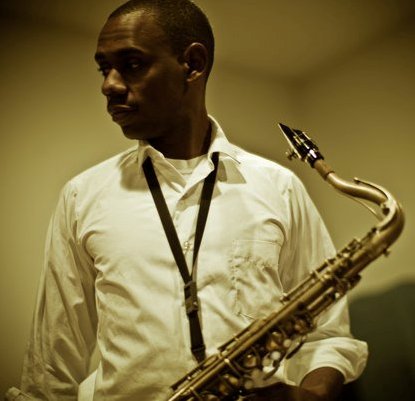
 Photo by Antoine Sanfuentes.
There has been a buzz surrounding Brian Settles for quite some time now. The talented saxophonist has undergone a remarkable growth in his playing, partly due to his recent graduate studies at Howard University under the tutelage of master instructor, Charlie Young. But there is more to it than that. There is a soulfulness to Settles’ playing that cannot be taught and it is this aspect of his sound that seems to have come to the fore. He has developed to the point where he has a unique voice on his instrument, which only comes with dedicated practice, experience and time.
A native Washingtonian, Settles graduated from the prestigious Duke Ellington School of the Arts, where he worked with Davey Yarborough, who has been a mentor to so many great musicians coming out of the District. He continued his formal training at New York’s New School, studying with bassist Reggie Workman, drummer Chico Hamilton and a number of other renowned jazz musician-educators. Both during and since completing his master’s degree in 2008, Settles has had a busy performance schedule, both as a sideman and with his own groups.
Things have been really picking up for Settles in the past year or so. He is coming off a very successful performance at the DC Jazz Festival, where he led his own trio and played with drummer Tomas Fujiwara‘s group at CapitalBop‘s D.C. Jazz Loft series. Last October, he gathered many of his New York schoolmates under the name Central Union to record his debut album, Secret Handshake. The free-spirited recording showcases Settle’s eclectic approach, which ranges from free jazz to ethereal ballads. While the diversity of the material can make for a disjointed experience when listening to the whole album (assuming that still even happens), it is a strong opening statement from a promising artist.
To celebrate the recording, Settles is leading a group as Artist-in-Residence at Bohemian Caverns. He will also host a formal CD release event at the club on August 21. In the meantime, we asked Settles a few questions about the recording, his various projects and his thoughts on the local scene.
Who is Central Union? How did you form this band and why did you choose these particular musicians for Secret Handshake?
The band takes it’s name from my grandfather’s church, Central Union Baptist Church, in Northeast Washington, D.C. The musicians on the recording are Neil Podgurski [piano], Corcoran Holt [bass], Jeremy Carlstedt [drums], Jean Marie Collatin-Faye [percussion] and myself on soprano and tenor saxophones. These are my guys.
When I was offered an opportunity to record, I called the guys that I’ve been playing with for over a decade. Jeremy, Neil, Jean Marie and I lived together in a house in Brooklyn, New York between 1996 and 1999. This house functioned in a similar way to a church. There we studied with the great Steve Neil, bassist and overall badass musician. Before Steve passed away in 2009, he expresses to me that he felt a strong vibration from Corcoran Holt, which confirmed my thoughts about who was to replace Steve in the band should that day come. Corcoran and I had begun working together while he was in college at Shenandoah University. We connected immediately on many levels.
What is your writing process like?
My writing process usually starts with a melody. I try to sing it and get it in my head. Then, I sit down at the piano and figure out the harmony.
What did you hope to accomplish with this recording, musically and in terms of career development?
Secret Handshake is my debut recording. I’ve wanted to record all of my life. I finally got an opportunity. Musically, I wanted to make a record that was me. As far as my career is concerned, I’ve added a record to my portfolio.
I play music, my career started the moment I committed to the music. I hope that this record affords me more opportunities to record, tour with my band and collaborate with musicians from other cultures.
Tell me about your trio with bassist Tarus Mateen and drummer Tiacoh Sadia. How did you go about choosing them?
Tarus and I have been playing together since he moved to D.C. a couple of years ago. We clicked the very first time we played together. I met Tiacoh in New York through a mutual friend. He and I also have a very strong connection and as soon as I had an opportunity to call him for a gig, I did. In my mind, I knew that Tarus and Tiacoh would connect on many levels and I also had a feeling that the music would be strong. Both men are very accomplished and have extremely evolved spirits.
Is there any specific kind of sound you had in your head for this group?
Not really. I just had a feeling that when we got together we would come up with something unique, based on what I know about them as individuals and what I know about their playing. I knew that the rhythm would be strong — considering Tiacoh’s Ivory Coast roots and Tarus’s time spent immersed in Senegalese culture — and that the energy would be intense. That’s all I ever need.
How does Central Union relate to the trio?
Central Union is home, you know. But there are many projects on my mind, involving many different musicians, some that I know and some that I don’t but I love their playing and would be into collaborating with them at the drop of a hat.
The trio is a strong unit but the doors are always open, meaning: this band can expand at any time, and does for that matter. At the Caverns, we’ve added voice [Settles’ wife, Jessica Boykin-Settles] and piano [Allyn Johnson].
What do you hope to communicate to your audience when you are performing?
With the trio as well as with my other groups, I hope to give a memorable performance. I communicate what’s in the moment. I feel good when folks leave the gig feeling good.
Do you have any plans to record the trio?
Yes, I’ve been planning on making a trio record for a while. I just released a record with Central Union, so I haven’t had much time to devote to writing, rehearsing and performing with the trio, but I’d love to go into the studio by the end of the year.
What are your thoughts on D.C.’s jazz scene?
I am very excited about the D.C. jazz scene. There are a lot of great musicians in the area, playing on a high level. Moreover, there are adventurous listeners who support the scene and patronize the venues. That’s what makes the scene. There are always players hiding out in basements and music schools but they might not have any gigs. Here in D.C., there are a fair amount of gigs, so the musicians can work and be heard.
DC Jazz Festival, Capital Bop, DC Jazz Loft, Bohemian Caverns and Jazz at the Atlas come to mind as some of the most progressive ventures and venues in the city. These are very exciting times.
What do you think are the greatest strengths of the local jazz scene?
The greatest strengths of the local jazz scene are the jazz education programs for the youth. You have the jazz programs at the Duke Ellington School of the Arts and the Washington Jazz Arts Institute, both under the direction of Davey Yarborough, Paul Carr’s Jazz Academy of Music as well as the jazz programs at Howard University and UDC.
Who are some of the musicians you most admire?
I admire all of the musicians in our community. It takes a lot of courage to do this thing. In particular, I admire all of the musicians who came before me and helped to pave the way for the current jazz scene as we know it here in D.C. Musicians like Buck Hill, Andrew White, Davey Yarborough, Charlie Young, James King, Nasar Abadey, Steve Novosel, Paul Carr, Lenny Robinson, Thad Wilson, Marshall Keys and Mike Bowie. These musicians have helped sustain the local jazz scene and maintained international careers for decades — most honorable.
A clip of Brian Settles’ trio performing at CapitalBop’s D.C. Jazz Loft in February of this year. The segment begins at the 3:25 mark.:
Brian Settles concludes his Artist-in-Residence run at Bohemian Caverns tonight. 8 p.m. $7 in advance, $10 at the door.