

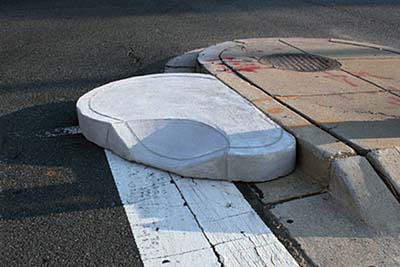
 Lindsay Rowinski. Median, 2011. 44 x 63 inches. Archival inkjet print, edition 1 of 2. Courtesy Transformer.
Leaving Transformer after last night’s opening, I walked up 14th Street and found a red carpet laid down at an angle between the curb and Posto, awaiting some absent VIP. It looked somewhow strange, in the way that art can temporarily reset your eyes and make you wonder at the world. The subtle shift in perception is thanks to Lindsay Rowinski’s installation at Transformer.
Following Oreen Cohen’s Running Drill, Rowinski’s Trying to be There is the second part of this year’s Exercises for Emerging Artists. In E8: Sculpture, facilitated by Joe Hicks, artists create site-specific works for the Transformer space. The E8 press release represents Rowinski’s recent work with a photograph depicting a set of three median curbs in a parking lot. It’s the stuff of ordinary suburban life, but something seems slightly off about it. The deliberately placed boulders on each ovoid curb seem to have no actual function, but neither do they fit the standard definition of decoration. A person walks among the curbs, his path slightly skewed by the arrangement.
Many would find such an image boring, but its seeming ordinariness intrigued me. Rowinski likens the medians to aquarium arrangements, as if some unseen master picked up a handful of curbs at the human pet store and plopped them down in our simulated habitat. But the curbs are not an fact an installation. They were simply found by the artist, a kind of parking lot readymade on the campus of NIH.
This framing of the world and observation of what is normally taken for granted is at the core of Rowinski’s subtle art. At first glance, the exhibit at Transformer seems to consist of two 44″ by 63″ photographs of Rowinski’s recent site-specific work: Slop stair (2011), a mustard-colored concrete installation, and Median (2011), in which the artist took a standard street curb and built for it a concrete appendix, with a narrow ramp suitable for bicycle access. These functional but slightly skewed pieces reveal a quiet strangeness in the things surround us every day.
You may be thinking, wait, this year’s E8 focuses on site-specific sculpture. Where is it? This is where the work gets really interesting. Rowinski had little more than a day to make alterations to Transformer’s space, and first time visitors to the gallery may not even notice they are there: a block built out from the window with a space for a single folding chair, a drop down ceiling corner, a plywood wall. Rowinski has previously worked as a performer, and admires the improvisational films of John Cassavettes. The subtle architectural alterations of Trying to be There create a kind of stage. As median curbs gently lead pedestrian and vehicular traffic in a certain direction, so these alterations subtly “block” the actors in the piece: you, the viewer.
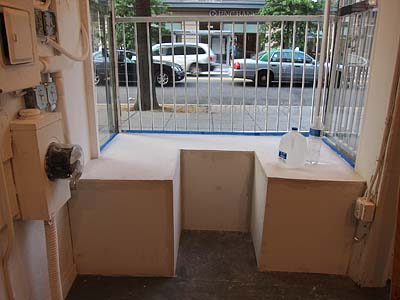 Detail from Lindsay Rowinski, Trying to be There (2011)
The effect is on the edge of perception; even gallery regulars may not notice the difference at first. And the differences made me question what I thought was the original gallery space: was that radiator there last week? The scale of the photographs block the action as well: large prints in a narrow space require visitors to step back to find a good vantage point, thus requiring them to explore the gallery space. This is photography as sculpture, guiding the viewer through three dimensions. This is sculpture as photography, framing the world to make sense of it — but instead of fixing an image in silver or pixels, what is captured, fleetingly, is a fluid, interactive dance.
Rowinski’s art is as deadpan dry as John Baldessari, one of her influences, but it thrives upon needs the warmth of human interaction, which it gently directs in ways you don’t even notice. This may seem less transformation than mere observation. It is that — but it also opens up the transformative power of our everyday surroundings.
Trying to be There will be on view at Transformer Gallery for one week only. See the piece Friday and Saturday, July 22 and 23; and Wednesday through Saturday, July 27-31. Gallery hours are 1 to 7 p.m. each day.


