DCist’s highly subjective and hardly comprehensive guide to the most interesting movies playing around town in the coming week.
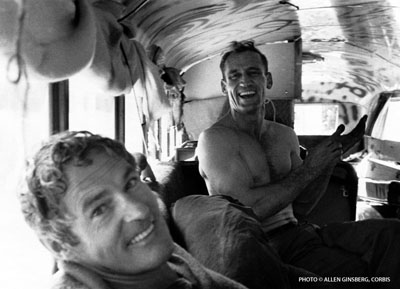 Photo courtesy of Magnolia Pictures.
What it is: The 1960s, documented through 21st century eyes.
Why you want to see it: Author Ken Kesey warned that you should not trust a prankster: he will lie to you. The same might be said of Magic Trip, Alex Gibney and Alison Ellwood’s curious and conflicting documentary about Kesey and his Merry Band of Pranksters.
In 1964, Kesey and his self-proclaimed pranksters hopped a bus called Further and travelled from California to the New York World’s Fair. Gibney and Ellwood were given full access to hours of 16mm footage shot by the pranksters, which included Neal Cassady, made famous by Kerouac in On the Road. But as the participants freely point out, nobody was an experienced camera or sound person, and such amateurism, combined with a variety of psychedelic drugs, is not alone a recipe for Magic. So the directors supplement original footage with copious recreations. This is a clever but problematic strategy, as it’s not always clear what is and isn’t from the pranksters’ lens. Adding to the confusion, many of the pranksters’ audio reminiscences are actually performed by actors reading from transcripts. Kesey’s real voice is heard, as is Cassady’s, whose stream-of-conscious rants about the fourth dimension and other passing obsessions is fairly intelligible (in the you can understand the words sense), but is provided with subtitles anyway — in the much-maligned font Comic Sans. Given the home-grown visual style of much the film’s graphics, including the vivid hand-lettering that spells out the audio from Kesey’s first LSD experiments, Comic Sans is clearly being used ironically. But it’s still Comic Sans — is its use a commentary on Cassady’s easy but ultimately empty joviality?
About those LSD experiments: more intriguing than the bus trip is a side-bar into
Kesey’s introduction to psychedelics — at the hands of the U.S. government. Kesey was a
straight-laced All-American boy when he volunteered for the Stanford experiments with LSD, later deemed to be a CIA project to rot the best minds of his generation. Audio was made of Kesey’s reactions to the drug, and these recordings are supplemented in the movie with shots of a vintage tape recorder as well as hand-lettered transcriptions. But then there are the visuals that spell out Kesey’s hallucinations. When he describes a frog-man, a crude animated frog appears, and tie-dye colors naturally follow. This visual hand-holding recurs throughout: when the bus reaches New Orleans and Kesey notes that everybody seems to move in slow motion due to the humidity, sure enough, the footage is slowed down. Music is crucial to the era, and one of the more telling musical choices is the John Coltrane Duke Ellington duet, “In a Sentimental Mood”, innovation meets tradition. Timeless as this music is, its use is sentimental and melodramatic, and the surviving pranksters (or the actors reciting their transcripts) finally admit that this is also true of their crazy project. Kesey’s pranksters checked out of society but fell into the same patterns of coupling and uncoupling of the society they left behind. This conflict lies at the heart of Magic Trip: a document of an iconoclastic time that frequently reverts to what the Pranksters themselves would have called lies, served on a plate of obvious and cinematic trickery again and again.
View the trailer.
Opens tomorrow at E Street.
—
What it is: Another kind of road movie.
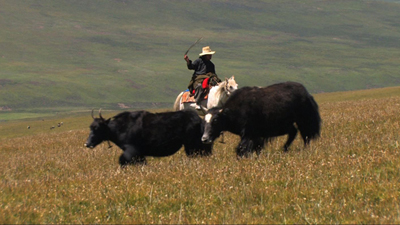
Why you want to see it: It’s a scene that could be from a county fair: a field dotted with tents and fair goers watching animal demonstrations while local musicians ply them with song. But the voice over the P.A. announces something you won’t hear next to the Tilt-A-Whirl: “The Monastery Association is missing a female yak.” Lynn True and Neslon Walker’s Summer Pasture documents one season in the life of a young Tibetan couple. Locho and Yama spend a nomadic life herding yaks in cold, forbidding mountain grassland. Summer Pasture is beautifiully photographed in colors and dominated by the earth tones colors of landscape, yak dung, and native garb. The film’s aesthetic may romanticize the exotic, but it also finds poetry in the mundane — these people may spread yak dung by hand, but they also pair off and raise families (up to a government-alloted quota of three children). Summer Pasture also recalls Sweetgrass, another working class road movie, but in this case, the road is 15,000 feet above sea level in a remote area of Sichuan Province.
View the trailer.
Opens tomorrow at the West End Cinema.
—
What it is: A French romantic comedy about politics and strange bedfellows.
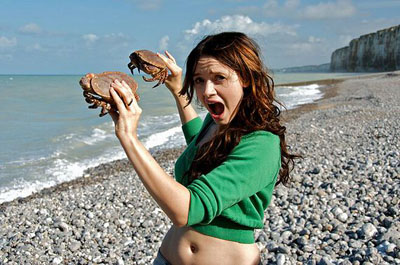
Why you want to see it: The French title of the film, Le Nom de Gens translates to the less romantic The Names of People. Which pretty much spells the difference between French and American rom-coms. The Names of Love is about the names and labels we assign to each other — political, racial — and the realtionships that transcend these labels. But that’s not to say there’s no “meet cute.” Young left-wing activist Baya (Sara Forestier, who plays France Gall in the upcoming Serge Gainsbourg biopic) is hired to screen questions for a radio talk show when she bursts in on greying veterinarian Arthur Martin (Jacques Gamblin) to give him a piece of her mind about bird flu hysteria. Did I mention blue-eyed Baya is half-Algerian? If this sounds as contrived as any American rom-com, it is, but it’s also autobiographical — director Michel Leclerc’s partner and co-writer’s name is also Baya. It may sound like Le Same Old, but the actors are so engaging and the writing clever enough to give the usual rom-com tropes a fresh and very French flavor. (The age difference between the leads would require an American remake to cast, approximately, Emma Stone and Tom Hanks).
View the trailer.
Opens tomorrow at Bethesda Row.
—
What it is: An early Bette Davis picture, part of this weekend’s slate in the National Gallery’s UCLA Preservation Festival.
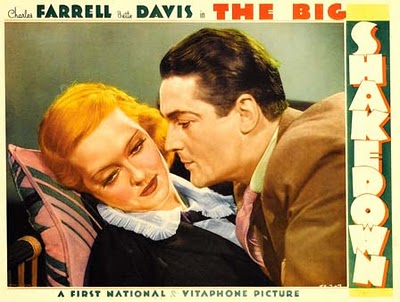
Why you want to see it: Modern medicine is not without its problems, but things used to be worse. Bootlegged drugs wreak havoc in The Big Shakedown (1934), a gangster picture featuring Bette Davis before she broke out of B-movies and became the legend of song. Shown with Strangers in the Night (1944), in which an amorous pen-pal turns out not to be what they seem to be. Shades of Catfish? Director Anthony Mann, noted for a series of dark westerns starring Jimmy Stewart, lays the framework here for his more famous work in film noir.
View the trailer for The Big Shakedown.
Sunday at 4:30 at the National Gallery of Art. Free.
—
What it is: The AFI’s Elizabeth Taylor series continues with this seldom-revived melodrama.
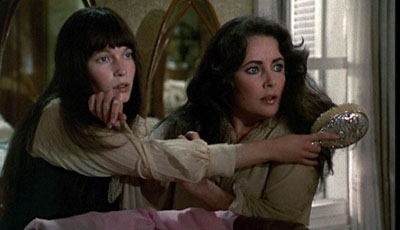
Why you want to see it: The AFI’s Hitchcock series hits the dregs this week with two of the director’s weakest films, the Cold War thrillers Torn Curtain and Topaz. But next week, the celebration of Liz brings us the rarely screened Secret Ceremony, starring Taylor and Mia Farrow in an intense surrogate mother-daughter relationship (with Robert Mitchum as the stepfather). Director Joseph Losey never again reached the heights of The Servant (1963), but his overheated melodramas may be a good counterpart to these dog days. Next week, you can also see one of Robert Mitchum’s last leading roles in The Friends of Eddie Coyle, part of the theater’s tribute to director Peter Yates.
View the trailer.
Sunday, August 21 and Monday, August 22 at the AFI Silver.
—
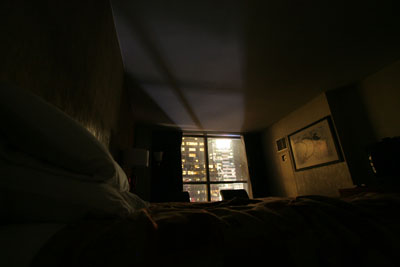
What it is: A documentary on urban light pollution, presented by the Environmental Film Festival.
Why you want to see it: Filmmaker Ian Cheney traded one light show for another when moved to New York City from rural Maine. But does the light emitted from the heart of the metropolis deprive us of more than celestial grandeur? City Dark is full of gorgeous astrophotography, tempered by sobering discussions of light pollution’s effect on animal and human populations alike.
View the trailer.
Screens one night only, Thursday, August 25 at 7 p.m. at the E Street Cinema. $15.