You know this story and its elements by heart. A basically good-hearted hero with a dark side. A woman in trouble. A femme fatale. Powerful forces of evil conspiring to drag our hero to his demise. Quiet, atmospheric contemplation. Fast cars and city lights. Nicolas Winding Refn’s Drive is a 50s noir, filtered through a 70s existential thriller, all dressed up as a neon-bathed, synthesizer-scored 80s L.A. action flick. Yet no matter how well versed you are in its influences, you’ve never seen a movie quite like this before.
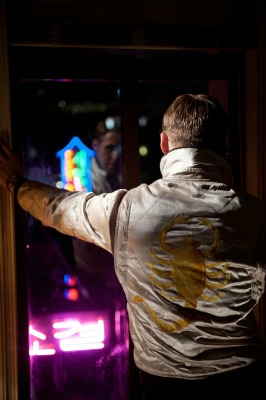
Ryan Gosling stars as the unnamed lead character, referred to in the credits simply as “Driver”. He doesn’t need a name: His identity barely extends beyond what he does, and what he does is drive. He does some stunt driving for the movies, he hopes to drive a stock car for his boss Shannon (Bryan Cranston) at the garage where he works, and he moonlights driving getaway cars for heists.
That last occupation is where we find him in the film’s prologue, which succinctly defines his character without ever having to give any background or history (as far as the film is concerned, he doesn’t have any), and with barely any dialogue. Because he’s so good behind the wheel, the first of the film’s three car chases isn’t really a chase: it’s a high-tension exercise in hide and seek that takes place entirely from the perspective of within the getaway car, with a brilliantly executed, unexpected payoff that Refn has been subtly foreshadowing throughout the entire set piece.
Gosling’s performance in these first few minutes — deliberate, quiet, intense — is all the background we need on Driver. The performance, and the character, are so inward facing that it seems at any moment as if he might collapse into himself. How he became this person is unimportant. His path forward is what concerns the film, and directly in that path are Irene (Carey Mulligan) and Benicio, a woman and her young son who live down the hall in his new apartment building. Her husband is in prison, and the two strike up a friendship that has, at its start, a pure and innocent bliss. A montage of their first “date” soundtracked by College’s gorgeous 80’s-throwback synth-pop tune “A Real Hero” is the most genuinely tender and loving five minutes I’ve seen on film in a long time. The un-self-conscious grin can be seen on Driver’s face during his time around Irene that is like the much needed release valve on his tightly pressurized existence.
 Also on his path forward is Bernie Rose, a coldly calculating criminal played with stunning complexity of emotion by Albert Brooks. It’s the kind of performance that makes one wish Brooks acted more, and ought to be a lock for awards season recognition. Bernie is ruthless, but also hugely smart and surprisingly empathetic. He’s financing Shannon’s dream of heading up a racing team, and the friendly charisma Bernie displays in his first few scenes are cause enough to generate real hope, even if we instinctively know that he’s going to be key to the eventual, inevitable descent.
That descent is sparked by events that, in a nice touch of noirish irony, grow out of the kindest impulses in Driver’s heart. This is, in part, a character study of Driver, a human battlefield between the source of those kind little grins on one side, and his affectless, near-psychopathic relationship with violence on the other. But Refn also interested in luck, and how those forces are weakened and bolstered by its influence. Shannon bears a tattoo of a horseshoe on his neck, while Driver’s keys hang from a rabbit’s foot. Refn’s universe doesn’t much care about those totems.
As the bad luck piles up, the director uses every cinematic tool at his disposal to elicit exactly the reaction he desires from the viewer. The sound design is genius, with gunshots ringing out louder than they reasonably should be just to provide the appropriate amount of shock, and with the roar of duelling car engines defining the centerpiece car chase much more than the visual aspects. Cliff Martinez’ electronic score perfectly sets the mood for each scene, some of which are edited to rhythmically integrate the sound and the picture, with cuts lined up to match the sound cues.
Visually, the film is stylized to within an inch of its life, as Refn employs slow motion, odd angles, striking framing, and lighting that wouldn’t exist in real world scenarios. It’s showy and dazzling, without ever being overkill. Refn is able to avoid having his techniques become excessively ostentatious by maintaining precise control over how every element comes together. Even when the violence becomes shocking in its graphic nature — and be forewarned, Refn is not shy about blood — there is an operatic grace in its deployment.
Refn is already a popular fixture with cult and art-house audiences, from his Danish Pusher trilogy, to his British inmate biopic Bronson, to last year’s nearly impenetrable, symbolism-laden Crusades-era Norse epic Valhalla Rising. What’s perhaps most surprising about this Hollywood coming-out is that it is so viscerally thrilling and hugely entertaining without ever departing from the surrealist impulses or hyper-stylization that make his work so distinctive. Refn accomplishes the near impossible in modern movies: combining uncompromising art-house style with the real potential for mass-market accessibility, in a pitch-perfect blend of pulp narrative and pure cinema.
—
Drive
Directed by Nicolas Winding Refn
Written by Hossein Amini, based on the book by James Sallis
Starring Ryan Gosling, Cary Mulligan, Bryan Cranston, Albert Brooks
Running time: 100 minutes
Rated R for strong brutal bloody violence, language and some nudity..
Opens today at theaters across the area.