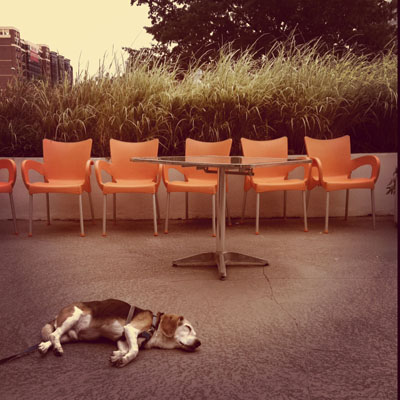
 Detail from Doghouse, by Patrick McDonough. Installation photo by Pat Padua.
It’s not often I walk into an art fair and like the first piece of art I see. By the pool at (e)merge art fair at the Capitol Skyline Hotel, I saw a beagle was dozing before a row of orange chairs. This turned out to be part of Patrick McDonough’s latest provocative installation, Doghouse, a constructed canine habitat with an incongruous split-level (a McDonough sketch by the same name presents an even more elaborate home for Fido). As with McDonough’s previous installations, Doghouse is more than it appears. This simple construction ingeniously addresses man’s anthoropomorphic projection onto pets, whom we assume would enjoy the same comforts we do. Yet, man’s best friend rejects the imposition: in this humid weather the dog spent the evening lounging outside.
(e)merge explains that it is the first American event to feature “a virtual art fair originating from a physical fair,” with programs available to art lovers worldwide. But the physicality of the fair is what makes or breaks it, and where (e)merge is most successful is where the artists and galleries make the best use of the venue.
That venue is the Capitol Skyline Hotel. In contrast to an armory style fair, with art scattered in semi-cubicles that break up a vast floor space, the organizers of (e)merge reserved rooms in the Capitol Skyline Hotel. New York’s Dependent Art Fair used a similar approach this March, reserving a block of rooms at a Sheraton Hotel in Chelsea for one of the many fairs organized as alternatives to the institutionalized Armory Show. (e)merge is organized by Helen Allen, former organizer of the Pulse Contemporary Art Fair, in collaboration with Leigh Conner and Jamie Smith of Conner Contemporary, and they offer a hybrid event of Washington’s institutionalized galleries and unrepresented artists.
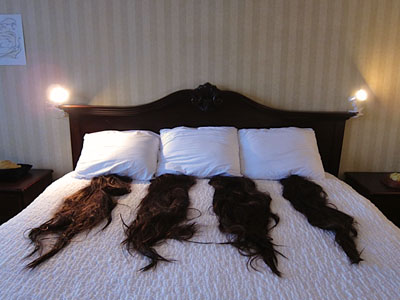 Four by Emilia Olsen. Transformer Gallery, room 219. Installation photograph by Pat Padua.
Using hotel rooms as exhibit spaces offers plenty of wall space, but the all-you-can-eat buffet aspect of going from room to room (and tricky lighting conditions) makes it hard for two-dimensional works to stand out. This can encourage shock tactics as a way of simply keeping the viewer in the room to engage with the art. The St. Petersburg, Florida gallery Mindy Solomon takes this to an extreme. Fans of naked women wearing meat helmets and peeing in the woods will find much to appreciate in the transgressive photographs of Becky Flanders. But I was drawn to work that drew the viewer in by more subtle means.
One of the great strengths of Transformer Gallery is their artists’ use of the narrow and idiosyncratic P Street space, and at (e)merge they prove that they know their way around a hotel room. Erin Boland, Emilia Olsen and Jessica Cebra contribute both flat and three-dimensional pieces to room 219. The flat pieces are strong examinations of various anatomical themes, it is the explorations of the room’s 3D space that the room sings. Boland’s Untitled (Ectoplasm) looks like monster excretions emerging from the hotel bathroom faucet; Cebra’s cardboard, acrylic and plaster Shapes seem like a sly take on abstract hotel art; Olson’s wigs drop from the king sized bed’s pillows — at once chaste, yet also suggesting the surreal raunch of Nicholson Baker’s recent novel House of Holes.
While local galleries offer strong work, (e)merge exhibitors include galleries from around the country and the world. A pleasant surprise is the New York gallery Josée Bienvenu (room 206). When you happen by the room the first thing you may notice is that the hotel’s windows appear to be taped up with unfolded cardboard boxes. It appears to be a gallery that has not yet unpacked their art. But art rewards the curious, and the curious will find it curiouser at a closer look: blank canvasses facing the wall are tucked beside one twin bed; a flattened cardboard box lays unceremoniously on another. There’s something studied about it, and upon further examination, you notice that the ripped cardboard is part real, part paint. A piece of cardboard is hung so that the stripes of tape don’t reveal their nature until you approach closer and on tiptoes. But the exposed cardboard corrugation is real. Spanish artist Marti Cormand is the genius whose trompe l’oiel encourages you to engage with cardboard.
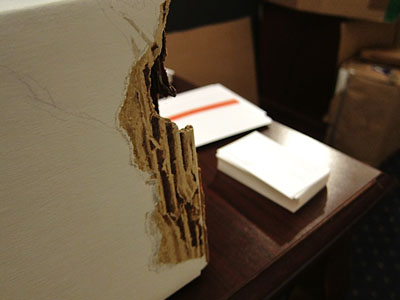 Detail from Marti Cormand’s installation. Josee Bienvenu Gallery, Room 206. Installation photo by Pat Padua
(e)merge is not just for commercial galleries. Non-profit webjournal The Studio Visit, led by director Isabel Manalo, documents visits with artists in their working environment. They do not offer gallery representation, but are presenting work by some of their collaborating artists in room 320. These include photographs by Washington artist Ding Ren (whom DCist interviewed last summer), currently in residence in Amsterdam. One of Ren’s photos shows a detail of a sofa whose upholstery has been given a makeshift tape repair. I would love to have seen this translated to the hotel’s furniture.
The gallery scene takes up the Capitol Skyline’s second and third floors, but artists represented and unrepresented alike can be found on the first and the ground floor. A Free Art Booth is presented by the collaborative project Peacock, which asks “is there such a thing as cultural capital?” Artists Chris Attenborough and Sean Naftel put out a call for contributions, and 75 artists answered with more than 200 pieces which will be available for free to fair attendees. Work by local artists include a diptych by photographer Cynthia Connolly, a racially charged flyer by Linda Hesh, and an appropriated men’s underwear ad by Baltimore photographer Jim Lucio.
(e)merge is not free. Admission is $15, which is inexpensive as art fairs go, but more than Washington-area art consumers are accustomed to paying. But it’s at least a couple of hours of entertainment, and if the highs and lows are not as predictable as the latest in 3D Hollywood diversion, that already makes it a better value for your art dollar.
(e)merge art fair takes place at the Capitol Skyline Hotel located at 10 I Street SW at South Capitol Street. Exhibition hours are Friday, September 23 from 12 to 7 p.m.; Saturday, September 24 from 12 to 7 p.m.; and Sunday, September 25 from 12 to 5 p.m. See the fair’s website for a full schedule of related programs and performances. Check out the counter-programming offered by alternative fairs But Is it Art and Submerge .