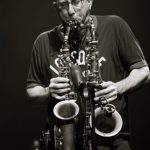
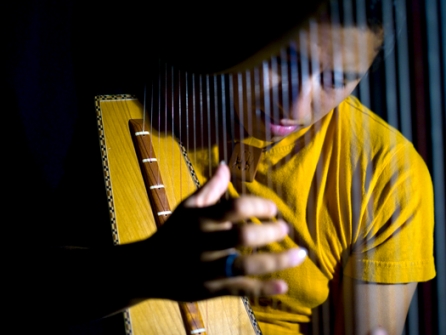
 Edmar Castañeda.
One central beauty of jazz is the art form’s ability to integrate global influences without co-opting them. Whether it be the bossa nova of Brazil or the ragas of India, all music has its place in this great American art form, and the fusion often creates a sub-genre of its own. So it’s no surprise that when Edmar Castañeda arrived in this country from his native Colombia, he immediately began investigating how his native music could fit into his new surroundings.
“I came to the United States when I was 16, in ’94, and that’s when I met jazz,” said Castañeda, who will be performing this weekend at Bohemian Caverns. “That’s when I heard jazz for the first time and I fell in love with it.”
While this tale is hardly uncommon to the immigrant experience, Castañeda’s story is unique because of the instrument with which he expresses himself in the jazz idiom — the Colombian harp. The instrument is standard in that country’s folk tradition and Castañeda’s father is also a harpist. Young Edmar started on the instrument at age 13 after having spent several years dancing and singing with his father’s ensembles. After moving to the States, he began playing trumpet in his school’s jazz ensemble and continued studying trumpet in college. There, Castañeda began incorporating his jazz knowledge into his harp playing.
“Whatever I learned on the trumpet, I used to try to imitate it on the harp,” he recalled. “And in New York, it is a mix of everything and I would get influenced from everywhere.”
Also while in college, Castañeda got a regular solo gig at a New York restaurant that gave him the space and opportunity to develop a real jazz vocabulary on the harp. He also went to numerous jam sessions that earned him notice from his fellow musicians. Castañeda’s big break came from Latin jazz legend Paquito D’Rivera, who is known for seeking out fresh young talent.
“He has been like a godfather to me,” Castañeda said of his mentor.
Castañeda is now among the most exciting performers in jazz. His 2009 release, Entre Cuerdas, has received near universal praise from critics in the United States and abroad. He performs regularly at major festivals and venues around the world and has played in D.C. quite a bit. He first visited Twins Jazz, then the Kennedy Center, then made a 2010 appearance at the D.C. Jazz Festival.
This weekend’s performances will feature Castañeda’s standard quartet. At its core lies the interaction between him and David Silliman, who blends drumset and hand percussion seamlessly while having a thorough understanding of the South American rhythms upon which Castañeda’s compositions are based. Israeli saxophonist Shlomi Cohen will add another element to the international melange. Rounding out the band is Castañeda’s wife, vocalist Andrea Tierra, who writes original lyrics and melodies in traditional styles that Castañeda then arranges for the group.
“I always look for a special sound in the people that I play with so that they can add to the music that I write,” said Castañeda.
The audience can expect the band to play a lot of material from Entre Cuerdas, along with some newer, not-yet-recorded songs. Though Castañeda and his colleagues are all gifted players whose infectious sound will satisfy even the hardest crowd, Castañeda sees a higher purpose to his music making, as shown in his album’s most emotional track, “Jesus de Nazareth.”
“The extent of what I do is for love and God,” he said. “He just uses this instrument to touch the heart of people.”
Edmar Castaneda and his band will perform 8:30 and 10:30 p.m. sets tonight and tomorrow at Bohemian Caverns. $20.