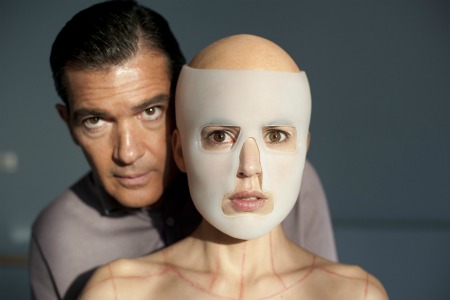
 On a massive flatscreen, Dr. Ledgard studies a closed-circuit television feed of Vera, the woman he has locked in an upstairs room in his palatial home. She wears nothing but a neck-to-toe body-stocking, and spends her days reading books and half-heartedly trying to trick Ledgard’s maid (Marisa Paredes) into giving her sharp objects. These requests are rebuked with a weary tone that suggests this trick has long since gotten old. Through director Pedro Almodóvar’s lens, we watch Ledgard (Antonio Banderas) watching Vera (Elena Anaya), and Almodóvar’s window into his work of art turns out to be no less obsessive, meticulous and distanced than is Ledgard’s attitude towards his own creation.
Ledgard is a renowned plastic surgeon and researcher, and at the film’s start he is lecturing about a new technology for creating an organic synthesized skin that is indistinguishable from, yet far more sturdy than, normal human skin. This would be a breakthrough for burn victims — like, for instance, Ledgard’s wife, who we discover barely survived a car fire years before, and then killed herself when she finally glimpsed her reflection and saw her disfigurement. He claims that he’s conducting his research on mice, but it quickly becomes clear that the woman locked up in his home is his effort to move progress along faster than small mammal trials might allow.
That’s just the tip of the nightmarish iceberg Almodóvar slowly reveals over the course of the next two hours. The director has suggested that this is his first foray into horror filmmaking, but don’t let that make you think that this won’t be immediately recognizable as an Almodóvar film. His monsters are suave and sedate. His sets, with one notable exception, are not dim, grimy basements, but bright, colorful displays of ostentatious wealth. Fashion giant Jean-Paul Gaultier would never allow his couture to be sullied in a Saw film, so his elegant hand dressing these actors should give you a sense that this is no less classy than the rest of the director’s latter-day output.
 The glossy shell of the design and grace of the filmmaking serves to shroud and slightly soften the impact of shocks more in line with the director’s more outré early work. The combination makes for an utterly engrossing intellectual exercise, even if it also limits the degree to which one can really connect emotionally with the film. It’s impossible to talk in any detail about any of those reveals, or even any of the second half of the film — which is built around dual flashbacks, one from Vera, one from Dr. Ledgard — without completely spoiling everything.
But we can talk about Banderas’ performance, which is closed and shielded so tightly that not even a scalpel’s blade would be able to slip in and pry it open. This is a psychological thriller in which the psychology of the character who is — for most of the movie, anyway — central to the story, is completely inaccessible. It’s not that he’s wooden. Just like everything else in this movie, this performance is exactly what the director wanted down to the last blank-faced detail. It just goes no deeper than the skin, which is perhaps a little joke the notoriously sly Almodóvar is playing on the film’s subject.
Even Vera, long suffering up in her room, a prisoner for over half a decade as the movie opens, seems oddly impenetrable for much of the film. The director even literalizes this notion in a terribly awkward sex scene that follows close on the heels of a bizarre rape sequence — one of two of two rapes in the film, and more to add to the long list of sexual assaults in the director’s filmography. Sexual roles and power dynamics are at work here as they often are in Almodóvar’s work, as are a few other touchstones that can’t even be mentioned for fear of spoiling things.
There is little to love about The Skin I Live In, but there is so much to admire that it’s impossible not to enthusiastically recommend. Despite the lack of emotional affect, the film elicits enormous and uncomfortable tension. The crawl of the credits is like one long exhale. Most importantly, it’s a film that sticks with you for a long time afterward, owing perhaps to how it leaves so many questions about its characters unanswered. The film may remain as untouchable to us as Vera is to Ledgard when he watches her on the screen, yet just as he is, we are powerless to be anything but transfixed by the images.
—
The Skin I Live In
Directed by Pedro Almodóvar
Written by Pedro Almodóvar, based on the novel by Thierry Jonquet
Starring Antonio Banderas, Elena Anaya, Marisa Paredes, Jan Cornet
Running time: 117 minutes
Rated Rated R for disturbing violent content including sexual assault, strong sexuality, graphic nudity, drug use and language.
Opens today at E Street, Bethesda Row, and Cinema Arts.