 Lenorable is possibly the best band we could profile on Halloween weekend — and not only because they have an upcoming show on October 31st. For one thing, all of the songs on their first EP are based on poems by Edgar Allan Poe. (They even did a Poe House benefit show recently at the Velvet Lounge.) The song currently streaming on their website is actually based on the work of Kafka, and as such, are unsurprisingly dark. Lisa Reed’s rollercoaster vocals run the gamut between commanding imperiousness and wild fearfulness. However, it always seems to fit in with the noisy guitar screeching that Ian Graham plays atop catchy driving synthy lines.
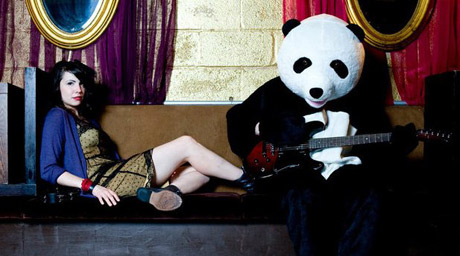
It’s not nearly as kitschy as it may sound upon reading the last paragraph. While the work draws inspiration lyrically from great works of literature and stylistically from greats like Joy Division and Sonic Youth, the songs sound entirely original. We talked to Reed and Graham about the Poe inspiration, their glow in the dark vinyl and why Graham is dressed like a panda in their press photos.
Find them online: http://music.lenorable.net/
See them next: Monday night, at the Black Cat Backstage with Dance for the Dying and Loose Lips.
Where did you go to school?
Ian: University of Montana.
Oh, yeah. You’re from nowhere near here.
Ian: I’m from nowhere near most places.
When did you move out here?
Ian: 2008. Early 2008. And you moved here a few months after me.
Lisa: And I was going to school in Mississippi.
Where do you work?
Ian: I work out at Fort Meade. I’m a defense contractor.
Is that how you ended up moving out here?
Ian: Yeah. Chasing a job, pretty much. Had some connections because both of my parents are in the military, so I knew some people who knew some people who knew where some job openings were. It wasn’t easy getting a job at a newspaper in 2007.
I noticed. Lisa, how did you end up here?
Lisa: I joined the military after high school just because I tried school and I wasn’t ready for it. I got out of that, moved to Richmond but I didn’t know anybody from Richmond. RIchmond is a hard place to be in if you don’t know a ton of people. It’s very connnected. So, I moved back to Mississippi to stay with my parents because there was school. Unfortunately, I moved there two weeks before Hurricane Katrina hit. I was going to go to school on the coast and then I was like, “I’m not staying here.” So, I went and hour and a half north to USM’s main campus, and I got involved in Amnesty International, and I studied in Tibet and India, and then took an internship here with the International Campaign for Tibet.
So, you’ve been all over the place.
Lisa: It’s nice to have a very varying environment. I kind of really get a kick out of it, trying yourself out in different places just to see if you can in the first place. That’s what the military was for me, that I wondered what that would be like and whether I could actually do it.
Had both of you been playing music before you ended up here?
Ian: I had been playing since I was maybe, two. My parents started me on violin lessons. So, I played that when I was really young and then stopped.
Lisa: His mom calls him a phenom.
Ian: Does she? Then they got me on piano lessons for a few years and I quit that because when you’re in fifth grade, piano lessons are terminally uncool and then by the time you’re 17, 18, 19, you’re like, “Damn, I wish I played piano again. I wish I would have stuck with that.” Then, I did the orchestra in high school and went back to violin. I played upright bass for awhile. I picked up guitar in high school and we had a band. It was this awful punk-ska thing. In the early 2000s that was everyone’s high school band. That broke up. I went to school and started skateboarding a lot more and playing music less. I didn’t play for a band but I wrote for the school paper. I was in journalism school and did arts and entertainment.
Then, when I moved out here, the first thing I did was buy a new amplifier because I’d sold a whole bunch of stuff to move here and got on Craigslist and started a band with a bunch of friends that I met on Craigslist. It was fun. It was a pop-punk band again. It was cool because none of us had known each other. We were all from pretty different places. The drummer had grown up in the Riverdale/College Park area. The bassist was from Centreville. The singer was from New York and I was from Montana. None of us knew anyone and didn’t know each other until the band, and we broke up after a few years. Then [Lenorable] got together. Oh yeah, and I was in Lightfoot for six months or so. I played bass. I was in the band until May or June and I was still in the other band, Deville. We played some big shows but we were bad at keeping fans. I think our sound wasn’t really right for a lot of people. If we had been in Fairfax and playing at Jammin’ Java a bunch, we probably would have had a huge high school crowd. Our singer was pretty obsessed with Paramore and Rihanna and stuff.
Lisa: I feel like they could have done so well in so many areas but pop-punk in D.C. just doesn’t work.
Ian: If we had been in Orlando we would be huge. We put out an album sort of post-humously and I feel like if we’d been in Florida or Southern California or somewhere that we could have tapped into high school kids going to punk shows at the community center, people would be more into it. Then, I joined Lightfoot and then we started writing together. If memory serves me correctly it’s because I wanted to write some more songs but I hate my own lyrics. She had written some poetry so I was like, well, why don’t you write lyrics?
Lisa: They were goofy songs. “I want to hug a dinosaur” is the one that we try to put as much distance from.
Ian: Those demos ended up sounding like the more poppy Sonic Youth sounds. It was like pop-punk guitar with electronic drums and then I was just doing these weird other stuff for lead guitar — just making noise. We played three songs at my friend’s birthday party at Red and the Black. People liked it and we decided we were going to keep writing. We wrote a few more songs and spent most of this year making our way into our sound. We started with that but we both have big diverse backgrounds so we’re like, “What do we want to do with this?” We knew we wanted to have a duet and weird guitar and electronic — something.
Lisa: We both had pretty different ideas and that is what has made it kind of interesting.
Ian: And I was just trying to write different things than I was writing. So, we had stuff that was maybe more inspired by Bowie or Arcade Fire or something epic ballad-y, almost. When have we settled into what we’re doing now? Have we settled into what we’re doing now? I guess at the beginning of this year we started writing some new songs and we were still not on the same page but the songs were simple enough at their core that we could tweak this or that and change the sound. So, a song that I had originally wrote kind of in that same Sonic Youth-y vein, I tweaked the guitar a bit so that it was suddenly more dark.
Lisa: Which is what I was pushing for because I like The Cure and Joy Division.
Ian: So, it was a lot more Cure. I tried to do a Johnny Marr Smiths guitar sound with it but it sort of went more in that post-punk/goth/darker area. We both liked that so we stuck with it and that’s what we’ve been doing since.
Lisa, had you been doing music before?
Lisa: No. I had actually done theater in high school and was told by a vocal lesson teacher that I shouldn’t sing and that I should play piano instead. I was convinced that I was really bad so I kind of made my way through musicals but wasn’t really excited about them. Then, I hadn’t done anything until we started working together. I didn’t sing anything. It was kind of weird singing where he could hear it, to me, at first because I wasn’t used to it. You can tell in our very early songs how uncomfortable I was because I was more, like, yelling. So, it’s been interesting. My voice sounds different just from last year to this year. It’s strange.
What’s changed besides less yelling?
Ian: She has a really good vocal tone and you can hear that in the early songs but she wasn’t comfortable actually singing.
Lisa: And I was a huge fan of punk, so I kind of wanted to sing a little lower. I think that I was writing stylistically in a certain way and I think my voice developed into what we were writing.
It seems like there are a lot of literary and cultural reference points in your songs. For instance, I realized that you learned the Twin Peaks theme song.
Ian: We were obsessed with that show this summer when it was too hot to go outside so we just stayed in with the air-conditioning on and stayed up all night watching Twin Peaks on Netflix.
Lisa: We also have a cover of “In Heaven” from Eraserhead. That’s one of our favorite covers. The Lady in the Radiator song.
Ian: And the reason we actually are involved with this Poe benefit is because the EP we’re getting ready to release is based on Edgar Allan Poe stories. We went up to Westminister up in Baltimore where Poe is buried.
Lisa: And I’d been going up there for Poe events. I had been to a few Poe events before that.
Ian: And they have the birthday party celebrations up there. So we went up to his birthday up there in February or January and that’s when the guy made the formal announcement that because of budget stuff, Baltimore was going to cut funding for the house by 2012. So that sort of inspired Kai, who’s running the benefit, and we were up there with her. So, we had a recording session lined up.
Lisa: She didn’t really mention a benefit. We weren’t aware of a benefit. We didn’t write the album with a benefit in mind…
…But the benefit idea sounded appealing because you had written the album?
Lisa: Right. I’ve just been a fan of Poe for a very long time as many people are. And if you’re doing a concept album like that, it’s interesting to have somebody else’s ideas. It’s kind of weird.
Ian: It’s kind of a cool writing exercise to take someone else’s story and turn it into your own story.
Lisa: And all my songs are in first person as one of the characters.
Ian: Originally, we were going to write another EP based on Kafka. On Metamorphosis. Our song Metamorphosis and the song it’s paired with on Bandcamp, Born Again, were going to be the first two songs on that. We sort of have tabled that but have kept the song.
Lisa: It’s not just Kafka. Kafka came in mind for that but I really like writing about alienation. I think a lot of people identify with that and I’ve felt it in my life. It’s kind of a way to inspect yourself.
Was the band name after the Poe character?
Ian: No.
Lisa: My middle name is Lenora and my friend had a nickname for me called Lenorable and then Ian thought that was a good band name.
Ian: We couldn’t think of a band name and I saw that she has that in her email address so I was like, “Why don’t we just go with Lenorable?” It kind of fit with the Simpsons thing where you say it once and you think it’s clever and then it kind of settles in. What did they call theirs…the B Sharps? You’re like, “Oh yeah” and afterwards it sort of works.
Lisa: I suggested that we call ourselves The Lenorables, but Ian specified that he wanted it to be an idea.
Ian: I tend to not like naming bands The (Something)s. I don’t have a problem with people who name their bands that. It works.
Lisa: It doesn’t really go with our style anyway.
Ian: But a lot of people have assumed that. Before people know about our songs they’ve asked, “Oh, is that a Poe reference?” Then we go, “Actually, that song we just played is based on ‘Ligeia’ by Edgar Allan Poe.” They’re like, “Really?” People really like Edgar Allan Poe.
Lisa: But there’s so much in his stories. There’s so many different directions that you can go with that and what you can take. And ‘Ligeia’ is the only one of those three that has any reference to the story. The other two are “The Prince” and that’s based off of “The Masque of the Red Death”.
Ian: I think it’s an interesting story. Especially now with a lot of the Occupy Wall Street stuff going on, because it’s totally about this prince that thinks he can escape the Black Plague by getting all of his royalty friends together and locking the door and locking the poor people out, because they’re the ones who have the plague.
Lisa: One of the lines is “Fortune brings a certain fear.”
Ian: So, there’s panicking about an uprising or something like that. And in the story, someone gets in who has the plague but they walk around with a mask on so you can’t see their face.
Lisa: The other one is called “Inquisition” and that’s based off of “The Pit and the Pendulum” which is a first person starting with someone who just discovered where they are in the pit and working through that and working out of the drugs that they’ve been put on and how they felt.
Ian: It’s an easy way to sort of get a feel for writing darker, weirder stuff, especially for me ’cause it was a totally different thing, so I was like, “These lyrics are kind of fucked up. How can I write something that’s going to be appropriately unusual and weird and sort of jarring in some cases. “The Prince” is pretty poppy and “Ligeia” is meant to be a dance song, but, “Inquisition”…we slowed it down and the guitar part is really sparse and not meant to be a normal progression.
Lisa: People have referred to it as more experimental.
Ian: It’s more experimental sounding. We throw some weird jazz chords in there. There’s added on notes that give it a bit of dissonance.
Do you like having that variety of sounds?
Ian: Yeah. It’s fun because even if we just think of the bands that inspire us in that genre, it ranges from the Bauhaus and Joy Division to Smiths and Gang of Four to…
Lisa: Freddie Mercury.
Ian: To Queen and Depeche Mode. Everything from synth pop to The Rolling Stones kind of works their way in. We’re actually working on a cover of a Rolling Stones song that’s done in a more intense Depeche Mode song kind of way — very synth heavy and slowed down a little bit. It’s fun for me to do that just as a musical exercise. Download a chord sheet online, learn the song the way it was meant originally and thinking, “Okay, how can I fuck this song up?”
Lisa: But it’s interesting because I write some of the melodies for keys and I don’t know notes. I don’t know anything about music. I have no experience.
Ian: We have a copy of Music Theory For Dummies which hasn’t been opened.
Lisa: But we have a pad control so he could put it in the key…
Ian: …program the right notes.
Lisa: It’s a touch thing and then I took that and just came up with some stuff. Also, hearing, sometimes you can hear harmonies that aren’t really there. Maybe it’s a little feedback, but you can go off of that and turn it into something.
Ian: It’s gotten to the point where I’ll be playing a guitar part and I’ll record some stuff and she’ll listen and be like, “Did you hear that?” “Hear what? There’s the guitar and there’s bass and there’s drums,” and she’ll sing something and I’ll be like “Sing that again” and I’ll grab a keyboard and write it down and play it real quick and record a loop.
What do you usually play when you do this live?
Ian: Right now, it’s just me playing guitar and the synths and drums and everything are programmed in a computer. We use Ableton Live. We’re using the cheap intro version, but we haven’t even been able to get into all that it can do. I always thought it would be cool to do vocoded stuff as vocal accents. So, like when Lisa would be singing a chorus live, maybe having a vocal backup, but as a keyboard run through a vocoder.
Lisa: And I’ve been struggling with that because I like the freedom that I have with no instruments, but at the same time, I’d like to be playing keys. So we’re going to start working on that where there’s keys and noise in between songs. Just, more atmospheric than directly contributing. We’re trying to work in some pedals, too…
Ian: …with some vocal effects that she can control live. Basically, a bunch of my old guitar pedals and just getting the right cables to run her mic through it. So, then she can just stomp on a chorus* pedal or stomp on an echo pedal.
Lisa: It’s a little bit more difficult to take up the stage when you have two people, so I guess we try to think of things that can achieve that.
What’s something that you’ve found that has worked pretty well for you so far? Are you very mobile onstage?
Lisa: I’m not very mobile.
Ian: If anything, she’s got an old sort of vampy kind of thing, like a little flirty sometimes, but not super overt. Going back to David Lynch, kind of how Isabella Rosselini* was singing “Blue Velvet,” kind of like a lounge singer. And we’ve got that old Shure microphone. So, she stands up there and holds onto the mic and sort of just gets into it like she’s right there with the mic. It’s not as active but it’s engaging, still, because she’s intense. All of her focus is just there on singing that song.
Lisa: Partially because I’m very shy.
Ian: That works. And then, I sort of do the same thing. I’ll wander around the stage a little bit, but mostly I just try to stay behind her and play guitar. I’m a little bit anchored because I click a bunch of effects on and off during the songs. So, I’m not running around climbing on rafters or anything.
Lisa: But, you can do a lot with just a mic stand. I know that sounds kind of weird, but I’ll stand on the mic stand and I definitely use it very much.
Ian: I think as she gets a little more comfortable, there will be more Freddie Mercury-inspired stuff. She won’t be prancing around the stage in a cape and crown.
Lisa: We’re still in our experimental stage. We tried a projector for one show and then we realized that our projector was really shitty. We picked it up at TJ Maxx. But, we made an entire video — just a mixture of things that we had recorded. Then, there’s also an Alice in Wonderland from a Czech version of it. It’s very dark. It’s awesome. It uses dead stuffed animals for all the animal characters.
Ian: It’s creepy but it’s amazing. It’s also narrated, kinda, by the girl who plays Alice. But then when they have dialogue, she’ll say something and then it will cut to the girl’s mouth and she’ll say, “…said Alice.” It’s not a movie you can settle down and watch. You’re always a little uncomfortable watching it. That’s why we thought it would work really well with our show and I think it would…
Lisa: …but we’ve done a lot of art and stuff as well. We have one video where we have a me watercolor painting time lapsed. So, I painted it and you can see the entire development. It’s really interesting with watercolor. I like to watch it because of the way the colors spread.
Ian: That was like, two hours of painting or something condensed into two and a half minutes.
Lisa: More like 45 minutes. We’ve made a few of our videos, too, which I like because I feel like we’re going to be putting a lot of our focus on videos. I think that’s where our expression comes from. It’s kind of hard to show the real darkness live. It’s a different way of showing the darkness.
Ian: Live, you can put off a dark vibe by having fog and the right colored lights. If you have red lights and fog or blue and green lights and fog you can get this sort of dark weird vibe onstage. But, if you don’t have the money for a laser light show and a bunch of fog machines and you just have two people carrying in a bunch of crap, it’s a lot harder to do.
Lisa: We want to keep it very simple. Like, the video we put out for Ligeia, I’m standing there and he’s standing there. There’s not a whole bunch of movement. And it was all shot with the iPhone which was really cool. But, people have said that it makes them uncomfortable. One friend said that the music was kind of scary. We took down the quality of it and we put two layers. He’s playing in one layer and we recorded at two different times.
Ian: So, it’s sort of got this off kilter look, because the angle is slightly different, but the room’s pretty much the same. But, because we shot the whole room and then cropped each other’s video out, she can actually fade in and out. There’s a part where she actually flickers out of the shot. I have a few coworkers who are older and maybe a bit more conservative and one guy listened to it for about ten seconds and was visibly disturbed. He was really weirded out by it.
Lisa: I don’t want to totally weird people out, just make them sort of uncomfortable. But, it’s a different way of expression and I think it can be just as much a part of the art as the music itself. So, we’re trying to combine that. We’re going to try to put out stuff we make.
Ian: Everyone’s kind of doing everything right now in music to try and get their name out there. Portishead got their big break scoring a movie and now everyone loves them. But, it was that movie that got people listening to them and then that started everything.
Lisa: Although, the first music video we did was a last minute thing when we were on Christmas vacation last year and there was a song by Basil Marceaux.
Ian: Do you remember that dude who was a congressional candidate in Tennessee and he was batshit crazy and it’s hard to tell the first time you watch whether he’s making fun of people or if he’s weird and not quite there. He kind of jumps around from point to point like he’s trying to remember his script and he’s trying to see if he’s nervous on camera.
Lisa: But, he had somebody else write this song for him and they made a little video.
Ian: It’s a Christmas song.
Lisa: It’s a Christmas song, so we actually made a spoof of it, because, honestly it’s kind of good for marketing.
Ian: We were getting insane traffic on our Facebook page because tagging a few of his fan pages and saying, “Hey, we made a video!”
Lisa: Actually, the author of the song contacted us because it’s hard to understand him, so, we had some words wrong. But, then he said that if we ever wanted him to write a song for us to do in a video again, that he would. It was really strange. But, we made it very different from the original. It was one of our first more techno songs.
Ian: I think I was listening to the Tron soundtrack a lot, so, very low bass. We put it on a — her dad has a really big TV with a nice soundsystem. It’s hooked up so you can watch Netflix and YouTube. So, we pulled it up on YouTube and hit the play button and it shook the room. We had to turn it down because we were worried that it was going to blow up the subwoofer or something. So, we went that far and knew we could tone it back from there and it’s worked really well for us.
Lisa: And the video is kind of a spoof of it so it’s interesting.
Ian: Someone on YouTube commented, “This is what hipster Christmas looks like” or “This is indie Christmas.”
Lisa: I have an apron on in one of the scenes. I don’t know how that coud be.
Ian: It’s just all goofy and weird.
Lisa: We had fun. It wasn’t something that was serious or anything. We were just on Christmas vacation in Mississippi where there’s not as much to do, so we were like, “Let’s make a music video!” It took our entire vacation working on that.
The first time I met you, you mentioned that the vinyl for this album would be glow in the dark?
Ian: 100 of them are. We’re doing a run of 300 and 100 of the 300 will be glow in the dark.
How did you come up with that idea?
Ian: We just saw it on a website. I think the first place we saw it…Third Man Records might have done something glow in the dark.
Lisa: I had never seen it. I was just excited. So, we started a Kickstarter campaign where we raised all the money for putting our vinyl out, which was really nice, because it really is a kickstart. If we can not as monetarily invest in the first one, because we don’t have that kind of money, we can make the first record and we can sell that and hopefully be able to sustain ourselves.
Ian: There will be 100 made, but because of the Kickstarter, I think 25 people already have dibs on one, so there will be 75 left. I’m excited about it.
So, when do you release the vinyl?
Ian: Shortly after we get it into our hands.
Lisa: We’re starting the process with the vinyl company, but…
Ian: It takes six to eight weeks.
Lisa: They have to send the vinyl back to you to see if it’s good. That’s actually another thing. People on our Kickstarter can get test pressings.
Ian: It’s two to three weeks to get the test pressings back and to listen to them and see if they’re okay or not and if they’re not okay, do another round of test pressings and so on.
Lisa: So, we’re hoping that for Halloween, because we’re playing Black Cat Backstage. We bought costumes. I’m going to be a goth sailor and he’s going to be a shark. It’s also kind of an inside joke for our band because he’s dressed up as so many animals. For our main picture, he’s dressed up as a panda.
I was wondering about the panda. What’s the story behind that?
Ian: Random.
Lisa: The photographer had rented it and said, “I have a panda costume.”
Ian: We ended up winning a photo shoot in a raffle from our friend Malta who’s an amazing photographer. That photo actually ended up in Vogue Italia.
Lisa: He’s actually holding a benefit where he re-rented the panda costume and he’s going to let people try it on and take pictures.
Ian: It’s also ended up in Washingtonian and he’s gotten lots of feedback. “Oh my god, I love the panda!”
People in D.C. love their pandas.
Lisa: It’s also on the metro.
I saw that, too. I half-wondered if it was a local in-joke.
Ian: It wasn’t, but it turned out that way.