Martin Austermuhle
If you walked into what are commonly known as “head shops” in the District, you could legally buy yourself a large water pipe — but a visible disclaimer would let you know that it could only be used to smoke tobacco.
Foolish as the disclaimer may seem, it represents the fine legal line between what’s allowable under District law and what constitutes drug paraphernalia. It’s that fine line which may have served as cause for the four raids on local head shops that took place last week — three in Adams Morgan, one in Chinatown — and yielded 10 arrests.
Last Wednesday, police simultaneously raided two Capitol Hemp locations, seizing some $300,000 worth of merchandise that included expensive water pipes and other smoking devices. Seven people were arrested; a police report of the raid on the Adams Morgan location said that “paraphernalia found was in such a copious amount” that three employees were charged with possession with intent to distribute drug paraphernalia.
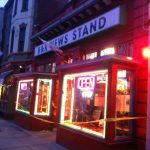
Two days later, two other Adams Morgan head shops — B&K Newsstand and Shiva — were similarly raided. Three people were arrested, and police spent hours taking inventory of pipes, vaporizers, scales and other products, covering them in bubble-wrap and putting them in boxes.
The raids were executed under search warrants that were part of an “ongoing” police investigation, but police officials have repeatedly refused to comment on what they were looking for or what provoked the raids. All but the Chinatown Capitol Hemp location have re-opened, though the glass cases where the pipes once stood remain empty.
Depending on who you ask, the raids were other a fully justified crackdown on the sale of what most people would see as bongs used to smoke marijuana, or a waste of police resources used against small businesses that have to obey a law that is vaguely worded and open to interpretation.
District law only narrowly distinguishes a water pipe from a bong. Selling a water pipe is perfectly legal, but it becomes forbidden drug paraphernalia when “direct or circumstantial evidence” serves to prove that a salesperson would “reasonably know” that it would be used to ingest a controlled substance (that is, illegal drugs). Hence, all the disclaimers at head shops, and why head shops sell tobacco — if a shop can’t show that 25 percent of its sales come from tobacco, it can’t even sell rolling papers.
D.C. police and officials have long played a game of whack-a-mole with drug paraphernalia, moving to prohibit items used for illegal drug use as quickly as they make it to corner stores. In 2006, it was the rose pipe, which police claimed was used to smoke crack. Just last year, the D.C. Council passed legislation prohibiting the sale of “blunt wraps,” or large rolling papers they claimed were used to smoke marijuana or PCP.
Retailers and producers haven’t been happy with the prohibitions and crackdowns. People close to Capitol Hemp argue that anyone mentioning illegal drugs would be asked to leave the store, and that a large part of its sales was in loose-leaf tobacco. Earlier this year, Kentucky-based National Tobacco Company — makers of Zig-Zag rolling papers — sued the District over its rolling paper law. (The District argued that, because of technical inconsistencies in the law, it wasn’t even enforcing it, but a court ruled that the suit could still proceed.)
The issue of proving intent has also been controversial. According to some libertarian thinkers, proving that someone intends to sell a pipe for illegal drug use comes dangerously close to stepping on the First Amendment. According to an individual with knowledge of the raid on the Adams Morgan Capitol Hemp, police took interest in books and DVDs on marijuana and the drug war. Would a book alone, or the sale of hemp products, offer enough evidence of intent regarding the use of a water pipe?
The District’s laws on drug paraphernalia have survived legal challenges in the past, though. In August, the D.C. Court of Appeals ruled that the law was sound, rejecting the claims of two gas station operators who were arrested in 2007 for selling “ink pens,” or glass tubes police claim could be used to smoke crack. The court stated that intent could be proven with only circumstantial evidence, giving the government ample latitude to determine what’s paraphernalia and what’s not.
These aren’t insignificant distinctions for some. Chris McCalla, legislative director for the International Premium Cigar & Pipe Retailers Association, told DCist that they do not condone the sale of paraphernalia, nor do they allow it in their annual trade show. If it doesn’t meet certain specifications, they see it as paraphernalia, no matter what retailers argue. McCalla made a specific exception for hookah, which he cited as a growing and legitimate way to smoke tobacco. (Hookah pipes sold at B&K and Shiva were not seized by police.)
But for a city that’s about to launch its long-awaited medical marijuana program, wouldn’t a crackdown on the vendors of the very means to ingest it seem contradictory? Yes, but D.C. officials are prepared for that — the rules regulating the program allow for the sale of paraphernalia in dispensaries.
Whether or not anything comes of the raids remains to be seen. While Capitol Hemp may be most interested in getting its merchandise back — computers were also seized, making simple tax calculations more difficult — it also has to contend with the fact that several of its employees that were arrested were charged with possessing small amounts of marijuana. They have since been fired, having violated store policy. (A call to the store’s attorney was not returned.)
As for B&K, it has been raided before. In 2003, a store manager was arrested in connection to a stolen goods operation allegedly run through the store. In 2008, a second B&K location at 10th and F Streets NW was shut down after its owner was found to have been selling 36 stun guns, which are illegal in the District.
In short, if you’re looking for a water pipe or vaporizer any time soon, the District may be a tough place to find one.