 “It’s more than you think, if you’re willing to explore.”
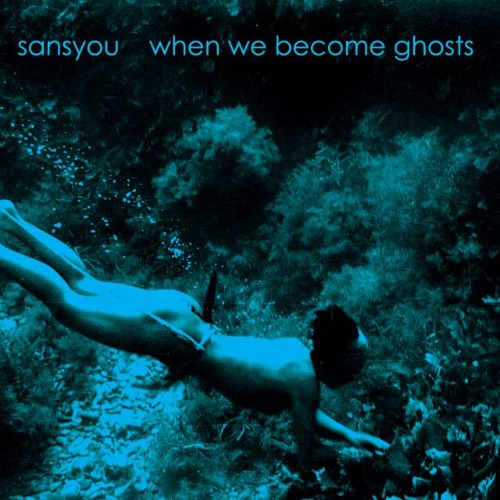
Sansyou guitarist David Nicholas said that in reference to the current state of D.C. music, but he may as well have been talking about his own work. The lush, dreamy dual guitar seems to mirror the journey of the Japanese pearl diver in the cover art for their EP, When We Became Ghosts. The tempo rises and falls and occasionally meanders, complemented by the reverberated percussion that gives the music an additional otherworldly sense.
We talked to Nicholas earlier this week about the Japanese cultural influence on both the music and the band’s name, and the inspiring photos that appear on the band’s album packaging.
Find them onilne: http://www.sansyoumusic.com
Buy their music: http://sansyou.bandcamp.com
See them next: At Galaxy Hut on Monday with Janel & Anthony.
One thing that surprised me after hearing the record was discovering that only two of you played on it.
Right. It’s myself and Matt, and Matt added piano parts as well as hand percussion. So, there’s just the two of us. Since the CD, Davis White has joined us on percussion.
Is it at all difficult recreating that sound live?
Actually, the recording is almost live in itself. There’s really no multi-tracking except on one cut and other than Matt adding on a layer of piano and percussion, because you can’t play that and guitar at the same time, the guitar parts were recorded basically live, the two of us together. So, it actually ended up being a really accurate presentation of what we sound like live.
One thing that struck me about that percussion, particularly on “Ama Descending” — it sounded like you actually put some reverb on that percussion. The effect made it sound like a more grandiose hit.
Yeah, there’s reverb on the percussion. I think there’s probably some reverb touches on the piano parts, too. It just fit in with the sound. When we were mixing it, we thought about adding different kinds of reverb, so we found one that worked and it sounded accurate to what the song needed. You’re right, there is reverb on the percussion that adds space for the track.
This album seems very conceptual. Was that the intent?
It’s funny, the theme kind of emerged along the way. I know that I really loved the artwork, the photography of Fosco Maraini, which is what you see represented there. I knew that those photographs meant something to me in terms of that suspended, flowing quality that you see and I wanted that in the music. Actually a cycle, a feeling of descending and then staying down at the bottom and then ascending back up kind of emerged in a very loose concept of a cycle — how one might go through space in a downward spiral and be reborn up and back out at the end.
That was just sort of the feeling and I thought about the piecing of it. You go through different lights and shades and darknesses and textures throughout the recording. It’s only eighteen-some minutes, but we get into a lot of different shades of dark and then some light. It’s hard for me to say that there was a central concept, but it’s a very loose, cyclical one is what I ended up feeling when I was done with it and looked at it all in one sitting.
Where did you first see the Fosco Maraini photography?
The whole concept of the pearl diver, or the ama diver as they call it, is something I learned about on a trip to Japan last year and found out about this really amazing culture of women in Japan who would harvest the pearls with very little technology to go on. It was a really compelling story about this culture that lived very close to the environment and was uniquely female. So, I had heard about that and was pretty interested in that as a story itself and then I saw the photographs and really wanted to pursue using them but with permission — in the right way. I didn’t want to just take them off the web.
So, I actually had to find the book that was first published that contained those was out of print. The photographer, Fosco Maraini, had passed away in the ’70s. I was really desperately seeking for a way to get permission for this. I found out that he has a surviving daughter who’s a playwright in Italy. An Italian-speaking friend put me in touch with her to request permission. It turns out she doesn’t own the rights to the photos that her father took, but the Ministry of Culture in Italy does. So, I requested from their photo archives the use of these two pictures that you see in the packaging. They granted it and that was able to put the whole picture together for me what I wanted to see in the whole concept that you were talking about earlier of beginning, middle and end and a cycle of ascending and descending. That was important to me that we did it and did it the right way and gave credit where credit is due.
How long did that entire process take?
Tracking down and researching the photos was maybe a couple of weeks, to go back and forth with the institute in Florence that granted the permissions. Probably two or three weeks, all told. The packaging work and fabrication was part of the pressing of the CDs, too. I was lucky to have a friend who speaks Italian, otherwise I would have never made it.
Had you made the trip to Japan before your benefit for the Japanese Red Cross at Marx Cafe?
That was before. I had really been impressed. The whole trip was important to me. My wife is Japanese, so it was an important trip for us to take together. Then, when we came back months later and realized that these disasters had occurred and touched on places we had visited, I just knew that there was something we could do as a band and got together with other DJs and artists and put together a night that raised some money for Red Cross Japan. That was really a small thing that we could do, but an important one for me, personally.
It sounds like the current sound of Sansyou is not the original sound that the band was going for.
Right. We were really an acoustic unit to start and one that used cello and acoustic guitar and hand percussion. I think we really enjoyed that experiment to see how far we could take that sound. We played some shows around D.C. with that lineup. We did some recording but didn’t release it. That was a good test for me, too becuase I had been playing with previous bands, always electric and needed to try something different with acoustic sounds and it was really fun to work with cello. Doug Stailey is the cellist that we worked with and he’s embossed in different projects himself, around town, working in the improvised and noise areas. So, we wanted to pursue something differently. I wanted to plug back in, go electric and work in just a trio, two guitars and hand percussion. That’s how we evolved into the sound you hear now and that really came together in the early part of 2010.
It sounds like a very different sound from at least one previous band of yours, Flume.
We stopped as a unit in 2002 or 2003, I think, so it’s been a long time. I think the Flume sound was really straightforward jangle pop sound that I wanted to capture and get out of my system. I had a whole bunch of those types of sounds and songs that I wanted to document and we did it. The Flume record is a pretty good representation of what I was thinking along those lines at that time. We all move on to different projects, and I’m sure the stuff you were doing eight years ago is different than the stuff you’re doing now. Evolving is a good thing. It’s a fair representation for us and the CD is still out there and that’s fine, but I’ve definitely moved into what Sansyou is doing now, which is very open-ended. I like the sparseness and the space that comes along with working in instrumental fields. Worrying about where to place vocals and making arrangement decisions that are based on vocals is something that it’s very freeing to work without and I like that. That’s what Sansyou has been able to open up for me as a musician.
How did you come up with the name, Sansyou?
It’s actually an approximation of the word in Japanese for what means giant salamander. It’s a creature that’s native to Japan that I’ve always been fascinated with as a kid. Very unique animal and there’s actually a breeding program for them now, here at the National Zoo, so I’m lucky that I get to go see them. I asked my wife what the word was for this in Japanese and she said, “Loosely, it’s ‘Sansyou.'” I said, “Wow, that looks like it means something else, but I never would have guessed that, so maybe that makes a good band name since I’ve always been enamored with this particular creature.
Are you excited about Monday’s show?
This is a good time for Sansyou to be out and playing. I feel lucky that we can play a show with a duo like Janel & Anthony, but they’re really wonderful. They’re out and active. They’re a presence on the scene, and it’s fantastic music and it’s great fortune to me that we get to play a show together. It’s lucky for me that there’s improvised music around like Lost Civilizations, Ted Zook and his many projects going on around town in which a standard rock band format isn’t mandatory anymore. You can find that if you want, but I feel like there’s a lot more open-ended space now for bands that are interested in doing improvised material, instrumental music, ambient sounds, bands like us that don’t use a traditional drum kit and use a lot of silence and space in our songs. There’s places to play and there’s an audience for it and I feel really lucky that there’s an appreciation for that sound in D.C., so I go to a lot of those shows and absorb it and take it all in as much as I can, too.
I think it’s unique. I don’t recall this kind of sound being prevalent, five, six, seven years ago and it’s a really interesting development in the scene because so many people have, I think, preconceived notions of what the D.C. sound is — and I think right now is the best I’ve seen in terms of being able to say, “It’s more than you think, if you’re willing to explore.” That’s something I’m really appreciative of, right now.