Martin Austermuhle
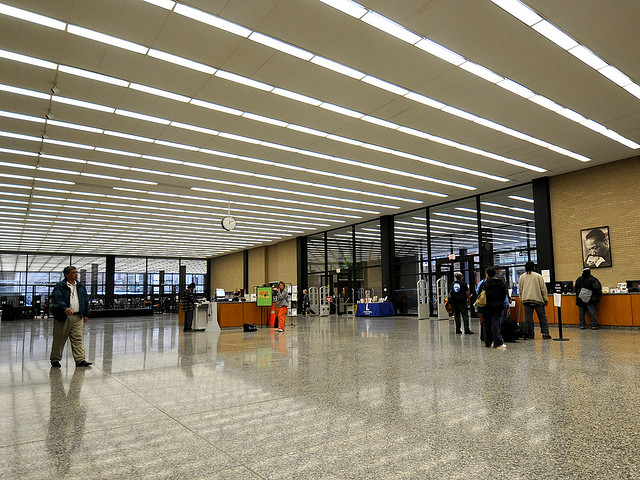 Photo by M.V. Jantzen.
Yesterday, an eight-person panel convened by the Urban Land Institute started a week-long process to help figure out what to do with a building that has split opinion among District officials and residents for years — the Martin Luther King, Jr. Memorial Library.
The problem? None of the people that might decide the iconic building’s fate are District residents.
Late last week, the D.C. Library Renaissance Project issued a press release noting that the eight members of the panel were all out-of-towners, with five being from California, and the closest from Richmond. Writing in D.C. Watch’s bi-weekly online newsletter yesterday, District resident Ann Loikow complained:
The eight members of the ULI panel are all from out of town, five from California, one from Tennessee, and one from Texas. Most are developers or architects or planners for developers (including the VP of architecture and planning for Disney’s real estate development group in France, an adviser to NBC Universal on the master plan for its back lot development, and a consultant for real estate developers of urban mixed use, master planned residential and commercial land and multifamily apartments and senior housing). Another creates marketing programs for home builders. Only one has any experience as a librarian. Another was a project manager for construction of two libraries, and one is a historical architect with some experience in adaptive re-use. Although the ULI panel is to consult with “stakeholders,” it is questionable how many citizens and real library patrons they will really consult.
The implications are obvious — the District is removing residents from a heated debate over what should happen with the library, which sits in a renowned building that has suffered from persistent maintenance issues. (Some people love the building, others hate it.)
But that the panel is anything but local seems to be the point, according to the Urban Land Institute’s Thomas Eitler, vice president of advisory services panel program.
“The fresh, outside view provided by the panel is the key to achieving productive results. We seek possibilities and opportunities that might have been overlooked. The advisory services panel program is all about seeing things a different way. Our goal is to provide practical, feasible solutions to enhance the economic and social fabric of a community,” Eitler said in a statement.
For Richard Layman, a local blogger and urban planning expert, having outside views can sometimes be a plus, especially on an issue as contentious as the future of the District’s flagship library.
“There is something to be said for having people only from the outside, because even those of us who are planners often have blinders when we approach issues in our own communities (this is true for me, and I think of myself as a decent commercial district revitalization and transportation planner),” he wrote late last week. (Layman also noted that ULI panels turned out good reports on the Anacostia Waterfront Development and Greet Street Initiative.)
Residents will have a chance to offer their input tomorrow at a meeting of the library’s Board of Trustees (6 p.m., Southwest Neighborhood Library, 900 Wesley Place SW), and the panel’s conclusion will be unveiled on Friday at MLK. Regardless of what the panel recommends, any final decision on the MLK Library will have to work its way through the D.C. Council. Additionally, Chief D.C. Librarian Ginnie Cooper has said that even if the building is abandoned, a central library in downtown D.C. will remain.