Martin Austermuhle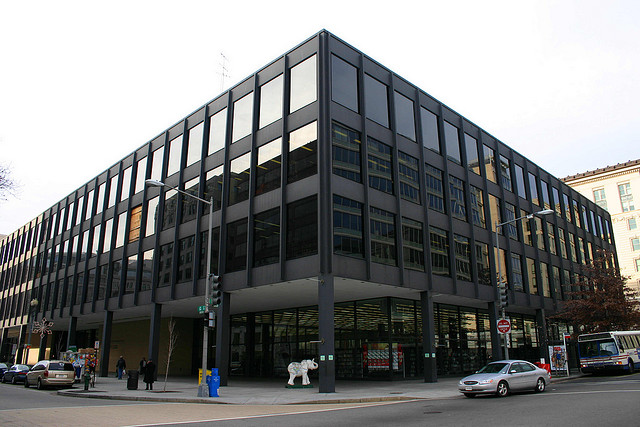
 Photo by ElvertBarnes
If the Martin Luther King, Jr. Memorial Library were moved and its building sold to a developer, fervent library advocates would complain that the District was turning its back on the iconic Modernist structure and the central location it finds itself in. If it were to remain as is, financial hawks would scream of the prohibitive costs of maintaining and renovating the aging building.
So why not just split the difference?
That was amongst one of the more intriguing possibilities presented today by a nine-person panel brought together by the Urban Land Institute to identify solutions for the city’s flagship library.
Having considered either of the two extremes, the panel seemed to settle on a proposal to leave the library in its current location while offering excess space to a separate tenant. The rent alone — estimated to bring in between $4.1 and $5.5 million a year — would help cover long overdue renovations and put space that the library admits it doesn’t need to better use. Library officials noted that while the Mies van der Rohe buiding has 440,000 square feet of space, the library itself only needs 225,000 square feet for its core functions.
Under this scenario, the building itself could see some structural changes. Two more floors could be added to the top, terracing and setbacks could be used to create a more attractive facade and outdoor space, and light wells carved out through the middle of the building would allow light to flow into what are now the darkened recesses of the library’s mid-section. There was even talk of bringing amenities like a coffee shop to the library; one panelist was especially excited with the prospect of bringing Georgetown’s Baked and Wired to the building.
According to members of the panel, van der Rohe’s original design was meant to be flexible enough to allow for the addition of floors. “If adding two floors makes this building viable in the future, I’d say Mies would be out there applauding this,” said Mimi Sadler, a Richmond-based architect.
The panel’s proposal was made that much more attractive when stacked against the alternatives. Selling the building could fetch the city between $58.8 and $70.5 million, but would require moving the library to another downtown location — preferably one already owned by the city.
Keeping the library as is would require renovations that could cost between $200 and $250 million and would not resolve the question of what to do with the excess space. Panelists indicated that city officials had already told them that the latter option simply wasn’t financially feasible.
Councilmember Tommy Wells (D-Ward 6), who chairs the D.C. Council’s Committee on Libraries, Parks, Recreation and Planning, said he was intrigued by the shared-use proposal and would work with Mayor Vince Gray to see it through.
“I really like the idea of shared-use,” Wells said, calling it a “once in a generation” opportunity. He pledged to work to identify money in the capital budget to push the proposal forward.
“My goal is to have people pay attention to this wonderful building, and to realize what we need to operate a library here. I hope we’ve started the conversation, and I’m so excited with the possibilities that they suggest for us,” said Ginnie Cooper, the District’s Chief Librarian.
Obviously, no amount of good ideas will make the District’s central library any better without committed political action from stakeholders. The debate over what to do with the building dates back to the mid-2000s, if not before, and another delay is always possible. That’s not something the city can really afford.
“This is a big issue…we urge you to attend to it sooner rather than later,” said panel chair Wayne Ratkovich.
Urban Land Institute – Martin Luther King, Jr. Memorial Library Building Presentation 111811