 Photo by mediaslave
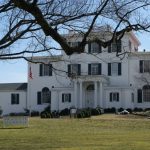
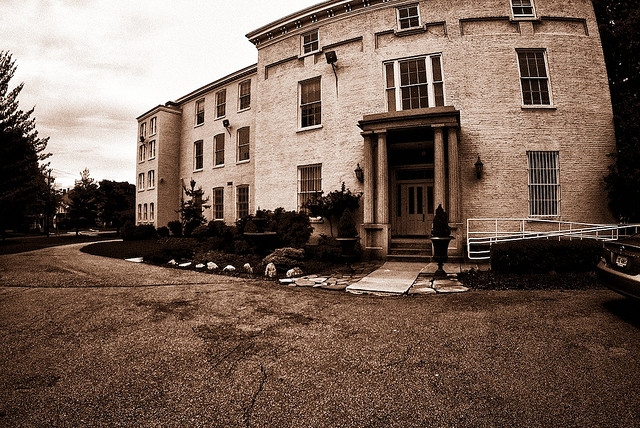
The Brooks Mansion is a regal plantation house at 901 Newton Street. The three-story Greek Revival structure was built by Colonel Jehiel Brooks for his bride, Ann Margaret Queen, and the couple called the house Bellair, the seat of their large estate. After Brooks’s death in 1886, the house was sold and the estate subdivided. Developers laid out streets, sold lots and christened the neighborhood “Brookland.”
Brooks was a prominent lawyer, War of 1812 veteran and a treaty negotiator during President Andrew Jackson’s administration. The community that sprouted on the land he once owned would eventually play a role in ensuring his mansion remained standing as a beacon of the neighborhood’s birth.
Groundwork was laid for the neighborhood when the Baltimore and Ohio Railroad ran its western branch tracks through the Brooks farmland, alongside the mansion. Shortly afterward, the railroad opened Brooks Station.
In the late 1880s, most mentions of “Brookland” referred to real estate transfers and building permits as the community started to form. They went like this: “Benjamin F. Leighton and Richard E. Pain, trustees, sold land to Martin D. Peabody, $414.37, lot 15, block 13, ‘Brookland.'”
Stories about the neighborhood started to emerge in the 1890s. From The Post:
The young gentlemen of the pretty suburb of Brookland gave the opening event of the Brookland Assembly Club in the town hall last night. It was a remarkably well managed affair and reflected credit on its projectors. Other will follow at intervals of two weeks. Many people were out from Washington, the Eckington line running two electric cars for their accommodation after the dance was over. The hall was handsomely decorated with flags and the stage was filled with palms and potted plants.
Part of the neighborhood’s identity is rooted in the culture created by the presence of Catholic University, which also lent the neighborhood a name. The university established itself in the late 1880s north of the Brooks’ farm. Between 1900 and 1940 more than 50 Catholic institutions rented or owned property in the neighborhood, and clerics and religious men and women would often walk around in their religious robes, which prompted the neighborhood nickname, “Little Rome.”
Modern Brookland pays some tribute to its history. In 1983, The Post did a piece on Colonel Brooks’ Tavern, still in business today, which is adorned with mementos from the past. From The Post:
Behind the wooden bar hangs a large framed photograph of the man for whom the tavern was named, Jehiel Brooks, made by Civil War photographer Mathew Brady. On the walls hang more recent pictures of neighborhood folk mixed with shots of the 1936 Catholic University Orange Bowl Champions, the first known aerial shot of Trinity College (made in 1922) and various Civil War scenes. Old-fashioned rail-back chairs, wooden tables and dark stained wood floors add to the antebellum atmosphere.
The Brooks Mansion changed hands many times throughout the years. In 1891, the corporation of the Marist Fathers purchased it for $20,000 to house the Marist College. The mansion was used by various Catholic Orders, included the Benedictine Sisters, and for educational purposes until 1970, when it was sold to the Washington Metropolitan Area Transit Authority (WMATA), which had every intention of demolishing it to build a Metro parking lot.
Residents fought back. The mansion survived in large part because of the neighborhood around it — they wouldn’t stand for its destruction. From The Post in 1976:
A week ago Saturday, citizens of Brookland, once a railroad commuter suburb and now one of the city’s most self-respecting neighborhoods, armed themselves with rakes and brooms and gathered at the historic Brooks Mansion to clean up, celebrate and protest. … Six years ago, it was purchased from the Catholic Archdiocese by the Metropolitan Area Transit Authority, which wanted to demolish the mansion and turn the 1 ½ site into a parking lot. As a result of vociferous citizen protests, the City Council ruled out the parking lot and directed the city government to save the mansion provided it can be put to a useful purpose.
The mansion is now on the National Register of Historic Places. Today, it’s home to DCTV. And Brookland, defined by its community activism, preserved the legacy of its namesake.