
 Martin Austermuhle
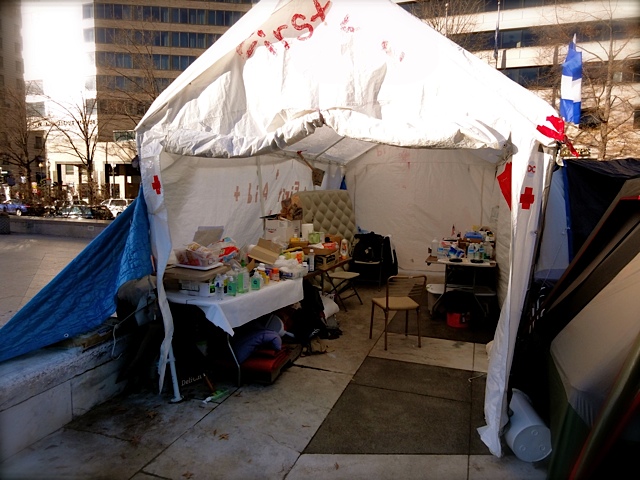 The First Aid tent at Freedom Plaza, where a team of medics concentrate on preventive medicine.
If you put enough people outside for a long enough time during the fall and winter months, someone will eventually get sick — and whatever they have will likely spread quickly. For protesters at McPherson Square and Freedom Plaza, and the District’s health officials that are carefully monitoring them, this reality underlies the ongoing challenge of maintaining healthy encampments as the weather turns.
So far, city officials have remained mum about health concerns at the two camps, despite moves by their counterparts in other cities to evict protesters due to concerns over health and hygiene. (Atlanta experienced a small tuberculosis outbreak, a persistent cough in New York came to be known as “Zuccotti lung” and a protester was found dead in a Salt Lake City encampment.)
Officials from the D.C. Department of Health have remained engaged and observant of the two camps, working with medics to identify problems and address them before they can become epidemics.
“We go and we visit them every day, sometimes twice a day, and walk through and talk to the people and see if there is any issue that may have emerged that may require some attention. Health conditions, generally speaking, are poor, because there is no running water. But otherwise, there is nobody who is in danger to themselves or is doing something that would endanger the life or well-being of other people,” said Dr. Mohammad Akhter, the director of the city’s Department of Health.
He added that the department had handed out Morbidity Surveillance Forms to the two encampments, which allow medics to more closely detail any health issues that might arise and how they’ve dealt with them.
“They pretty much take care of themselves,” said Akhter, who additionally sought to tamp down on a rumor last week that tuberculosis had become a concern.
At the McPherson Square camp, Ellie, a street medic from Maryland who was manning the First Aid tent on an unseasonably warm afternoon, said that the relationship between the city and the protesters has been limited, though good.
“It’s been a pretty beneficial relationship,” she said.
Ellie said that the medics and nurses she works with haven’t yet dealt with any serious health concerns, but recognized that once the weather turns cold for good, hypothermia will become something to more carefully watch for. There’s also more pedestrian worries, too — the medics reported yesterday that medical supplies and medicines were stolen from their tent; they’re asking for donations and a new tent to more securely keep supplies.
At Freedom Plaza, Frosty, a trained Army medic who helped set up the camp’s First Aid tent, said that the most he’s had to deal with is scrapes, cuts and “a few sniffles.” For him, prevention is the key, and he and his fellow medics keep personal hygiene kits on hand that anyone can take with them.
“I try to do a lot of preventive medicine so we don’t get sick,” Frosty said, leafing through a clinical log that the medical team keeps to better track what they’ve had to deal with. Only one person has had to be sent to the hospital from the Freedom Plaza encampment, he said, but she was homeless and had reported persistent health problems.
Health concerns may become more pressing as the days and nights get colder, and while he remains vigilant, Akhter doesn’t yet foresee any problems.
“We are always on the watch…we are fully prepared, and as long as the protesters remain peaceful, there’s not going to be any health issues that I can see.”