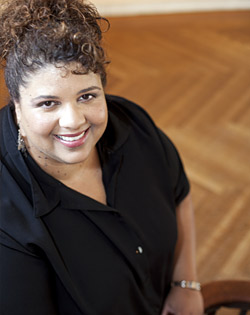
 Connaitre Miller.
2011 has been a big year for Afro Blue, Howard University’s premiere jazz vocal ensemble. They’ve performed multiple times at the Kennedy Center and collaborated with the legendary Bobby McFerrin in what was arguably the best show in the DC Jazz Festival‘s history, in addition to numerous other shows. However, all of that pales in comparison to the exposure the group received in its memorable run on NBC’s vocal competition, The Sing Off. Though Afro Blue’s season ended in disappointment, there is no doubt that the jazz choir left an impression on a national audience.
The seeds of this success were planted ten years ago by one person, Connaitre Miller, Afro Blue’s director and head of Jazz Vocal Studies at Howard. She deserves as much recognition and credit as any of those who performed on television, for it was Prof. Miller’s hard work that built the program that gave Afro Blue’s talented young artists the skills to shine.
Miller, who came to Howard in 2001, was no stranger to music academia when she arrived. The Kansas native earned a B.M. in music education and an M.M. in piano performance from Kansas State University. She also spent time studying Choral Conducting and Jazz Pedagogy at the University of Northern Colorado. After completing her training in the States, Miller moved to Australia, where she built a respected jazz program at the University of Adelaide’s Elder Conservatorium of Music. In addition to this impressive teaching résumé, she is also an accomplished performer, having appeared at festivals across the country.
Prof. Miller took time out of her busy schedule to chat with DCist about her own history, building Howard’s jazz vocal program and Afro Blue’s achievements.
What got you into singing, initially?
I have always sung. As a child I sang at church and that’s where I got my start, but I was primarily a pianist. My music training when I started was as a classically trained pianist. When I was in college I sang in a cover band and that was a lot of fun, but I started getting into jazz as a pianist, playing in the big band at school. When I was trying to learn how to play jazz, I really wasn’t doing anything by ear, I was doing all classical piano. My teacher told me to buy some records and to buy some books, that’s how I was supposed to learn how to play jazz. I called up a local music store where I got my classical music and I said, “What do I need to do to learn how to play jazz?” They told me some artists I needed to check out like Count Basie and Dave Brubeck, and someone said Oscar Peterson. Everybody they mentioned, I bought records of those particular artists. They also had some books on chord voicings that they sent to me. So, I was basically on a self-discovery of how to play jazz.
One of the records I bought in trying to learn how to play was a Count Basie recording with Ella Fitzgerald called A Perfect Match. In trying to learn how to play piano I was really just bitten by the sound of her voice, and what she was doing, with the scat singing and everything. I just listened and listened and listened to that record until I knew everything on it and could sing along with Ella. That’s how I started singing jazz. I went from being a pianist who sang, to now, I’m a singer who plays piano.
How did your instrumental training help or hinder your abilities as a vocalist?
It was a help in that I could read music really well, so I didn’t have a problem learning literature, and because I was a pianist I could definitely do the accompanying. It was a hindrance because the piano was my first instrument. It took me a long time to treat the voice like it was serious instrument. I guess I just kind of thought that everybody can sing. So that same sort of discipline I had when it came to piano, I didn’t have as a singer. I didn’t put the same amount of time or rehearsal in. The more difficult the literature is and the more you get involved as a professional, you realize that you have to do that daily, regular work to keep your instrument working just like any other instrumentalist. I eventually found that out, but I guess it took me a while. I guess I didn’t have as much respect for the voice until I became a singer.
Let’s fast forward a bit. You’ve gone to college and you’ve done all your formal training. How did you end up at Howard?
I was in California and I had just come back from six years teaching in Australia. I was looking really to get back to the U.S. I was homesick for America. I guess I just didn’t want to miss one more election, if that makes sense. It was important for me to not miss the 2000 election, so I got a job teaching in California.
While I was there, I met Fred Irby, who is the jazz band director here at Howard. He and I met at the jazz educator’s conference in New York in 2001. He told me that they were really interested in having me come to Howard because they wanted me to build a jazz voice program.
When you first started, was the jazz vocal program a blank slate, and what kind of vision did you have for it?
I guess I didn’t really have a vision, so to speak. I’m a very intuitive person, so I try not to have any set expectations when I go anywhere, because I have experienced that things are never ever what you expect. The easiest way to go into any new situation is just not to have any sort of clear expectation and to just figure out what’s going on, and to make your plan after that. I knew Howard was a very prestigious school and a lot of really great jazz instrumentalists had come from the program. Of course, it’s the school that produced Roberta Flack and Donny Hathaway. But I think the reason they brought me here was to build up the vocal jazz ensemble so that it was on a comparable level to the instrumental jazz ensemble. My goal when I got here was to have music that the students really, really want to learn.
What does the curriculum look like now? What pillars have you established?
Well, all of the students are learning to write. The biggest changes are the criteria we have for the students’ graduating recitals. The recital is a comprehensive performance exam. It should demonstrate everything they’ve learned while they’ve been here. On that recital they do vocalese [wordless singing], they sing something in the style of bebop, they do a ballad, a latin tune, a blues, they do something with a vocal ensemble, they do an original arrangement, they do an original tune, and they do something in an odd meter. So we teach toward the recital. The courses are geared toward them learning everything they need to learn.
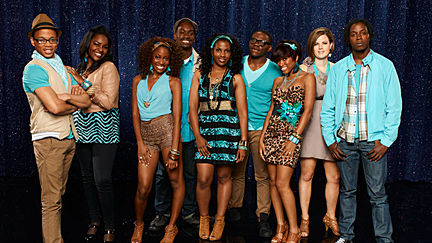 Members of Afro Blue who performed on NBC’s ‘The Sing Off’.
Now let’s switch gears and go to your work with Afro Blue. Where does Afro Blue fit into the program at large?
I started the vocal jazz ensembles as a way of giving the vocal students the vocal equivalent of the instrumental big band. I think of the jazz choir as a vocal big band, that’s my philosophy. I wanted to start an ensemble that the students would want to be in. There always needs to be, I think, some sort of competitive ensemble that will draw students to excellence. That was the main reason for forming Afro Blue. I had no idea it was going to take off in the way that it did. I just go with the flow and I just say, “Shine a light on the next step I’m supposed to take,” and so far that has worked out well for me.
What percentage of vocal majors at Howard get into Afro Blue? How competitive is it?
It varies from year to year because I don’t have a set number of students that are in the ensemble. Some semesters I’ve had as many as 15, and the smallest number I’ve had in the group, which was the very first year I started the group, was 7. I would say now, maybe 20% of the people have a chance.
When did you first start getting calls for performances at more prestigious venues or events?
The very first year, we won a Downbeat award for Best Jazz Group. I mistakenly entered them in the instrumental category. I guess this judge, he heard it and he was not familiar with what a lot of vocal ensembles were doing and he was really impressed. So we won that year in conjunction with two other instrumental ensembles. That got us some recognition right away, and it took maybe another year or so after that before we got a somewhat known around the D.C. area. Another big thing was that we sang at the jazz educator’s conference back when the IAJE [International Association of Jazz Educators] was still viable. Afro Blue was the first vocal group from an HBCU [Historically Black College or University] to perform at that conference. That was in January 2004.
You’ve had a bunch of big performances this year, so it seems like 10 years from now you could look back at 2011 as a watershed year for Afro Blue. What has it been like to get all these great opportunities to perform and watching your group receive national attention?
It’s pretty awesome, I have to say. It was a lot of work. I mean, The Sing Off was just a fluke. It was one of those things that a lot of people had told me about, but I’m not a fan of those sorts of music competitions on TV. I never agree with what the judges say and being a musician myself, I just can’t watch them.
I happened to be in my office and the casting agent called. She had heard about Afro Blue, and she was extending an invitation to just apply. By her explaining to me a little more in detail what the show was about, my main thought was that I wanted to give my students — I had a lot of students who graduated last year — to give them an opportunity to get some recognition, and be able to jump start their own careers. I thought this was a great opportunity for them to do some networking and get out there and see what the business is like, and maybe do something great musically. I had no idea that the public was going to respond to the ensemble in the way that it did.
As the competition was going on, what was your role?
Before they went out there, I did the arrangements of the first two songs that they did, because we knew they were going to do those two before they went out there. They have you do a signature song and they have you prepare a song for the second week in case you make it through. So I did the arrangements for “Put Your Records On” and rehearsed with them on that, and I did the arrangement for “American Boy”. And they had to have their swan song prepared before they went, so I did the arrangement for “We’ve Only Just Begun”, hoping that they wouldn’t have to sing it. While they were out there I did the arrangement of their Christmas song, which was “Christmas Time is Here”. Toward the end I did the arrangement of Sam Cooke’s “A Change Is Gonna Come”.
The casting agent had told me that they don’t pay for directors. You can have as much access as you want to the group, via computer and phone, and you can come out if you want but you have to pay for it yourself. So at about the third week I did go out there on my own dime to see what they were doing and to give as much advice as I could. In the mean time, I would send them ideas via computer for their arrangements. Everything moves there very quickly and everything changes constantly, but I was confident in that of the members of the group, six had taken my vocal arranging classes and one of the members was a composition major, so they know how to write. They had just never had to do it that quickly or at that level.
What was it like when the shows finally aired?
We had a big watching party here at the university and it was just great. It was an amazing night. The room was just full of people, mainly music students and music faculty. It was just pretty awesome. Every time they mentioned the name Afro Blue or Howard University, the whole room would just erupt and just roar. The energy was pretty intense. I will remember that night for a very, very long time.
Of course, they were eventually eliminated and you knew that ahead of time, but what was it like when that episode aired?
I got tons of e-mails, and phone calls, and messages on Facebook. People were really disappointed, some of them were angry, some were congratulatory. But I was really not quite prepared for the fact that there were so many people who were just really upset. I heard so many times the phrase, “You’ve been robbed!”
The thing that I felt about that was I realized they had touched so many people and they were so good. Particularly that last episode, every single thing that they sang was at such a high level that it didn’t quite make sense. If they had been eliminated an episode or two before people might not have reacted as strongly. They were pretty flawless that night. It was interesting to just kind of sit back and watch it all happen.
Moving forward, what is your vision for Afro Blue and your vocal program? How do you think the recent exposure will feed into that?
We have a CD that is almost ready to go. All the members that were on the show are on that CD. It’s all jazz and it’s what we normally do. I’m hoping someone might take an interest in that and maybe want to help distribute that. We’re also getting lots of calls for performances. On some of them we’re using the current Afro Blue group and some people specifically want the ensemble that was on The Sing Off. We’re just kind of sorting all of that out.
I know that recruitment-wise, we have a lot of new students that are interested in coming to Howard, so we’re looking at possibly having to add another jazz voice teacher. I just know that the program is going to grow, and that’s about what I’ve got for now.