Martin Austermuhle
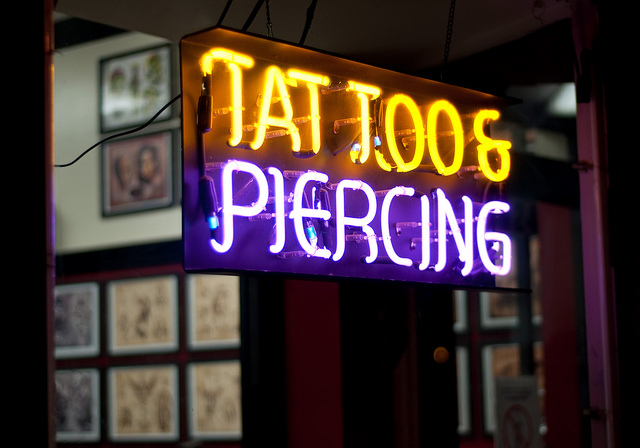 Photo by Kevin H.
If you’re a barber in the District, you have to be licensed and regulated by a city board. But if you’re a tattoo artist or piercer, a certain libertarian ethos seems to govern your trade within city limits—currently, the District remains one of the last places in the country in which tattooing and piercing are wholly unregulated. That looks like it will soon change, but how dramatic the change will be is yet to be determined.
At a hearing in the D.C. Council yesterday, legislators, tattoo artists and regulators squared off over what regulations—if any—should apply to the industry moving forward. Under a bill proposed by Councilmember Yvette Alexander (D-Ward 7) and seven of her colleagues in April, tattoo artists and piercers would have to be licensed by the D.C. Department of Consumer and Regulatory Affairs and abide by basic health and safety standards.
For some tattoo artists and parlor owners, that’s fine, but the regulations have to be drawn narrowly to recognize existing industry standards and to avoid burying small businesses in reams of paperwork and thousands of dollars in fees.
“Under controlled conditions and when performed by experienced practitioners, the risk of infection from a tattoo is minimal,” said Paul Roe, who owns Britishink Tattoos on H Street NE and has tattooed in the city for 13 years.
“In Washington D.C., reputable professional tattoo practitioners are using standard precautions to reduce blood-borne pathogen exposure to a minimum through the use of personal protective equipment, single-use sharps, correct disposal of contaminated waste, etc. Universal precautions are industry standard where each person and every point of contact in the procedure is considered potentially contaminated and treated accordingly,” he said, speaking in an authoritative tone that seemed to buck the stereotype of tattoo artists and piercers as a regulation-averse monolith.
Roe said that almost no good tattoo parlors in the District will work on anyone under the age of 18, that machines are regularly tested and that detailed disclaimers are signed by customers before a tattoo artist goes to work.
The real problem, Roe and others said, isn’t many of the existing tattoo artists or piercers that work in established shops, but rather “amateurs and hobbyists” that work from home or at weekend tattoo parties. Those, they noted ironically, would be hard to regulate, new law or not.
Regardless, witnesses from DCRA, the Department of Health and the Board of Barber and Cosmetology pushed Alexander to move ahead with some basic health and safety regulations, though each department seemed to have its own idea as to what would be appropriate and who would be responsible for enforcing them. In one possible scenario, DCRA said it could license tattoo artists, while DOH would be in charge of licensing the actual establishments in which they work.
Alexander also raised the specter of testing tattoo artists, but what exactly would be tested was left to debate. While she seemed more interested in establishing a training and testing regime for their actual craft, Roe and Matt Jessup, owner of Fatty’s Tattoos in Dupont Circle, seemed to think the most important training would be in cross-contamination prevention.
“I think the only test that should be taken to qualify somebody to do body art of any kind is disease prevention, cross-contamination prevention,” Jessup said. “My concern is not the skill level of a tattoo artist, I feel like the consumer can weed out how talented somebody is or untalented somebody is. What shouldn’t be up to the consumer to weed out is whether it’s safe or not.”
According to Jessup and Roe, tattoo artists traditionally serve in apprenticeships for at least two years, and that tattoo art remains a trade that is passed down from expert to beginner.
“You can’t legislate good tattoos,” said Jessup, who opened his first shop in Maryland in 1994 before moving to the District in 1998. His experience in Maryland was instructive, though—he said that regulations were imposed there in 1997 that were welcomed by tattoo artists and parlor owners, and that he hoped Alexander would look there for guidance.
Alexander didn’t hint that she would, nor did DCRA and DOH regulators, who said that they’d be finalizing their own proposals for the bill by early next year.