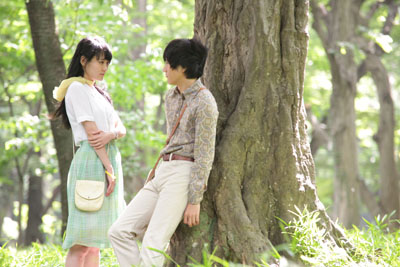
 Naoko (Rinko Kikuchi) and Watanabe (Kenichi Matsuyama). Courtesy Soda Pictures and Red Flag Releasing.
Japanese author Haruki Murakami has perhaps outgrown the “cult” label often applied to him. His highly anticipated doorstopper 1Q84 has been in the NY Times Best Sellers list since it was published last fall, and now a film adaptation of one of his most popular books has reached American shores. But will the rich imagery of Murakami’s complex novels be well served by the movie camera?
Murakami’s most ambitious novels, with their fractured, parallell narratives and unexpected turns to the supernatural, are frequently called unfilmable, though that hasn’t stopped artists from trying. One of his most challenging and satisfying novels, The Wind-up Bird Chronicle, was boldly adapated as a multimedia theatrical production. His short stories have been given the film treatment in Tony Takitani (2004) and All God’s Children (2008), but his popular novels have not made it to screen until now.
The novel Norwegian Wood is one of Murakami’s more straightforward works. It is basically a love story, though the same could be said at heart of more complex works like Kafka on the Shore and 1Q84. You’d think that a plot that doesn’t take the strange turns one expects from Murakami would be easier to adapt for the screen. But the film Norwegian Wood, while it largely keeps faithful to the book’s plot, fails to capture it’s simple yet elusive essence.
Murakami’s prose style, as expertly interpreted by longtime translator Jay Rubin, is crystal clear: even if you don’t know where you are plot wise, however lost and lonely the characters often are, no matter how many moons appear in the sky, the language is simple and precise. Yet the film’s approach, from shadowy interiors to bombastic music, seems nearly antithetical to the author’s spirit. Murakami’s legion of fans may worry that a filmmaker would not rise to the challenge of the work. In the case of Norwegian Wood, Vietnamese director Tran Anh Hung, best known for the neorealist-inspired Cyclo (1995), may instead be guilty of trying too hard.
 Watanabe (Kenichi Matsuyama) and Midori (Kiko Mizuhara). Courtesy Soda Pictures and Red Flag Releasing.
The film begins in 1967. Toru Watanabe (Kenichi Matsuyama) attends college against a backdrop of student protests, but stays out of them, spending idle time with his friends Kizuki (Kengo Kora) and Naoko (Rinko Kikuchi, nominated for an Oscar for a supporting role in Babel). It’s a defining relationship: Kizuki shortly commits suicide, leaving Naoko in a devastating depression that sends her to a mountain asylum for a long recovery. Watanabe is in love with Naoko and patiently waits for her return, but meanwhile the lively Midori (Kiku Mizuhara) enters his life. Whom will he choose?
The novel is set up with a framing device as Watanabe looks back on his youth years later and hears a 101-strings version of the titular Beatles’ song, which has always reminded him of Naoko. The film dispenses with reminiscing and simply depicts Watanabe’s world. But the picture adds up to less than a thousand words. Tran, who also wrote the screenplay, can be forgiven for giving short shrift to characters like Watanabe’s straight-laced roommate Storm Trooper, or for skipping over a poignant scene between Watanabe and Midori’s ailing father. But despite the film’s 133-minute running time, the development of characters and situations feels rushed, the novel’s frank sexuality tamed. A lot of of the book’s time is spent waiting. Watanabe awaits replies to letters he writes Naoko and Midori – this is an era of written letters and telephone calls and record stores. The patience, nuance, and simplicity of Murakami’s prose is replaced by something visually murky, with actors’ faces often obscured by underlit interiors. And then there’s the music. Jonny Greenwood, who composed the overbearing score for Paul Thomas Anderson’s There Will Be Blood, works in a similar vein here. But if his unsubtle touch arguably worked for Anderson’s tale of an oil magnate, it’s glaringly out of place in a love story. Greenwood’s score is less intrusive early in the film, but the period pop songs (rights were not secured for Beatles’ performances or anything else popular that would make this sound like Japanese Graffiti) eventually give way to bombastic strings, a heavyhanded telegraphing of emotion that is the polar opposite of the restraint at the heart of Murakami’s work.
The perfect film adaptation of a Murakami novel might blend the compassionate restraint of Ozu with the cool observation of the uncanny in David Lynch’s best work. But if a plot synopsis of Norwegian Wood sounds like a teenage melodrama, Tran approaches it with the rush of early Wong Kar-Wai, the drama of Douglas Sirk, and the pretenses of Lars Von Trier. If only this movie were as good as that sounds. Norwegian Wood is a well made film, but it may frustrate Murakami fans, and mystify those not familiar with the book. And I am so not looking forward to the inevitable American remake starring Joseph Gordon-Levitt.
Norwegian Wood
Directed by Ahn Hung Tran.
Written by Ahn Hung Tran, based upon the novel by Haruki Murakami.
Starring Kenichi Matsuyama, Rinko Kikuchi, and Kiko Mizyhara.
Running time: 133 minutes.
Unrated, contains nudity and scenes of violence and sexuality.
Opens today at West End Cinema.