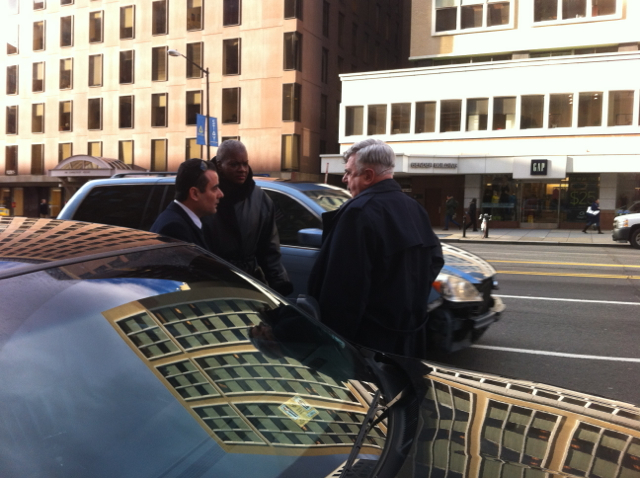
 Linton, right, cited an Uber-affiliated driver with operating illegally on Friday.
D.C. Taxicab Commission Chairman Ron Linton was quite the publicity hound Friday, following up his statement earlier last week that Uber, the high-end livery service, was operating illegally with a sting operation that left a driver with a hefty fine and Uber with some new business to discuss with the commission.
In the aftermath of the scene outside the Mayflower Hotel Friday morning, Uber pushed back hard, insisting on its company blog that the company and its drivers were being unfairly targeted and promoting an “#uberDClove” hashtag on Twitter and a very precious Tumblr blog.
Many of Uber’s customers, meanwhile, rushed to back the company. Even Wizards guard John Wall gave Uber’s D.C. operation a celebrity endorsement on Saturday:
Go Support the hot new company @Uber DC…Show some #UberDCLove!!
— John Wall (@John_Wall) January 14, 2012
(Not that there was any karma to be had in return, as the Wizards lost that night, their second defeat at the hands of the Philadelphia 76ers in as many days.)
David Alpert, editor of Greater Greater Washington, gave Uber a full-throated defense in an op-ed for the Post, writing that at the very least, Uber needs more time to incubate its business here. The company, which was founded in July 2010, only launched its D.C. operation in late November.
Alpert wrote:
But it deserves a chance to succeed, and so does anyone else who thinks they can build a business by safely making transportation better. This is a metropolitan area with many different transportation needs, and though there are many modes available, we can use more options.
Taxi drivers, who provide transportation at lower fare rates than Uber, complained that Uber is providing taxi-like service but not being regulated like taxis. This is analogous to Safeway complaining that some new cupcake shops are offering cupcakes at higher prices, and potentially higher quality, than Safeway’s bakeries do.
Not quite. Cupcakes, however widespread they’ve become, are not a regulated utility. Taxis are, and whether Uber wants to admit it or not—in an interview with DCist last week the company’s CEO, Travis Kalanick, said what Uber does is “coordinate a convenient and classy ride”—it is offering a taxi-like service in that it flags downcalls livery sedans and charges customers according to a proprietary fare schedule. (In D.C., Uber rides have a base rate of $7, plus $3.25 for each mile traveled and 75 cents for each minute a car is hired.)
After the sting Friday, Linton said he’s just doing his job.
“I’m getting tremendous pressure from cab companies the way Uber is functioning,” he said in an interview. “Nobody loves a regulator. We got rules, we got regulations, we got laws.”
In Linton’s view, Uber’s legality is still an outstanding question, and one that he says the company has not done enough to answer. The commissioner said that Uber made one phone call to DCTC as it was establishing itself here, but that the company never followed up after the clerk who took the call referred the matter to a superior. After the scene at the Mayflower, though, Linton said he got an email from Uber requesting a sit-down, which he said he’s more than happy to have.
But repeating his earlier statements on Uber, Linton said, “You’re either a limousine or a taxi.” D.C. regulations state that limousines must charge by time, not a combination of time and distance.
Linton has asked the attorney general’s office to look into whether Uber’s business model is violating any District laws. In the mean time, he said, he has to enforce the rules against the drivers.
“They simply cannot charge on a time and distance basis and be a limo,” he said. “If they do, they have to use one of our meters.”
The driver in Friday’s operation, Ridah Benamara, is from Virginia, resulting in much stiffer penalties than if Uber had dispatched a D.C.-based car to pick up Linton. Benamara was cited for charging for mileage and distance without a D.C. taxi license and for not having proper proof of insurance. Both carry fines of $500.
“If he had District plates and a face card there would be no citations for those,” Linton said. “The only thing that would have been in violation would be an unlawful charge.” But, as a Virginia-based driver, Benamara is not allowed to transport a customer entirely within District boundaries.
In his op-ed, Alpert prescribed relaxing the rules over fare schedules: “Let any company offer rides to the public, at any rate schedule they wish, as long as its drivers meet certain safety requirements and the fares don’t discriminate against disadvantaged areas.”
Linton, though, said he’s responding to complaints he’s heard from cabbies who say Uber’s eating into their business and from customers who feel they’ve been overcharged. The sting was necessary reconnaissance, he said.
“We needed a firsthand observation of what they’re doing. I ride cabs all the time. You know why? It’s my job.”