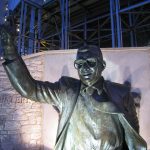
In Sunday’s Washington Post, Sally Jenkins landed what was one of the four or five most-sought interviews over the past few months—the first lengthy conversation with former Pennsylvania State University football coach Joe Paterno after he was fired from his longtime perch in November amid the fallout from sexual abuse charges against his former assistant coach Jerry Sandusky.
“I didn’t know exactly how to handle it and I was afraid to do something that might jeopardize what the university procedure was,” Paterno, 85, told Jenkins. “So I backed away and turned it over to some other people, people I thought would have a little more expertise than I did. It didn’t work out that way.”
The college football icon, who is currently receiving treatment for lung cancer and is recovering from a broken pelvis, appears very frail in Jenkins’ story. Paterno, who started at Penn State in 1950, lost the job he held for 46 years after it was discovered another assistant had given him an eyewitness account of Sandusky raping a young boy in a shower stall at the Nittany Lions’ practice facility. Per his legal responsibility under Pennsylvania law, Paterno informed his superiors—at the time athletic director Tim Curley and university vice president Gary Schultz—of the allegations, but took no further action. (Curley and Schultz were also removed from their jobs last year and have been charged with perjury for not reporting a crime.)
Of Paterno’s version of events, Jenkins wrote:
On a Saturday morning in 2002, an upset young assistant coach named Mike McQueary knocked on Paterno’s door to tell him he had witnessed a shocking scene in the Penn State football building showers. Until that moment, Paterno said, he had “no inkling” that Sandusky might be a sexual deviant. By then Sandusky was a former employee, with whom Paterno had little to do. Although Sandusky had been his close coaching associate and helped fashion Penn State defenses for three decades, their relationship was “professional, not social,” as Paterno described it. “He was a lot younger than me.” Sandusky had been out of the program for three years, and in fact, Paterno said he cannot recall the last time he had seen or spoken to Sandusky. “I can’t,” he said.
…
Paterno contends that ignorance was the context with which he heard McQueary’s disturbing story in 2002. McQueary, sitting at Paterno’s kitchen table, told him that he had been at the football building late the evening before when he heard noises coming from the shower.
“He was very upset and I said why, and he was very reluctant to get into it,” Paterno said. “He told me what he saw, and I said, what? He said it, well, looked like inappropriate, or fondling, I’m not quite sure exactly how he put it. I said you did what you had to do. It’s my job now to figure out what we want to do. So I sat around. It was a Saturday. Waited till Sunday because I wanted to make sure I knew what I was doing. And then I called my superiors and I said: ‘Hey, we got a problem, I think. Would you guys look into it?’ Cause I didn’t know, you know. We never had, until that point, 58 years I think, I had never had to deal with something like that. And I didn’t feel adequate.”
Reading this story when it went online Saturday afternoon prompted a few questions. Why the Post? And why Jenkins?
For starters, there’s the fact that of Penn State’s 450,000 living alumni, the largest concentration live in the D.C. area. (Including DCist editor Martin Austermuhle.) Also, a few weeks after his firing, Paterno hired a Washington-based attorney and an area public-relations firm to represent him as the Sandusky story plays out. The lawyer, Wick Sollers of King & Spalding, and PR guru, Dan McGinn of TMG Strategies, observed Jenkins’ interview with Paterno.
So how did the handlers settle on Jenkins? StateCollege.com has a pretty good explanation of how the Post sports columnist landed the gig:
Joe’s “people” from around the Beltway reached out to Jenkins, a seasoned columnist and former Sports Illustrated writer of the best pedigree.
She graduated from Stanford, has penned scads of books and is the daughter of octogenarian Dan Jenkins, perhaps the best damn football writer ever in these United States, as evidenced by his own “Semi-Tough” days at Sports Illustrated.
Witness what Father Jenkins wrote about Paterno in the Nov. 11, 1968 issue of Sports Illustrated:
“…and while the youthful keeper of all these characters, 41-year-old Penn State Coach Joe Paterno, should be fretting about his team’s possible climb toward No. 1 or an Orange Bowl bid, he stares at the boutique-colored leaves of the pastoral Alleghenies, thinks about romantic poets and longs to drive his kids over to Waddle or Martha Furnace or Tusseyville so they can sit down and talk to a cow.”
The Jenkins name clearly had some sway with Team Paterno. In her career, Sally Jenkins had never really spoken with the coach before last week. But shortly after the Sandusky scandal broke, Jenkins did pen a column largely excusing Paterno from blame. StateCollege.com notes that Jenkins told Penn State student radio that Paterno’s people had told her she “had written one of the few sensible columns” about the affair.
So, Team Paterno was expecting the kid gloves. And for the most part that’s what Jenkins brought. Her article, while a thorough portrait of a deposed titan in his winter, is pretty gentle. In the full transcript of their interview, Jenkins and Paterno spend as much time talking about legacy as they do about the scandal.
But not everyone was convinced with what Paterno said. Writing for The Atlantic, CBS legal analyst Andrew Cohen says Paterno’s explanation in Jenkins’ piece is pretty thin:
I’m genuinely glad that Paterno got his side of the story out in the public realm—in a controlled and controlling manner that entirely befitted his reputation as a head coach. And the frail old man should be “shocked and saddened” about what transpired under his regime. But if he is looking here for a form of absolution, looking for it with a few pitiable quotes under the watchful eyes and ears of his handlers, looking for it while contending at the same time that he’d never heard of “rape and a man,” he’s looking for it in all the wrong places.
Jenkins is taking questions today on WashingtonPost.com.