“What is camping?”
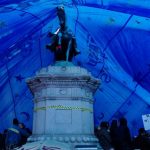
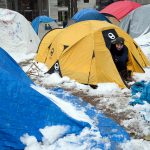
That was the dominant question at a House Oversight hearing this morning on Occupy D.C. and its nearly four-month stay in McPherson Square. The panel’s subcommittee that oversees the District spent over two hours grilling the head of the National Park Service and District officials about just how long the income-inequality protest movement will remain at the one-block park in the heart of downtown Washington.
Repeatedly, NPS Director Jonathan Jarvis said that Occupy D.C. is engaged in a round-the-clock vigil, not camping. Also, as a group of fewer than 500 protesters, it is not required to seek a permit from the agency. NPS does, however, at the parks it runs across the country, determine which areas are open to camping. McPherson, as signs around the square note, is not one of those spots.
But Rep. Trey Gowdy (R-S.C.), who chairs the subcommittee, did not let up. Citing NPS’ definition of “camping” as either “sleeping” or “preparing to sleep,” Gowdy asked Jarvis for a definitive answer.
“Is there sleeping going on in McPherson Square?” he asked. “Are they preparing to sleep or are they insomniacs?”
When Jarvis continued to identify Occupy D.C. as a 24-hour vigil, Gowdy suggested he would tell his constituents back home to bring tents of their own on any future visits to the nation’s capital.
Gowdy’s fellow Republican, Rep. Joe Walsh of Illinois, continued the camping-versus-vigil line of questioning. Seeking to highlight the effects of Occupy’s longterm stay in the square, Walsh presented a video he said was shot Monday night by two members of his staff. In the two-minute clip, the staffers go on a quick walkthrough of McPherson Square, stopping to chat with various members of the protest group.
In the video, the narrators can be heard commenting on conditions in the park, which does look quite weatherbeaten these days after nearly four months of nonstop habitation. But after the hearing, one member of Occupy D.C. said the Walsh staffers toured the site posing as independent bloggers. The protester, Brian Eister, said he sat for an interview with Walsh’s staffers as if he were speaking to any other journalists.
Walsh’s office has not replied to questions about the video.
Rep. Darrell Issa (R-Calif.), who chairs the full Oversight Committee and announced the hearing last week, was in and out of the chamber. Issa, who has been seeking documents from federal and District officials regarding their policies toward Occupy D.C., also on the camping definition.
“You have turned a blind eye to four months of law-breaking,” Issa told Jarvis. But Timothy Zick, a law professor at the College of William and Mary brought in as an expert witness, said Occupy D.C. does not appear to be abusing its First Amendment rights nor does NPS appear to be neglecting its duties.
“There is a difference between a recreational camper and camping as a protest,” Zick said.
Additionally, Jarvis mentioned a few protest movements that also camped out on federally controlled land for long stretches in the past, citing “Resurrection City,” the tent settlement on the National Mall in 1968 that was part of the civil rights movement, and Vietnam War veterans groups who began a constant vigil in 1985 to raise awareness of exposure to the chemical known as Agent Orange.
Democrats on the panel were far less enthusiastic than their majority Republican peers in pressing officials on how much longer to allow Occupy D.C. to remain at McPherson Square. Illinois Rep. Danny Davis, the ranking Democrat, used his opening remarks to read into the record a statement prepared by the protest movement. Many occupiers attended the hearing, including four who spent most of December on a hunger strike in support of D.C. statehood.
Rather, the Democrats were more focused on any health issues arising at McPherson. Mohammed Akhter, director of the D.C. Department of Health, told the panel “the health risks are real,” but that with a “lack of clarity on jurisdiction,” many were going unaddressed.
Rep. Scott DesJarlais (R-Tenn.), one of many first-term members of Congress elected in 2010 with Tea Party backing, asked Akhter if taxpayers should be footing the bill to keep Occupy D.C. healthy.
“Absolutely,” Akhter said.
As far as local law enforcement was concerned, both Deputy Mayor Paul Quander and Metropolitan Police Department Chief Cathy Lanier said that as Occupy has lasted, MPD has had to deploy fewer resources to monitoring the protest.
Still, the Republicans kept after Jarvis to determine if pitching a tent counts as protected speech.
“Is there First Amendment sleeping versus recreational sleeping?” Gowdy asked. “How does a group sleep?” Jarvis said a few times that while it’s taken a while, Occupy D.C. has become increasingly compliant with NPS rules.
Del. Eleanor Holmes Norton asked Quander if there has been a groundswell of public complaint from District residents and businesses. Though Mayor Vince Gray has said he’d like to see Occupy D.C. be consolidated the encampment at Freedom Plaza, Norton was not swayed by Quander’s reply that his office has received several emails and phone calls about the protest. She told her colleagues on the panel that any costs of enforcing the law or investigating health conditions with respect to Occupy D.C. should be borne out of a $15 million payment the federal government makes each year to the District to cover the costs of protests. (Though the money is allocated to the city, it isn’t readily available, said a senior D.C. official with knowledge of the issue. The city still has to formally request it, he said, and has already asked for $1.6 million to cover costs incurred so far.)
After the hearing, Norton told reporters she felt NPS is “on the right side of the issue.”
Late in the hearing, Norton became choked up when comparing the Occupy Wall Street protests with her own participation in the civil rights movement in the 1960s. She was also upset that no one from McPherson was asked to testify.
“I think Republicans are generationally removed,” she said after the hearing. “When we were sitting in [during the 1960s], they asked ‘What are you doing?'”
Though midway through the hearing Jarvis said that NPS would begin issuing warnings against camping at McPherson Square, occupiers who heard his testimony think otherwise, noting the director’s repeated concern for their health and safety.
“I think the Congressmen were going a mile out of the way to put words in his mouth,” Eister said.