It looks like despite the National Park Service’s insistence that the Occupy D.C. encampment at McPherson Square is a round-the-clock vigil, the federal agency will start issuing final warnings to protesters who are deemed to be camping.
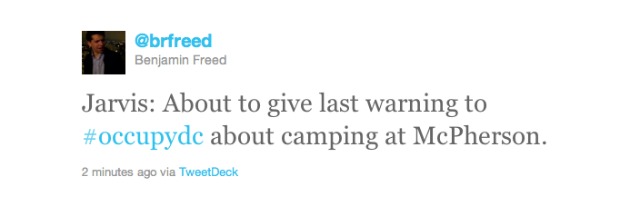
Under questioning today from the House Oversight subcommittee that deals with District matters, NPS Director Jonathan Jarvis admitted that individuals at McPherson Square have slept in their tents, which is against existing park rules. Should that continue, he said, U.S. Park Police would issue warnings to campers.
In an exchange with Republican congressmen, Jarvis was pressed into distinguishing when a 24-hour vigil becomes camping. According to him, as long as people remain awake, they aren’t considered to be camping. Of course, he admitted, people have been sleeping at McPherson Square.
Still, questions remain as to how far any future crackdowns could go. Jarvis noted that camping is an individual violation, and individuals could be cited. As for the whole encampment, though, a federal judge’s ruling that 24 hours notice be given before an eviction still stands, and a further hearing on the matter is scheduled for the end of the month.
The panel’s chairman, Rep. Trey Gowdy (R-S.C.) led the charge in pressing Jarvis why Occupy D.C. has lingered in McPherson Square for four months, repeatedly asking the park service’s director to define “camping.” Another Republican, Joe Walsh of Illinois, asked Jarvis if he was taking orders from his superiors not to enforce the rules against the protest.
“I know this isn’t you. Who’s telling you not to enforce the statutes?” Walsh asked.
Jarvis said that he regularly briefs Interior Secretary Ken Salazar on various matters related to NPS and the Park Police.
As the hearing continued, Gowdy repeatedly accused Jarvis of not enforcing the law against camping. After asking Timothy Zick, a law professor from the College of William and Mary, about selective prosecution—not enforcing the law against some based on content—Gowdy asked Jarvis once again to differentiate occupiers’ longterm residency at McPherson from a camper staying overnight in a National Park.
“Is there First Amendment sleeping versus recreational sleeping?” Gowdy asked. “How does a group sleep?”
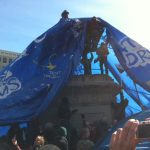
But Jarvis’ statement a few minutes earlier, that his agency would begin issuing final warnings before evicting protesters, was a new development for Occupy D.C., which despite a few run-ins early on (the barn, to name one such incident), has been granted a wide berth by NPS.
As the protest has kept on, Jarvis said later in the hearing NPS’ relationship with Occupy had become more cordial. The protesters “have brought a great deal of organization to the site,” he said.