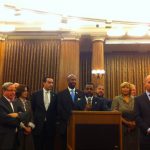
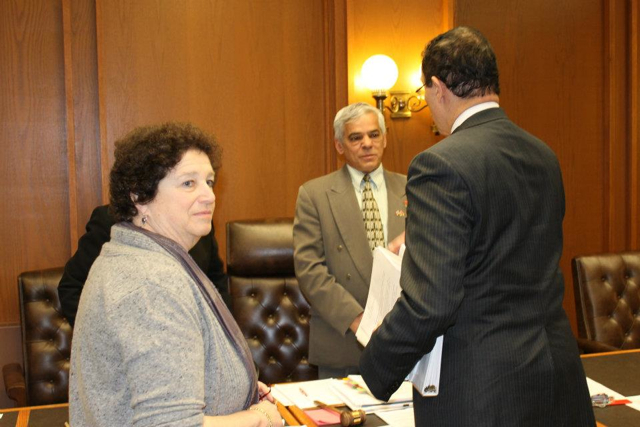
 New Hampshire State Reps. Cindy Rosenwald and Al Baldasaro with Mayor Vince Gray at the New Hampshire State House on Friday. (Via the office of Councilmember David Catania)
Despite a day of testimony from District officials and D.C. voting rights activists, a New Hampshire House of Representatives committee declined Friday to support a resolution endorsing D.C. statehood.
The measure, which fell on an 8-3 vote, was not dealt a death blow, however. Statehouse rules allow for the minority to report it into the full legislature, which its chief sponsor, State Rep. Cindy Rosenwald, intends to do in the next few weeks.
Mayor Vince Gray and members of the D.C. Council had traveled to Concord, N.H. to lobby the state legislature there on endorsing statehood for the District. The trip, originally planned for January 12, was rescheduled after a snowstorm in the Granite State threw a wrench in the itinerary.
The mayor was joined on the trip by Council Chairman Kwame Brown, and council members David Catania (I-At Large), Michael A. Brown (I-At Large), Vincent Orange (D-At Large) and Mary Cheh (D-Ward 3). Also showing up to testify on behalf of D.C. statehood to the New Hampshire House of Representative’s bill H.R. 26 were the group of activists, led by the performance artist Adrian Parsons, who went on a weeks-long hunger strike last month as a protest over the District’s lack of full representation in Congress.
A few reporters made the trip, too, including the Post’s Tim Craig and Fox 5’s Matt Ackland. Craig, early on, noted the political tendencies of the New Hampshire House’s State-Federal Relations and Veterans Affairs Committee:
Told DC officials will be testifying before “very conservative” committee. Few days ago, it passed resolution advocating withdrawal from UN
— Tim Craig (@timcraigpost) January 27, 2012
Still, the hearing seemed to get off on a good note for the District delegation. After leading the chamber in the Pledge of Allegiance, Gray used the early part of the session to make the boilerplate case for D.C. statehood—lack of legislative autonomy, Congressional meddling in the budget, funding for District operations being contingent on federal budget resolutions. He drew a comparison between D.C.’s motto of “Taxation Without Representation” and New Hampshire’s more brazen credo “Live Free or Die.”
Several of the questions from the panel asked Gray to outline how the District, if turned into a state, would govern itself. One member, citing the Article Four of the Constitution, noted that all states in the union are required to have a republican form of government. Gray said he imagined that would be the case.
After hearing from Kwame Brown, State Rep. Robert Theberge, a Democrat from the town of Berlin, told the chamber he “would be honored if New Hampshire was the first to pass” a resolution endorsing D.C. statehood. It’s worth noting that though Democrats hold only one-quarter of the seats in the New Hampshire House, there seemed, at least during the testimony, to be a dose of bipartisanship emerging on this issue.
Not long after Brown’s remarks, State Rep. Elaine Swinford, a Republican, reflecting the Granite State’s libertarian streak, sounded incredulous to hear about Congress’ oversight of the District’s legislative activity.
“You’ve gotta be kidding me, you’ve got to wait for Congress’ approval for anything you do?” she blurted out from the dais.
Cheh provided the historical legal analysis, running through a history of arguments by federal leaders for, but mostly against, expanded rights for the District since its founding in 1791:
The framers [of the Constitution] could not have foreseen that the District would grow to a population greater than Wyoming and, according to the most recent estimates, only about 8,400 fewer than Vermont. And it is incongruous to think that the Framers, having just fought a war to ensure that there would be no taxation without representation, would enshrine in the Constitution the existence of such a significant population with no representation in Congress.
Cheh, at one point, also brought up the model provided by the Northwest Ordinance, which allowed the territories we now know as Ohio, Indiana, Michigan, Illinois and Wisconsin to apply for statehood once they reached 60,000 residents. (The 1787 law has been in the news this week as it has also been cited by Republican presidential candidate Newt Gingrich in his aims for the moon.)
Besides the District’s elected leaders, who left about 12:30 p.m. for their flight back to Washington, the Granite State officials also heard from representatives of the advocacy group DC Vote as well as the one-time hunger strikers.
Among the people brought along by DC Vote executive director Ilir Zherka were several veterans of the U.S. Armed Forces, whom Rosenwald said made a the most compelling case.
Rosenwald, a Democrat from Nashua, does not sit on the State-Federal Relations panel and attended only as the bill’s sponsor and lead witness. In an interview after the vote, she relayed some of the reasons her colleagues who do sit on the committee gave for their hesitation to embrace D.C. statehood.
“There were a couple of people who were not inclined to look favorably on us because they thought your gun laws were too strict,” Rosenwald told DCist. Another state representative remarked that people who live in D.C. have “made a choice” to forego full representation at the federal level, she said.
After the testimony wrapped up—Parsons and his comrades from Occupy the Vote went last—the committee first weighed adding an amendment to Rosenwald’s bill that would have reduced it from endorsing full District statehood to one that just supported more substantial Congressional representation.
In the course of that debate, however, the committee lost its quorum and needed to pull in any state legislature members it could find in the building to record a tally. The two who joined the group, both Republicans, voted against the measure, which ened up being considered in its original form. Swinford, who earlier had been stunned to hear about Congressional meddling in District minutiae, departed before the vote.
Still, with the ability to file a minority report, Rosenwald said the issue of D.C. statehood still has life in the Granite State. “I doubt it’ll come up next week,” she said, “but the argument against it will be published.”
Catania spokesman Brendan Williams-Kief, who traveled with the District government group, said upon returning home that despite the outcome of the vote, it was still a productive trip.
“We were really well received by a lot of committee members who, when they heard what we have to go through with federal oversight, there was a visible reaction,” he said. “In New Hampshire it sort of borders on revulsion.”
Still, he added, “it’s clear that there’s a lot of education that needs to be done.”
In reflecting on the defeat of Rosenwald’s bill, there was also something of a “Live Free or Die” vibe to Williams-Kief’s takeaway from the day’s events:
“I would say we would have liked to had the New Hampshire legislature’s support, we accept their ability to make their own decisions within their own local government institutions—exactly what the District is seeking.”
Catania and Michael A. Brown’s offices are spearheading an election-year effort to take the statehood plea to as many local governments around the country as possible. Florida, Tennessee and Illinois are next on the horizon, though no hearings in those states have been scheduled yet.
And a defeat in one committee of one statehouse isn’t a deterrent, Williams-Kief said.
“Did we think we’re going to get 50 state legislatures to agree on anything?” he asked. “No.”