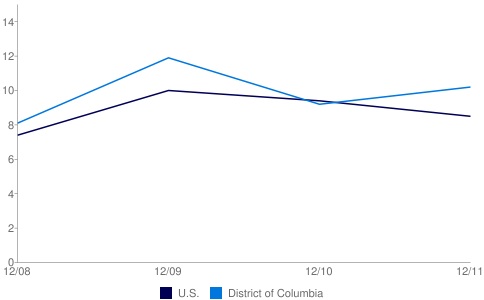
 Unemployment Rate, 12/08-12/11. From ProPublica.org
According to ProPublica’s Recovery Tracker database, the District of Columbia has received the most money per capita, $8,357, since the federal stimulus plan was enacted in 2009.
Unemployment in the District has also risen by about 20 percent since 2008.
So where has D.C.’s $5,028,734,803 in recovery funding been spent? Almost three years ago exactly we posted this, a list describing what the stimulus funding would mean for us.
Let’s check in on where we stand.
The Hope: The White House estimated the stimulus could create up to 12,000 new jobs in the District.
The Reality: As stated, unemployment has risen since 2009, but not for lack of trying. In 2010 the Fenty administration awarded $2.5 million to job training programs for 1,300 D.C. residents. The Department of Employment Services also used $627,753 from the American Reinvestment and Recovery Act to provide on-the-job training for healthcare and construction occupations, according to Recovery.DC.gov.
The Hope: Increase in unemployment benefits.
The Reality: Not only did D.C. raise the weekly unemployment compensation $25 per week based on ARRA, they also increased operating hours at their career counseling centers and hotline, according to the Department of Employment Services.
The Hope: D.C. Public Schools would be entitled to enough funds to refurbish around 34 schools.
The Reality: According to the April 2010 DCPS Outline for 2010-2011 Stimulus Funding test scores and graduation rates were up, but even with those gains, less than half of DCPS students were proficient in math and reading. The site states: “We are in the midst of a necessary and radical turnaround that has to continue in order to educate all children according to their rights and abilities.”
The Hope: Roadways would be improved.
The Reality: The District was quick to obligate $82.6 million of ARRA funds to DDOT, which immediately went to completing projects such as repaving I-395 and updating and repairing streetlights.
The Hope: Improved regional mass-transit.
The Reality: Nearly $202 million dollars were allocated to Washington Metropolitan Transit Authority for improvements to buses and rail cars. More than a quarter of that money went to purchasing 48 new hybrid buses and 80 new paratransit vehicles as well as constructing a new bus body and paint shop. The effort was expected to create over 100 new jobs.
“In addition to putting people in the D.C. area to work, these Recovery Act dollars will also mean Washington Metrobus riders will have a cleaner, safer ride,” said Federal Transit Administrator Peter Rogoff. “And they can be assured that by taking the bus, they are doing their part to reduce America’s dependence on oil and clean up the air.”
The Hope: St. Elizabeth’s Hospital in Anacostia would be rehabilitated to house the Department of Homeland Security.
The Reality: The project is underway after receiving more than $222 million in ARRA funding. Keep abrest of developments here.
There are many other small ways that stimulus funding has impacted D.C., follow spending at Recovery.dc.gov and StimulusWatch.org.