Martin Austermuhle
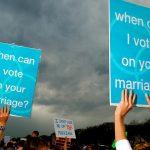
Since Maryland and Virginia started their respective legislative sessions this year, it’s fast become apparent how ideologically opposed the two legislatures seem to be on many issues. Today perfectly encapsulated that growing divide, as a Maryland Senate committee voted to send a same-sex marriage bill forward and a Virginia Senate committee gave final approval to a bill that would allow private adoption agencies to deny placement based on their moral beliefs.
More broadly, the competing political agendas in Maryland and Virginia mirror national political trends, as the Post’s Bob McCartney wrote in early January:
Given the economic climate, both politicians are stressing the need to create jobs. Democrat O’Malley proposes that government do so directly by rebuilding decaying public infrastructure such as roads, mass transit and sewage plants. To finance it, he’s willing to pay a political price by pushing to raise the gasoline or sales tax and add other fees. Republicans are saying Maryland family budgets can’t afford the hit.
Republican McDonnell has promised not to raise taxes so as to keep government small, saying that’s the best way to promote job growth in the future. With no extra funds to play with, he’s trying to make a political splash by shuffling money within the state budget to do more for priorities such as economic development, pension reform and transportation. Democrats are dismissing the changes as token gestures and saying they shortchange school budgets.
Does all this sound familiar? It closely parallels the budget debate at the national level. With the additional twist that O’Malley and McDonnell each chair his party’s governors association, the Potomac is a dividing line between the United States’ two competing visions of government.
Of course, things may be more problematic for McDonnell in the Old Dominion than for O’Malley in the Old Line State. Virginia’s legislators have been making national news with surprising regularity this year, and the majority of it has been for extreme stances on hot button social issues. Whether mandatory ultrasounds for women seeking abortions, a bill that would grant a fertilized egg the same rights as a person or the coming repeal of the one-gun-a-month law, Virginia legislators have established a position on just about every culture war front they could find. Last week, a Post editorial said that Virginia Republicans run the risk of overreaching.
O’Malley faces his own risks, too — a bill that would allow illegal immigrants who attend Maryland high schools to receive in-state tuition will be on the ballot this November, and it could well be joined by the same-sex marriage bill working its way through the legislature. Will voters stop O’Malley on both?
What makes all of this the more interesting is what the future holds for both governors. McDonnell has been pointed to as a possible vice presidential contender, while O’Malley could well be amongst potential 2016 Democratic presidential candidates. As for Virginia, does the legislature’s jump to the right help or hurt Attorney General Ken Cuccinelli in his bid to succeed O’Donnell? Voters may feel that a Republican legislature and Cuccinelli in the governor’s seat may be a little too much to handle all at once.
Of course, McDonnell could still wield the veto pen on some of the proposals coming from the Virginia Legislature, but will he? With another month left for Maryland and Virginia to finish up their work, it certainly makes for some political suspense worth watching.