DCist’s highly subjective and hardly comprehensive guide to the most interesting movies playing around town in the coming week.
—
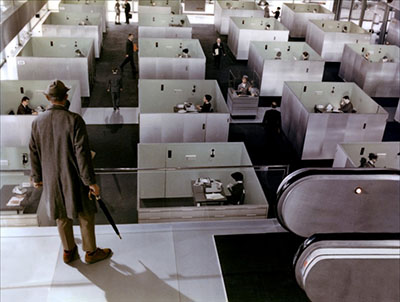
What it is: Jacques Tati’s vision of an idealized modern Paris, minus all that old-world charm.
Why you want to see it: Actor-director Jacques Tati made only a handful of features in a 25-year career. His signature character Mr. Hulot was a bungling misfit whose mostly wordless adventures placed him between an old fashioned world and the perils and joys of technology. A tension between the old and the new runs through all Tati’s films and reached its apex with the masterpiece that broke the bank. Play Time’s huge set, dubbed Tativille, was built in a suburb of Paris, and construction and shooting delays stretched production to three years. Tati’s previous film Mon Oncle alternated between the quaint old and the modern new. But Play Time immerses Mr. Hulot in the horrors of modernity. The only glimpses of Paris icons come through reflections in glass doors: the Eiffel Tower, The Arch de Triomphe. In this world of cold glass and symmetry the loping Hulot tries to keep a business meeting. We never find out the purpose of the meeting, which never really happens, because this forbidding world of skyscrapers and transparent rooms and uncomfortable furniture sends Hulot and the viewer on a feature length ride through the most densely orchestrated sight gags you may ever see. It’s a beautiful spectacle, and in some ways a terribly romantic film, as Hulot repeatedly encounters Barbara, a pretty young American tourist, in his misadventures. But as is true of most of Tati’s films, he doesn’t get the girl, and this is of a piece with his place in a world of glass houses: taking life as an observer more than a participant. For all his light-heartedness, Hulot is distant, and Tati’s masterpiece as alienating as it is beautiful. A must-see on the big screen, though the AFI will not be presenting it in 70mm this time. Shown as part of The City Imagined in Film, a series programmed by the AFI in tandem with the National Building Museum.
View the trailer.
Saturday, March 3rd and Sunday, March 4 at the AFI.
—
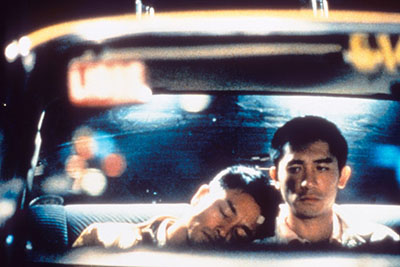
What it is: One of director Wong Kar-Wai’s most stylish visions of the human heart.
Why you want to see it: Lovers Tony Leung and Leslie Cheung fall in and out of love as they travel between Hong Kong and Beunos Aires. Director Wong Kar-wai’s has said that his improvisational films often begin as mix tapes. A soundtrack that includes generous helpings of both Frank Zappa and Astor Piazolla might sound like a disjointed recipe indeed. But the musical variety works beautifully with the visual restlessness of this bittersweet road movie. Cinematographer Christopher Doyle uses light and film stock like a paintbrush and, with the likeable actors, helps create a coherent and finally touching picture out of seemingly disparate parts.
View the trailer.
Friday, March 2-Monday, March 5 and Wednesday, March 7 at the AFI.
—
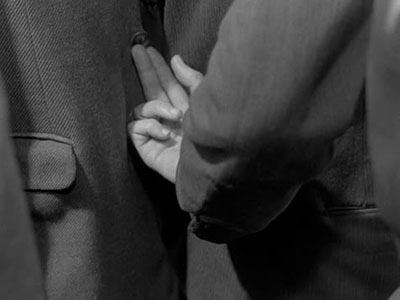 Pickpocket
Robert Bresson
What it is: The National Gallery’s survey of the complete works of a master director.
Why you want to see it: “‘A film is not made for you to promenade your eyes, but for you to enter it and become entirely absorbed by it.” This is how Robert Bresson sums up his approach to film making in his book Notes of a Cinematographer. The director’s modest filmography has inspired contemporary film makers from Kelly Reichert to the Dardenne Brothers, and even Drive can be read as a kind of Bressonian action movie. This weekend the National Gallery begins a retrospective of Bresson’s feature film work, including his rarely screened first feature,Les Anges du Péché. Also showing is his early masterpiece Pickpocket, a stripped-down and some would say eroticized look at that most subtle criminal art, whose impression of nonchalance and unwasted movement can be considered a metaphor for Bresson’s film making.
View the trailer for Pickpocket.
Les Anges du Péché screens Saturday, March 3 at 2:00. Pickpocket screens Saturday, March 3 at 4:15, and will be introduced by film scholar Keith Cohen. At the National Gallery of Art.
—
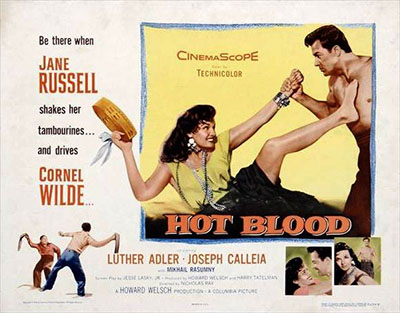
What it is: Bombshell Jane Russell plays a tempestuous gypsy in this rarely-seen item from director Nicholas Ray.
Why you want to see it: “Jane Russell shakes her tambourines … and drives Cornell Wilde!” Onetime Playtex spokeswoman Russell plays Annie Caldash, a gypsy from Chicago who is talked into an arranged marriage with the reluctant Stephan Torino (hot-blooded Hungarian Cornell Wilde). Will they fall in love? It’s a thin and dated premise but how often do you get a to see a Technicolor Cinemascope production on the big screen?
View a warm clip.
Sunday, March 4 and Tuesday, March 6 at the AFI.
—
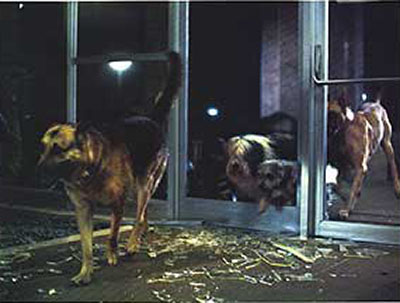 Sure they’re cute — until they take a chunk outta ya!
 What it is: Washington’s favorite cult movie series takes on a canine theme.
Why you want to see it: “Don’t pet them … FEAR them!” It’s Rover’s Revenge next week as the Washington Psychotronic Film Society launches The Dogs of March, a month of thematic programming dedicated to man’s best friend … or worst enemy? The 1976 Dogs stars Man from U.N.C.L.E. David McCallum as biologist Harlan Thompson, who takes on the standard when-animals-attack role of pleading with the Mayor to ask the public to keep their pets locked up. You may never take a shower again. Director Bruce Brinckerhoff went on to direct seventeen episodes of Alf.
View the trailer.
Monday March 5 at McFadden’s. Free.
—
Also opening this week, two very different approaches to childhood development: We Need to Talk About Kevin starring Tilda Swinton as the mother of a very troubled teen; and the Oscar-winning high school football documentary Undefeated. We’ll have full reviews tomorrow.