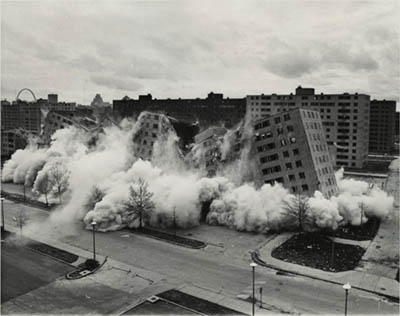
 Iconic Photo of Implosion of a Pruitt-Igoe building. St Louis Post-Dispatch, courtesy State Historical Society of Missouri and First Run Features.
A St. Louis public housing project went from Utopian vision to implosion in less than twenty years. A photo of its implosion became an iconic symbol, though what it was a symbol of depended on who you talked to: governmental excess, governmental neglect, the brutality of modernism, a collapsing society. But is this more than a story of inner-city decay? The title of a new documentary about the project suggests an alternate history to this textbook disaster, but it ultimately confirms the historical record without really getting to the bottom of it.
A city limits sign proudly boasts: “ST LOUIS POP. 856,796.” Like many places in the late 1940s, the Missouri city saw a post-war population boom, and with the boom came problems. Slumlords ruled the poor parts of town where people were crammed into tenements, and the city thought the answer was to expand. Officials planned for continued population growth to one million and beyond. The notorious Pruitt-Igoe public housing complex was born. It was supposed to solve the housing crisis, and, designed by architect Minoru Tamasaki, the proposed solution came in a sleek modern package. But the dreams of Utopia did not pan out as advertised. Tamasaki, shown briefly with a model of the project, also designed the World Trade Center, and alas, both projects were destroyed. Pace conspiracy theorists, in St. Louis, the end really was an inside job.
The first tenants moved into Pruitt-Igoe in 1954, and the complex briefly met expectations for well-maintained grounds and an integrated community. But all too soon, white flight from the cities turned it into a hyper-segregated complex as urban rentals went down and the suburbs filled. Welfare regulations prevented able-bodied men from living on the grounds, which broke up families and left single mothers vulnerable to predators. By the late1960s the population of St. Louis had plummeted, and Pruitt-Igoe was a broken shell, so dangerous police refused to respond to calls there.
 Courtesy First Run Features
Such horror stories make up the titular myth. But director Chad Friedrichs hopes to dispel the received wisdom and suggest that life at Pruitt-Igoe wasn’t as bad as all that. Interviews with former residents tell of happy times and an early feeling of community. But all acknowledge that something went very wrong. Implosion of Pruitt-Igoe’s 33 buildings began in 1972, less than two decades after the experiment began. The site became a wooded area that the filmmakers shot while the trees are barren, which seems to further perpetuate the notion that nothing good came out of that site.
Friedrichs has assembled a moving portrait of a decaying community, but there’s at least one crucial angle that is glossed over. Design issues may have played a factor in the failure of Pruitt-Igoe. With units as isolating as jail cells, It’s exactly the kind of complex that Jane Jacobs warned against in The Death and Life of Great American Cities. The Pruitt-Igoe Myth remains an ode to the fall of cities everywhere. Though its subject is decay, the film ends on a hopeful note. Residents have returned to cities and developers plan to clear the urban forest that has sprung from the ruins of Pruitt-Igoe and try again.
The Pruitt-Igoe Myth
Directed by Chad Friedrichs
Written by Chad and Jaime Friedrichs
Running time: 83 minutes
Not rated: contains profanity.
Opens today at West End Cinema.