Martin Austermuhle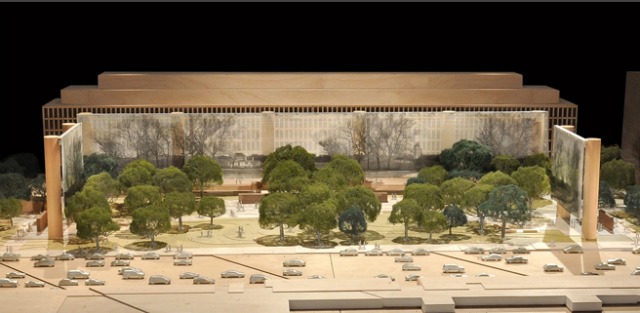
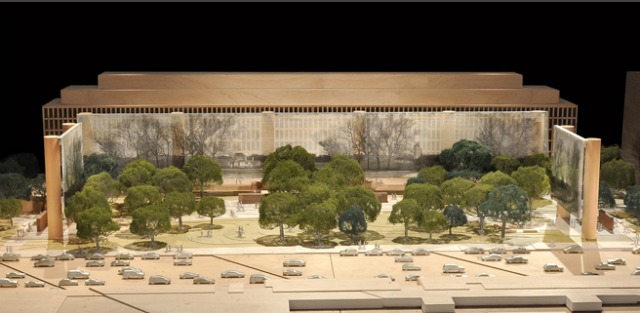 The proposed Eisenhower Memorial, as designed by Frank Gehry.
As a congressional committee heard complaints over a proposed memorial for President Dwight D. Eisenhower during a hearing yesterday, architect Frank Gehry said he would be open to making changes to his controversial design.
Amid additional criticisms of Gehry’s design by Susan Eisenhower and others, Gehry wrote in a letter that if his detractors “conclude that the sculpture of young Eisenhower is an inappropriate way to honor him, then I will be open to exploring other options with them.”
“My only interest is creating a monument to a great man who served our country so selflessly and who was a great champion of the American way,” he added. (His full letter is here in .PDF.)
He may not have much of a choice. In her testimony yesterday, Eisenhower was unsparing in her critique of the proposed design, decrying what she called the “the Horatio Alger-like narrative” of depicting the 34th president as a country boy from Kansas and comparing 80-foot-tall steel tapestries that will frame the memorial to similar tapestries honoring communist leaders.
“The design team at Gehry and Associates and the Eisenhower Memorial Commission has made a habit of referring to the metal curtains as ‘tapestries,’ referencing the tradition to place great people and events on woven material. This may be true of the Middle Ages, but noteworthy modern tapestries are those in the Communist world. Tapestries honoring Marx, Engels and Lenin used to hang in Red Square; Mao Zedong could be found in Tiananmen Square; and Ho Chi Minh’s tapestry hung from public buildings in Hanoi—to name a few,” she wrote in her testimony.
The memorial had its defenders, though, reported CBS:
Rep. Leonard Boswell of Iowa, a member of the federal commission, testified that he had his own reservations about depicting a young Eisenhower at first but came to realize it would be a draw for the millions of children who visit the nearby Air and Space Museum.
“The youngsters will come out of that museum and just naturally walk across the street and see what happened in a person’s life,” Boswell said. “Who would have ever thought, Abilene Kan., somebody would end up as supreme Allied commander and president of this great country? So I started really falling in love with this concept.”
Still, it doesn’t look like the proposed memorial will be moving forward any time soon. Rep. Rob Bishop (R-Ut.) said in a press release after the hearing that he remained concerned that there wasn’t consensus over the design and that estimates of how much it would cost to maintain Gehry’s ambitious tapestries weren’t yet available.
“Given the concerns shared by so many and unanswered questions that remain, it would be my hope that this project be placed on hold until further discussions can be had about the most appropriate and responsible path forward,” he said.
Of course, that consensus won’t be free—restarting the design process could tack an additional $16 million on the memorial’s estimated $112 million price tag and add significant delays, said the director of Eisenhower Memorial Commission.