

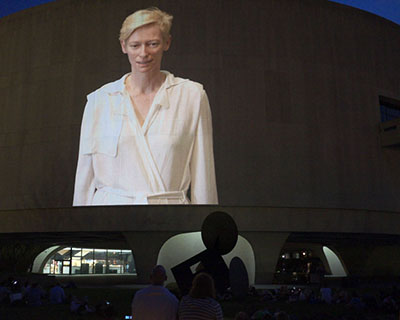
 Tilda Swinton in Doug Aitken’s Song 1. Artwork courtesy 303 Gallery, New York; Galerie Eva Presenhuber, Zurich; Victoria Miro Gallery, London; and Regen Projects, Los Angeles. Photo by Pat Padua.
Forget the Bubble. This spring’s most anticipated architectural bauble has already landed at the Hirshhorn. Doug Aitken’s Song 1 hopes to “develop a new vocabulary to turn the world of the moving image inside out.” It doesn’t exactly reach such a lofty vision, but it’s a diverting spectacle the likes of which Washington has never seen. It’s good reason to head out to L’Enfant Plaza after sunset.
Aitken has produced works of this scale before, like his sleepwalkers, projected on the exterior walls of the Museum of Modern Art courtyard in 2007. The Hirshhorn commissioned this new work from Aitken, who was inspired by the potential of using the Hirshhorn’s massive circumference as the world’s largest movie screen, an imposing 82 feet high by 725 wide. What he gets out of that urban circular stage is impressive but falls short of being truly mesmerizing.
Song 1 is a 35-minute loop, but the chances of somebody happening on the “beginning” are slim, so what narrative there is is fragmented. Characters appear and disappear, images wrap around the Hirshhorn that riff on the circle: reel-to-reel players, assembly lines, telephones, and especially car wheels and their many trappings: traffic, parking garages. What is most impressive about the work is its interaction with the area around the Hirshhorn. It’s a design built for serendipity, as viewers can expect to see cars passing outside the museum while traffic patterns are projected on its exterior, and museum patrons wander in the courtyard in a kind of participatory dance with their big screen counterparts. It’s too bad evening traffic around 7th and Independence isn’t heavier – this would allow more opportunities for interaction between image and reality, and one can only dream of a bar in stumbling distance for inebriated patrons to wander out of into Tilda Swinton’s 85-foot presence.
The song of Song 1 is the 1934 standard by Harry Warren and Al Dubin, “I only have eyes for you.” Its best known version is arguably the 1959 recording by the doo-wop group The Flamingos. The Hirshhorn understandably calls the song an “ultraminimal statement of desire,” and if Song 1’s soundtrack had simply been an endless loop of the Flamingos’ definitive version, the repetition would become hypnotic and meditative, bringing a simple coherence to the sprawl of images.
But the artist takes a different and not very minimal approach, and dozens of alternate versions of the song, by the likes of Beck, Devendra Banhart, No Age, and others, were created for the piece. This creates an impression that I think was best achieved in the Hollywood musical Love me Tonight, which links two lovers with the song “Isn’t it romantic,” whistled by Maurice Chevalier on one end of the scene, picked up by his tailor and other passersby, until a troop of soldiers carries the tune past the window of Chevalier’s soon to be beloved, Jeanette McDonald. In a similar, but less elegant way, “I only have eyes for you” is picked up by different voices: black, white, famous (Tilda Swinton, former X frontman John Doe) and not, professional singers, music fans singing along in their car. It’s a touching premise that in a seemingly disconnected age, humanity can still unify around a song. Though it’s sad to say that in this age of fragmented musical styles, that unifying song remains elusive.
Since the images are projected around the entire 360 degrees of the Hirshhorn, there is no one optimum vantage point, and navigating this around the museum and discovering new angles is part of the fun. Song 1 is not a masterpiece, but it’s better than a lot of what you’ll find at the multiplex.
Song 1 is on view from sundown to midnight at the Hirshhorn until May 13. The Hirshhorn is located at 7th and Independence Ave, SW


