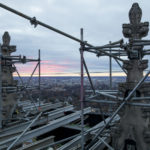
It takes 333 sometimes treacherous steps to reach nearly the top of the Washington National Cathedral’s central tower, a trip that for years delighted architecture buffs and religious sightseers alike the few times a year the church opened its innards to the onlooking public.
But since last August, when a 5.8 magnitude earthquake fractured some of the cathedral’s Gothic details and caused about $20 million in damage to the structure that was first laid down in 1907. After several months of exhaustive inspections, the central tower was finally reopened to the public for the first time since the temblor. All day Saturday, hundreds of curious people ascended a narrow, darkly lit stone passage and two forbidding spiral staircases to an observation point that would have provided stunning views of Northwest D.C. and beyond were it not for a thick layer of fog. (Disclosure: We took an elevator for part of the trip to the top.)
In a cavernous workspace at the top of the limestone stairwell that constituted the first segment of the ascent, climbers’ curiosities were piqued by rows of empty champagne bottles mounted on impossibly high shelves. The boozy collection was built over five decades of new year’s celebrations by the cathedral’s stonemasons, whom every December 31 from 1959 to 2000 would empty a bottle of bubbly and keep it for posterity.
But how did four decades’ worth of champagne bottles not tumble to their destruction last August 23? In a turn of lucky timing, Joe Alonso, the current head mason, installed guide wires in front of the bottles about a week before the quake, a cathedral spokeswoman said.
Up the spiral stairs, now more than 200 feet above ground level, sat Edward Nassor, the cathedral’s resident carillonneur. It wasn’t until the week before Christmas last year that Nassor was able to return to the massive structure of 53 cast-iron bells for the first time since the earthquake, though he stayed in practice through his other gig at the Iwo Jima Memorial in Arlington.
Nassor played several hymns for the tower-climbers. Outside the cathedral, the carillon’s bells are pleasant and float off in the wind. Standing next to the Brobdingnagian device, the chimes are huge and clamorous.
“It’s as if you’re playing a piano with the sustain pedal down,” Nassor said, referring to the keyboard of knobs and levers that yank the finely attuned wires that move each of the bells’ hammers.
On the way down the tower, through another claustrophobic limestone spiral, Louie Stewart, a cathedral docent, told those within earshot of an oddball discovery made shortly after the earthquake. As crews were inspecting every hatch and cranny of the structure, a room was discovered in the catacombs not far from where President Woodrow Wilson is buried. Inside the room, workers found old beer cans and other fun objects. Turns out, this was a place where the boys from St. Alban’s School and the girls from the National Cathedral School would sneak into for a bit of relaxation.
Another secret of the cathedral revealed.