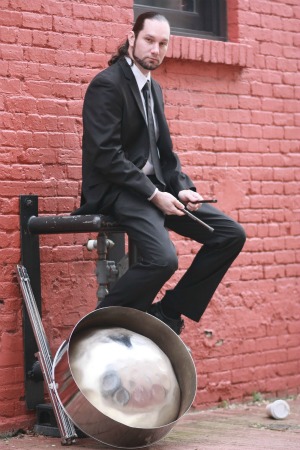
 Victor Provost, photo by Xue Anqi.
There are a few iconic sounds that a listener associates with Caribbean music: reggae’s skank, the Afro-Cuban clavé rhythm and, of course, the island vibe of the steel pan. While the instrument is ubiquitous in genres such as calypso and soca, that classic tropical sound is not one normally associated with straight-ahead jazz. Local pannist Victor Provost is aiming to change that.
Provost was born in the U.S. Virgin Islands on a 12-square mile strip of land called St. John. His retired parents are still there, and that Provost’s brother owns the island’s only barber shop gives you an idea of what life on St. John might be like. Like so many kids, Provost’s introduction to music came in the form of piano lessons, which he began at age 10. Just two years later, Provost won the Virgin Islands Classical Music Competition. He began playing steel pan in an after school program that same year at the St. John School of the Arts. The ensemble’s instructor, Rudy Wells, is considered a pioneer of the instrument, and he had the group playing arrangements by composers as diverse as Chick Corea and Rachmaninoff. Provost’s parents were also jazz aficionados, so In addition to the Caribbean music he heard on the radio and played at school, he also immersed himself in the classic jazz of Cannonball Adderley, Miles Davis and Stan Getz.
In 1998, Provost was the first featured steel pan soloist at the world-renowned Umbria Jazz Festival in Perugia, Italy. Provost decided to move to the United States the following year. Currently based out of the District, Provost has collaborated with world class musicians such as Hugh Masakela, Nicholas Payton, Steve Turre and Wycliffe Gordon. Late last year, Provost crossed a new threshold by releasing his first album, Her Favorite Shade of Yellow. A combination of original compositions and creatively arranged standards, the recording is wonderfully executed acoustic jazz, through-and-through. Provost’s knowledge of the straight-ahead vocabulary and his ability to transfer this knowledge to an uncommon instrument are impressive, and result in a highly successful first effort.
Provost will be leading a group on Saturday at The Dunes, where he will be on the bill with woodwind artist Andrew D’Angelo‘s big band in a show co-sponsored by CapitalBop and Search & Restore. We asked Provost a few questions about his career, new album and Saturday’s performance.
What brought you to D.C.?
Luck. Or fate, maybe? I was in the process of moving my family to Dekalb, Illinois to finish some course work for a long-overdue music degree when the housing market tanked, making it impossible for to sell our condo in Chesapeake. My wife and I decided it was good idea to stay within a reasonable driving distance of the condo, but we went back and forth between an NYC or D.C. move. She got a teaching gig — she’s a dancer — in D.C. mid-year and we made the move.
What did you want to accomplish with Her Favorite Shade of Yellow?
First, I wanted to make a record that was unmistakably a bop-oriented jazz record. There are other steel pan players that have made records on the fringes of jazz, and some who have done a great deal to bring the instrument to the world stage as a vehicle for improvisational music, but often those projects are labeled as being some sort of niche. Although many of these players create harmonically and rhythmically rich work, none of them really approach bop the way I wanted to.
My second goal was to elevate the melodic and harmonic expectations of the instrument. I try to push the envelope and go beyond the typical musical language of other pan players, at least in terms of a contemporary approach to improvisation. I’ve never been interested in being a particularly “chopsy” player, I just try to play melodically.
I also needed to accomplish the first two goals without alienating the audience that appreciates a more traditional approach to the instrument. I took special care to make some of material that would be less familiar to the non-jazz-listener accessible by presenting it in a straight ahead, simple arrangement.
What was the writing process like?
It was pretty intense. I talked to Dion Parson, who co-produced the record, in December [2010] about making a record. I had sketches of the original tunes and an idea of the other tunes I wanted to cover. But I basically spent the month of January finishing the compositions and writing all of the arrangements. I knew the band I was writing for, so that made the process a bit easier. Again, I wanted to make sure that I didn’t drift too far to one side or the other, keeping a good balance of music that challenges the listener, but that also really grooves. One of my favorite interpretations on the record is Bob Marley’s “Redemption Song”. Lots of people have done Afro-Latin-Caribbean versions of jazz standards, but there aren’t many straight ahead versions of Caribbean standards.
How did you go about choosing musicians for this album?
Choosing the musicians was the easy part. Getting them all in the same city on the same day was difficult. I’ve been working with Dion Parson, Reuben Rogers, Ron Blake and Carlton Holmes in Dion’s 21st Century Band for several years. Although we are all generations apart, Dion, Reuben, and Ron are also from the Virgin Islands, so there is a natural chemistry there. Aside from the fact that they are some of the most talented and accomplished musicians working today, we understand each other’s vibes and enjoy being around each other. I knew I wanted Dion to co-produce the record so I started with him. I was able to get Ron on board, despite his duties at Juilliard and Saturday Night Live, and Reuben was in town doing a week at the [Village] Vanguard. Carlton was available and despite the threat of an enormous snow storm, we all got together at Euphoria Studios in downtown Manhattan to rehearse for the record date the following day.
What was the recording process like?
We recorded at Bennett Studios in Englewood, New Jersey. It was a gorgeous studio but it unfortunately it closed in September of last year after battling the recession and a general decline in the industry. On Dion’s suggestion, I hired Rob Harari to engineer the session, which he did flawlessly. Rob was totally thorough and got a great sound almost immediately. The mixing was painless because of the detail he put into the initial recording. It was a really long day — I think 12 hours in the studio — but it was a pretty relaxed pace. I knew it would be months before I could pin everyone down again, so I was determined to get the record done in one session. Things went really smoothly, no big hiccups. In retrospect, I probably should have hired a producer for the date, but at the time I felt like I was the only one who could articulate what the record should be.
The steel pan is not a common jazz instrument. How did you end up applying it to the jazz idiom?
As I mentioned earlier, my early experience with the instrument was coupled with exposure to great music. As a young teenager I discovered Monty Alexander‘s record, Ivory & Steel, featuring pannist Othello Molineaux, and a record by the Caribbean Jazz Project, which featured Dave Samuels, Paquito D’Rivera and Andy Narell. I was initially interested in these records because of how Othello and Andy played over jazz-oriented harmonies, which was really fluid and beautiful. But as I continued listening to the records, my interest in Paquito, Samuels and Monty prevailed, so I started transcribing their solos instead of the steel solos. I kept this habit up and just kept transcribing other instrumentalists, anyone I could get my hands on. Early on it was Milt Jackson, Bobby Hutcherson, Gary Burton and J.J. Johnson, but I’ve checked out lots of music from James P. Johnson to Kurt Rosenwinkle to Vince Mendoza.
Right now I’m in a Joe Locke/Michael Brecker phase, but I was going through a Dexter Gordon phase last month. I love horn players. I’m so jealous of the way they are able to shape their sound — scoop and bend, false fingerings, overtones — all that cool stuff that you just can’t do on a struck percussion instrument. I think that trying to emulate horn players has definitely helped me develop my sound.
What are your thoughts on the D.C. jazz scene? Who are some of the musicians you admire most?
You know the only thing greater than the talent in D.C. is the mutual love and admiration that all the cats share. It’s not a cutting scene like New York, where every young player wants to be the next Chris Potter and all the elders want the young Potter-wannabe’s to shut up and learn how to swing. It’s a scene that is multi-generational, where on a given night you can see younger players like Elijah Balbed, the Jolley Brothers or Allen Jones share the stage with elders like Nasar Abadey, Herman Burney, Michael Bowie or Larry Willis. D.C. is a city where cats still just get together at someone’s house to play a few tunes and share a few stories. We have access to legends and legendary venues, and these venues actual hire local talent. How rare is that?
Obviously I admire the guys I’ve already mentioned. I’m really hesitant to start dropping names because I haven’t met a serious musician in D.C. who I did not admire. Whether it’s someone swinging hard in the trenches or a refined, well-developed player/educator, the thing that prevails is a genuine love for the music. Some of the guys I work with most often include Reginald Cyntje, Herman Burney, Amin Gumbs, Michael Bowie, the Jolley Brothers. I really love all the incredibly hip vocalists in D.C., especially the young men and women that make up Afro Blue and its various contingents.
Who will be playing with you on Saturday, and what can the audience expect?
I have Nate Jolley on drums, Herman Burney on bass and Amy Bormet on keys. I love that it’s such a diverse group. Nate, Herman, and I all put out records last year, so we’re going to play some music from each of those. Aside from creating and organizing the Washington Women in Jazz Festival, Amy is a great writer and plays a whole lot of piano, so I’m looking forward to playing some of her music as well. We’ll probably play some standards, but I don’t know what yet. The band’s sound is contemporary, but without losing the value of swing. One Herman Burney bass solo has about 80 years worth of jazz vocabulary in it, balanced with Nate’s ability bring a raw neo-soul, hip-hop oriented approach when necessary, and Amy’s sweetness, mixed with my little Caribbean overtones — it’s just a really killing group.
Victor Provost & Co. will be performing with the Andrew D’Angelo Big Band on Saturday, March 31, 2012 at The Dunes. 8:30 p.m. doors. Tickets are $15.